
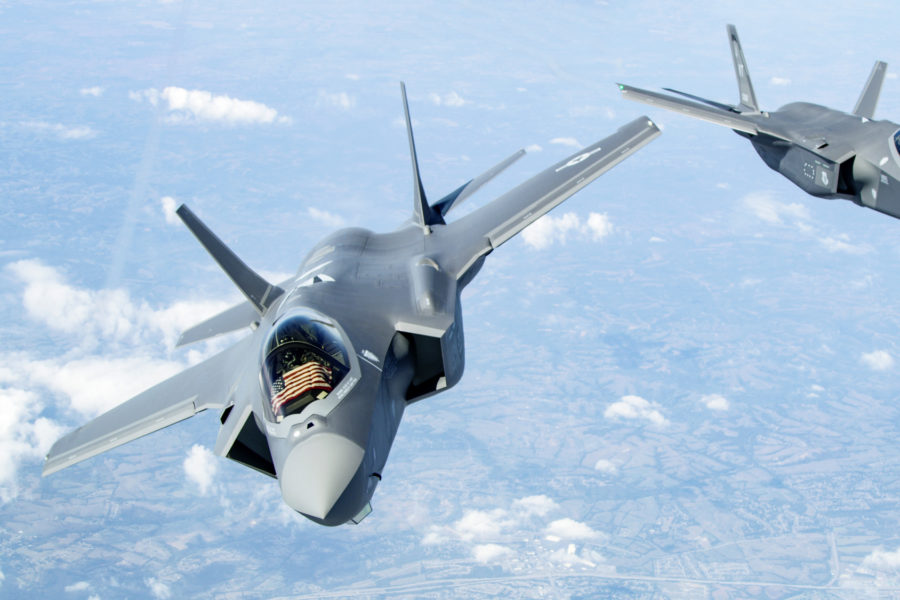
The F-35 Lightning II is a multirole, stealthy, penetrating, all-weather fighter/attack family of tactical aircraft developed under the multinational Joint Strike Fighter program. USAF’s conventional F-35A is complemented by the F-35B short takeoff and vertical landing (STOVL) version for USMC, and the carrier-capable F-35C for the Navy and USMC. The X-35 demonstrator first flew on Oct. 24, 2000, winning the go-ahead for the F-35A which first flew in developmental form in 2006. Lightning II is replacing legacy fleets, offering better penetrating capability against advanced A2/AD threats to strike heavily defended targets.
USAF’s F-35A can carry up to 22,000 lb of weapons on 10 stations: two internal bays for stealth, and/or six wing and fuselage pylons for max loadout. Air Force F-35s first saw combat on April 30, 2019, during Inherent Resolve. The baseline F-35A is fully combat capable in interdiction, basic CAS, and limited SEAD. Continuous Capability Development and Delivery (C2D2) will provide ongoing development and modernization. The program office and Lockheed Martin agreed on a finalized deal for Lots 18 and 19 in September 2025, with deliveries starting this year through FY27. The F-35A was approved for full rate production on March 12, 2024, following completion of initial operational and live-fire testing, opening the possibility of cost-saving multiyear block buys starting with Lot 20.
Rollout of Block 4 intended to expand the jet’s combat roles, add advanced weapons, synthesize sensors and correct deficiencies from concurrent development and fielding has been hampered by development and test delays. Problems testing the TR-3 configuration required to host Block 4 resulted in a yearlong pause in deliveries. USAF cleared the 30-jet backlog in July 2024, but jets were delivered with “truncated” software which limited them to noncombat training. Integration and supply problems with the Block 4’s improved APG-85 radar slated for phase-in last year resulted in aircraft delivered with legacy AESA or no radar installed. Lockheed opted to re-scope Block 4 due to delays and changing mission requirements, delaying some capabilities to Block 5 or later, and accelerating mature technologies such as Automatic Ground Collision Avoidance. Planned capabilities previously included maritime strike, nuclear B61-12 as well as Stand-in Attack Weapon (SiAW) and SDB II integration, as well as the new radar and EW improvements. Block 4 also requires additional power which Pratt and Whitney is adding via their Engine Core Upgrade.
The company also expanded engine production by nearly 20 percent to alleviate supply chain problems which have contributed to the F-35’s low mission capable rate. USAF requested only 24 F-35As in FY26, focusing instead on maturing TR-3 software, Block 4, and robusting sustainment, and three additional jets are undergoing modification to support accelerated testing. The 500th production F-35A was delivered to the Florida ANG’s 125th FW at Jacksonville on Aug. 21, 2025, and Misawa received its first USAF F-35A on March 28, 2026. The Lightning II flew its first operational “Wild Weasel” SEAD mission over Iran during Operation Midnight Hammer on June 22, 2025. Two aircraft were lost in nonfatal incidents at Eielson on Jan. 28, 2025, and at Nellis on March 31, 2026.
F-35 Lightning II Technical Data
Contractors: Lockheed Martin; BAE Systems; Northrop Grumman; Pratt & Whitney (engine and Engine Core Upgrade).
First Flight: Dec. 15, 2006.
Delivered: April 2011-present.
IOC: Aug. 2, 2016.
Production: Planned: 1,763 (USAF F-35As).
Inventory: 500 (USAF).
Operator: ACC, AETC, AFMC, AFRC, ANG, PACAF, USAFE.
Aircraft Location: Burlington ANGB, Vt.; Dannelly Field, Ala.; Edwards AFB, Calif.; Eglin AFB, Fla.; Eielson AFB, Alaska; Hill AFB, Utah; Jacksonville Arpt., Fla.; Luke AFB, Ariz.; Misawa AB, Japan; NAS JRB Fort Worth, Texas; Nellis AFB, Nev.; RAF Lakenheath, U.K.; Truax Field, Wis.; Tyndall AFB, Fla. Planned: Barnes ANGB, Mass.; Jacksonville ANGB, Fla.; Kingsley Field, Ore.; Moody AFB, Ga.
Active Variant: •F-35A. Conventional takeoff and landing (CTOL) variant for the Air Force.
Dimensions: Span 35 ft, length 51.4 ft, height 14.4 ft.
Weight: Max T-O 70,000 lb.
Power Plant: F-35A: one Pratt & Whitney F135-PW-100 augmented turbofan, 40,000 lb thrust.
Performance: Speed Mach 1.6 with full internal weapons load, range 1,380 miles.
Ceiling: 50,000 ft.
Armament: F-35A: one 25 mm GAU-22/A cannon; standard internal loadout: two AIM-120 AMRAAMs and two GBU-31 JDAMs.
Accommodation: Pilot on Martin Baker MK16 zero/zero ejection seat.