
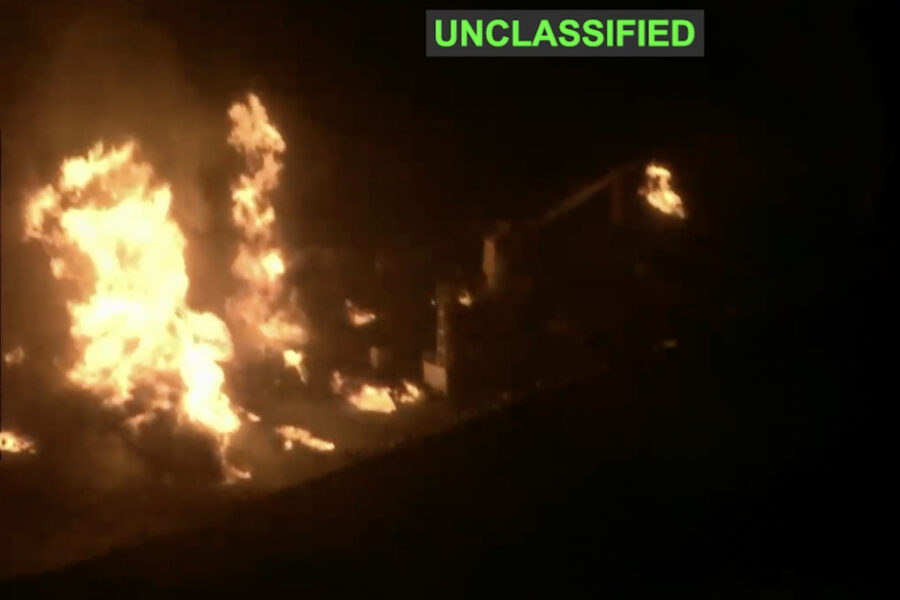
In a dramatic flare-up in the fighting between the U.S. and Iran, American forces struck and destroyed five Iranian oil tankers Sept. 8, U.S. Central Command said. Iran retaliated by lobbing ballistic missiles toward a major U.S. base in Jordan.
U.S. officials said CENTCOM took the action because Iran had fired ballistic missiles against a U.S. Navy warship twice in the past two days. The ship, which the U.S. military did not identify, was not hit, and no service members were harmed, CENTCOM said.
Nevertheless, the U.S. hit back with a major attack on Iranian shipping.
“CENTCOM destroyed the IRGC crude oil carriers M/T Kaviz, M/T Charminar, M/T Horizon 1, and M/T Riesco in the Gulf of Oman as well as M/T Derya near Kharg Island,” the command said in a statement, referring to ships controlled by Iran’s Islamic Revolutionary Guard Corps. CENTCOM released a video of the attacks, which shows several ships engulfed in flames.
The Iranian ships were attacked by U.S. Air Force and Navy fighters and drones.
The U.S. military said the crews were directed to abandon ship before the vessels were “rendered inoperable.”
“Iran has used the tankers as part of a multibillion-dollar shadow network that funds the IRGC and its regional proxies,” CENTCOM added. The command also delivered a harsh warning to Tehran: “Iran has no means by which to defend these vessels.”
Repeated, escalating tit-for-tat strikes in recent days have raised the risk that the two sides might resume the all-out fighting that characterized the first weeks of the war, which is now in its seventh month.
The Trump administration has adopted a policy of striking Iranian tankers to deter Iran from firing missiles at the aircraft carriers in the region and other Navy ships. On Sept. 5, Adm. Brad Cooper, who leads U.S. Central Command, warned the U.S. would “impose an even higher economic cost” on Iran by striking a “limited and exposed oil fleet” if Tehran did not cease its attacks on U.S. forces.
But that warning went unheeded.
In response to the latest U.S. attack, the Iranian military vowed to carry out fresh strikes of its own, specifically against long-standing American allies like Jordan, Kuwait, and Bahrain. Iranian officials also warned that it would target commercial oil tankers near ports in these countries. Iranian officials said such attacks would be justified because those ports had been used by the U.S.
Jordan was hardest hit as Iran fired dozens of ballistic missiles at the country. Iran said it was targeting Muwaffaq Salti Air Base, a key hub for U.S. airpower. Dramatic videos from Jordan showed ballistic missiles and interceptors filling the night sky. Without providing evidence, the IRGC claimed it damaged American fighter aircraft at Muwaffaq Salti, known as MSAB. No American personnel were killed in the intense barrage aimed at the base, according to initial accounts from U.S. officials.
The Trump administration has hoped that stepped-up economic sanctions and its ongoing blockade would force Iranians to stop interfering with traffic in the Strait of Hormuz and to make other concessions. But Tehran has shown no sign of backing down.
The U.S. is deploying fresh warplanes to the Middle East amid the fighting. F-35 Lightning II stealth fighters from the 115th Fighter Wing of the Wisconsin Air National Guard are deploying to the region and are set to arrive in the Middle East in the coming days, people familiar with the matter said.
The Wisconsin Air Guardsmen are replacing another F-35 unit, the 158th Fighter Wing of the Vermont Air National Guard. Vermont’s “Green Mountain Boys” wrapped up a roughly nine-month deployment to South America and the Middle East, where it supported the capture of Venezuelan president Nicolás Maduro before heading to the Middle East to fight Iran. Airmen from the unit returned home Sept. 6 and were greeted by Chief of the National Guard Bureau Air Force Gen. Steven Nordhaus.
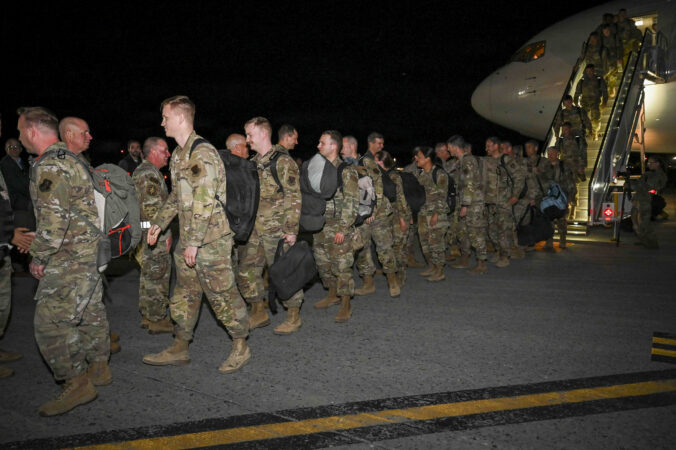
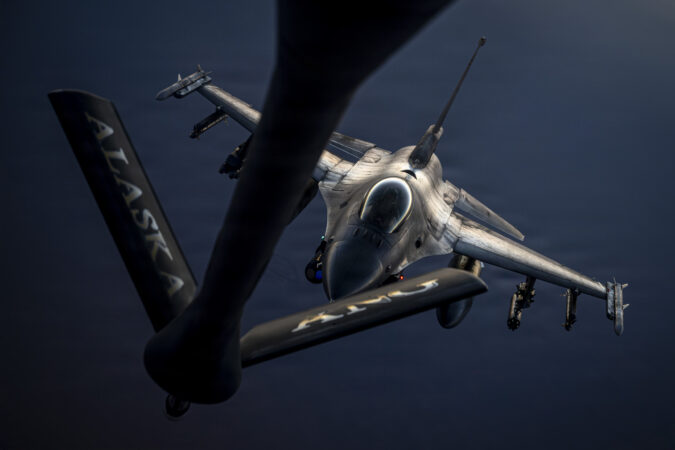
The fresh F-35s are not the only new fighter unit reinforcing America’s posture in the Middle East. F-16s from the Ohio Air National Guard’s 180th Fighter Wing deployed to the Middle East late last week, taking the place of F-16s from the 555th Fighter Squadron of the 31st Fighter Wing, which returned home to Aviano Air Base, Italy. Nicknamed the “Triple Nickel,” the 555th Fighter Squadron had been deployed to the Middle East since last November, a long deployment compared to the Air Force’s typical six-month rotations.
The Air Force has dozens of F-16, F-35, and F-15E Strike Eagle fighters and A-10 Thunderbolt II attack planes deployed to the Middle East, along with support aircraft and scores of tankers. More rotations are expected in the coming weeks.
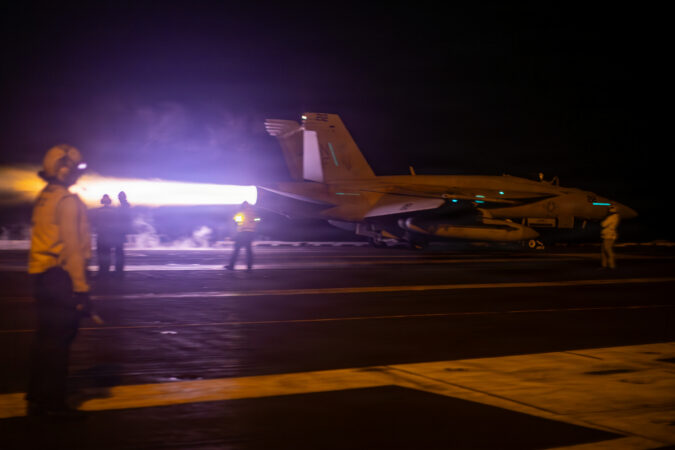
The U.S. Navy also has two aircraft carriers and their embarked carrier air wings supporting operations in the Middle East: the USS George H.W. Bush and USS George Washington, along with around 20 surface vessels.
Like the Air Force, the Navy has also had extended deployments in the Middle East to carry out operations against Iran. The USS Abraham Lincoln is headed home after a nine-month deployment. Before that, the USS Gerald R. Ford was deployed for 11 months and, like Vermont’s Air Force unit, supported operations against both Venezuela and Iran.
As the U.S. and Iran exchanged blows, the U.S. Treasury Department announced it was imposing new sanctions on companies that support Mahan Air, an airline that U.S. officials say is connected to Iran’s Islamic Revolutionary Guard Corps.
Fresh fighting between the Houthis and Saudi Arabia added to the tension in the region. The Iran-backed Houthis fired missiles and drones at energy facilities in southern Saudi Arabia on Sept. 8.