


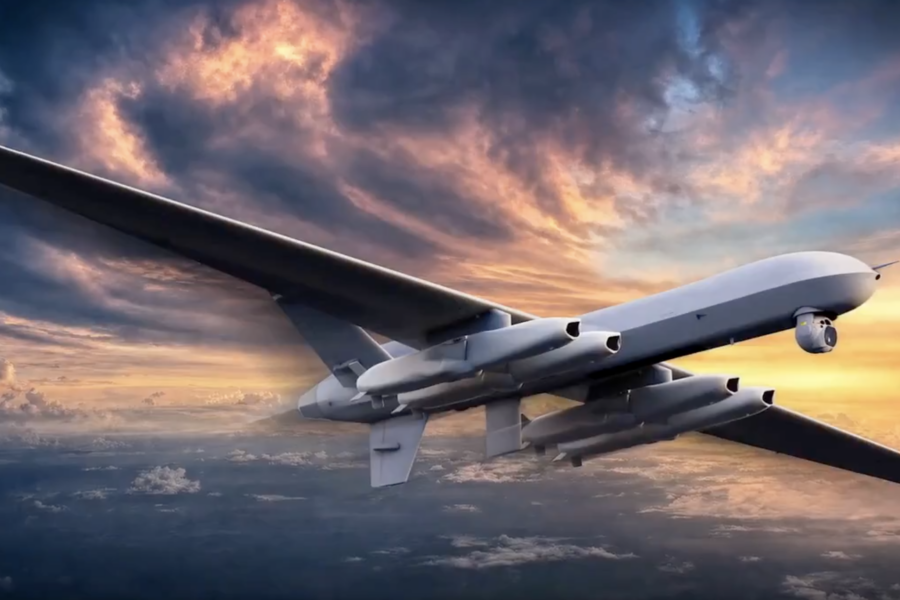
General Atomics has unveiled the first renderings of its Wildfire drone, which it plans to pitch for the Air Force’s hunt for a new, low-cost Massed Modular Aircraft.
Wildfire was unveiled in a sizzle reel-type video General Atomics Aeronautical Systems Inc. posted on social media Sept. 9. The video touts more than three decades of the company’s unmanned aerial vehicle development, starting with the Gnat and Predator drones flown in the 1990s up to and including its latest FQ-42A Dark Merlin, before revealing the first three images of Wildfire in short succession.
The images provide hints of the drone’s expected capabilities. One image shows Wildfire carrying four Joint Strike Missiles, which are stealthy cruise missiles, and another shows it with two Long Range Anti-Ship Missiles, or LRASMs.
“The whole point of a flying weapons truck is to come heavy,” General Atomics spokesman C. Mark Brinkley said in response to Air & Space Forces Magazine questions. “Wildfire will be able to carry a minimum of two LRASMs, four JSMs, or some similar configuration of heavy stand-off weapons, across meaningful combat distances.”
Brinkley said the MQ-9A is not be able to carry those payloads, and that they’re twice as much as the Pentagon originally envisioned for MMA. Brinkley said it’s too soon to sat how many Hellfire missiles—which the MQ-9A frequently employs—the Wildfire drone will be able to carry.
A third image shows a swarm of nearly a dozen Wildfire drones bearing down on a group of enemy ships and firing a barrage of missiles at them.
The Air Force envisions Massed Modular Aircraft, or MMA, as a low-cost drone to take on missions now done by General Atomics’ MQ-9A, and wants MMA to be semi-autonomous and able to be sent in groups to overwhelm enemy defenses.
Top Air Force officials told reporters Sept. 3 that they want the MMA’s air vehicle—not counting sensors or other capabilities—to cost no more than $10 million apiece. This would allow MMA to be “attritable,” meaning they would be inexpensive enough to be fielded in large numbers and easily replaced if lost in combat.
The Air Force and the Defense Innovation Unit, when unveiling the MMA concept in July, said losing $30 million drones in battle against an enemy would be unsustainable in a large-scale conflict, and a less expensive option is needed.
The conflict with Iran has cost the Air Force about 45 of its MQ-9 drones. In the Sept. 3 briefing, Air Force officials said the MQ-9 losses were concerning enough to push the service to accelerate its MMA effort. The Air Force and DIU want to have a prototype MMA a year after is contract is awarded and to start fielding it at scale within three years, or as early as 2029.
General Atomics created Wildfire as a clean-sheet design, and said it will be able to achieve all the Air Force’s MMA requirements at a high quality and an affordable price.
Brinkley said Wildfire will be able to exceed the Air Force and DIU’s 8,000 nautical mile ferry range requirement for MMA.
It will be modular, which will allow the Air Force to rapidly add or swap out different capabilities. When asked about Wildfire’s sensing capabilities, Brinkley said it will have “certain features available right out of the box,” but it will be up to the Air Force to decide what modular capabilities it wants to add.
“Modularity is key,” Brinkley said. “We’re showing that now with our Gambit series of uncrewed jets, which includes the XQ-67A Off-Board Sensing Station and FQ-42A Collaborative Combat Aircraft. One design, seamlessly pivoting to various missions. Wildfire will be able to do much the same from an [intelligence, surveillance and reconnaissance]/strike lane.”
Brinkley said General Atomics will use its experience on autonomy, artificial intelligence, and machine learning from its work on programs like CCA and the MQ-20 Avenger, “to network dozens of Wildfires together on Day One.”
Brinkley said General Atomics has more than 5 million square feet of manufacturing space it could leverage to build Wildfire, and that the company has produced up to 100 aircraft per year, including MQ-9s.
“We have said from the beginning that we can deliver Wildfires years earlier than the [Air Force and DIU’s original] fiscal 2031 timeline,” Brinkley said. “We can deliver more than twice as many aircraft as originally asked for in the same amount of time. We’re not worried about scaling at all.”