
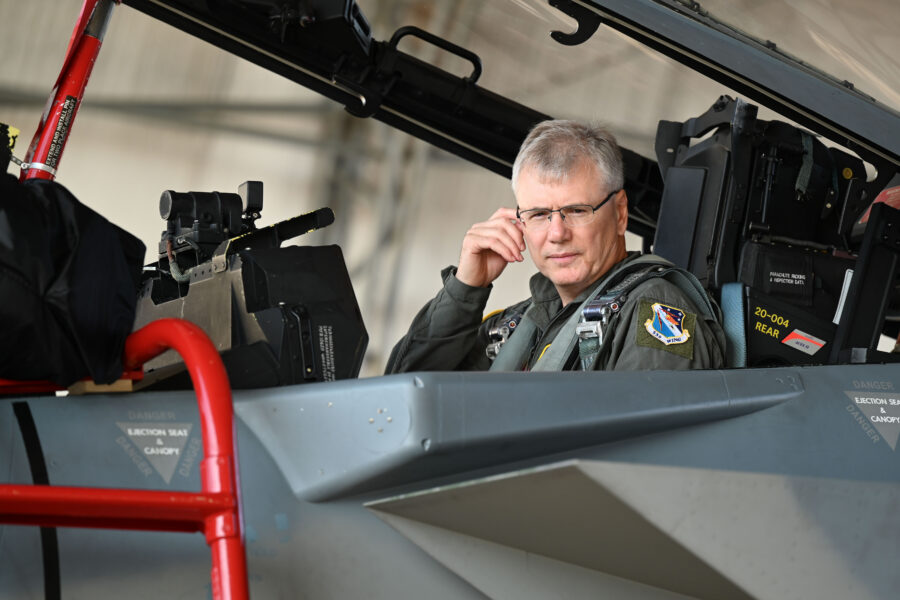
Just over a year after becoming the 27th Secretary of the Air Force, Troy Meink believes he’s making progress on his top priorities—increasing Air Force readiness, modernizing its aircraft fleet, and growing the nascent Space Force.
Meink acknowledged continuing headwinds in a June 26 interview with Air & Space Forces Magazine, but said the proof of his progress shows in the fiscal 2027 budget now working its way through Congress. Though Congress may not appropriate all of the $338 billion the Air Force and Space Force asked for—the department’s share of a proposed $1.5 trillion for fiscal 2027—he expressed confidence the two services are on a better glide path than before.
He cited plans to double the Space Force’s size over the next five years and to accelerate development of the F-47 fighter, B-21 bomber, and semi-autonomous Collaborative Combat Aircraft as proof.
“We never get everything we want,” he said. “I’m hopeful that we’re going to get a lot more than we have maybe in the past, based on what we’re seeing.”
The Air Force and Space Force are implementing a slate of acquisition reforms directed by Defense Secretary Pete Hegseth last November. Among them: empowering new “portfolio acquisition executives” with unprecedented decision-making authority across entire mission areas. The Department of the Air Force has set up seven of 27 planned PAEs so far.
“We’ve delegated probably 90-92 percent of contracting authorities down into what we call these portfolio acquisition executives, so that they can make the decisions there, not only for contracting decisions, but also hiring decisions,” Meink said.
Historically, many of those decisions were reviewed and approved at successive higher echelons, some rising all the way to the secretary level. Stripping out multiple levels; simplifying requirements; demanding modular, open systems architectures that prevent decades-long vendor lock-in; and forging multi-year acquisition deals are all part of the underlying strategy and all areas of focus for the secretary.
“Even though this acquisition transformation and this focus has only been a year or so in, we’re already seeing the benefits and we’re seeing really good performance across the board,” Meink said.
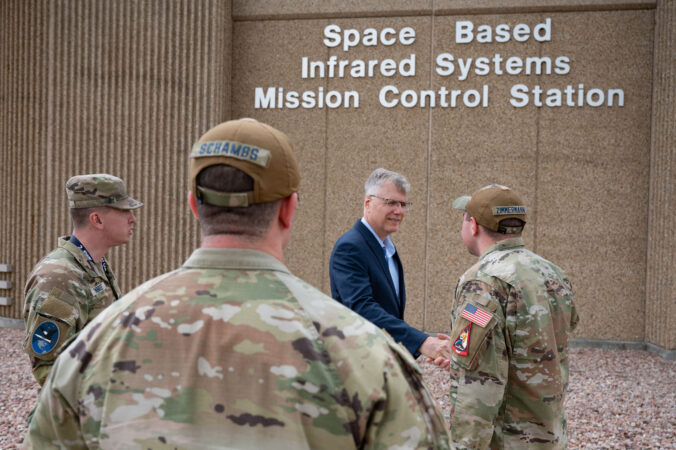
That’s come despite the DAF having the lowest budget, relative to the nation’s gross domestic product, in the last couple of decades, Meink said, also noting that chronic underfunding didn’t come without consequences.
“Corners have been cut,” he said. “One of those corners was readiness—parts, things like that. And so, the readiness levels were quite low.”
From 1994 to 2024, aircraft availability rates declined from 73 percent to 54 percent, then-Air Force Chief of Staff Gen. David Allvin said in March 2025 at AFA’s Air Warfare Symposium.
Cuts to the maintenance force are being fixed, he said, a challenge that needs to be addressed before new aircraft enter the fleet, including the B-21 Raider, T-7A Red Hawk, FQ-42 and FQ-44 CCAs, and more come online.
The DAF’s fiscal 2027 budget request would grow the department’s “foundational readiness investments,” Meink said, increasing funding for flying hours, weapon system sustainment and related categories by 34 percent, a figure he has touted in multiple hearings with lawmakers this spring and summer.
Additional funding for readiness is in the $67 billion defense supplemental request submitted to Congress last month, Meink said. He expressed optimism that lawmakers will support both the base budget and additional measures to bolster readiness. However, he noted that overcoming years of under-investment “is going to be a long-term effort” for the department.
Modernizing
Both the Air Force and Space Force are facing a modernization crunch. Existing systems are not only old, but increasingly vulnerable. The Air Force needs new hardware, but so does the Space Force, which is moving to a more distributed and proliferated space architecture to ensure space capabilities are less vulnerable to attack and disruption.
The Pentagon is pressing for greater authority to sign multi-year procurement contracts for new satellites, missiles, aircraft—and spare parts.
The more contractors know in advance about government demand, the better they can plan and the more willing they will be to invest in expanding production capacity and advanced manufacturing technology.
“When the future is uncertain, it’s hard for industry to make those investments to either modernize their facilities or do what they need to do to get to the production capacity we need,” Meink said. “So those long-term deals are a huge part of that.”
Multi-year weapons orders will help build fleets, he said, bringing prices down and theoretically enabling the services to buy more.
Meink said the Air Force is looking to slash missile prices by as much as “a factor of 10,” or up to 90 percent, as it works to replenish depleted stocks.
“Stable production is really important,” Meink said. “Buying things one year at a time is really not a good way to buy stuff. Nobody does that in the commercial world.”
Meink acknowledged that the Defense Department has tried and failed to fully implement similar reforms in the past, but he argued that this time is different.
“We’re really taking those things that we know work, and we’re just applying them across the entire department, which has really never been done in any acquisition world,” he said. “We’ve just decided we’re going to take what we know works and apply it everywhere, and so we are already seeing that decision process is going much more quickly.”
More of Everything
While it will take time and resources to grow the size of the Air Force and Space Force fleets, Meink said he expects the DAF’s focus on production will start yielding results in the next few years.
For the Air Force, Meink said that means by around 2029, it expects to bottom out its declining fleet size and start growing it again, slowly but surely.
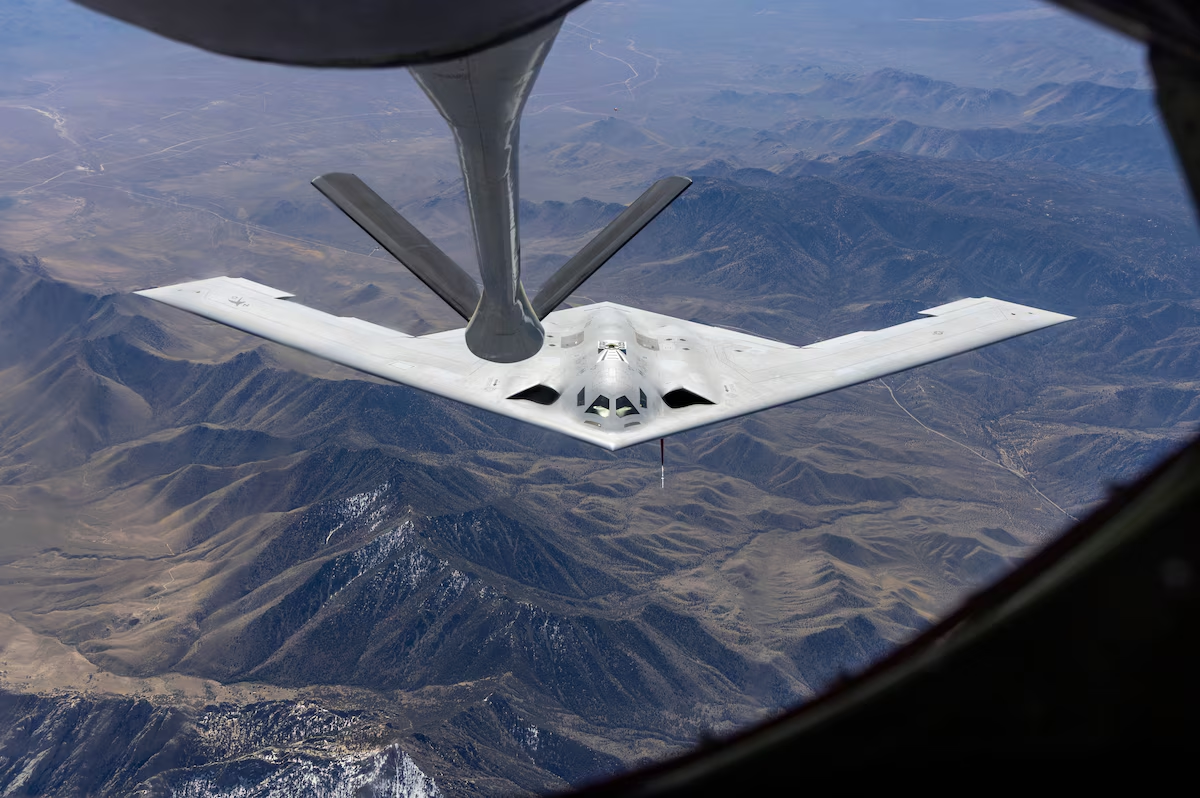
The Air Force has already moved, along with Boeing, to increase KC-46 production rates and is working on doing the same with the B-21 and F-15EX. The Pentagon has provided Northrop Grumman with billions in additional funding to boost B-21 production and is considering whether to open up a second production line in Palmdale, California. And Boeing is moving to expand its F-15EX production line in St. Louis, as the Air Force signals it wants to more than double the planned Eagle II fleet to 267.
Meink pointed to the F-15 fleet—which is now sending older C and D model Eagles to the Boneyard, while bringing on the new F-15EX Eagle IIs—as a prime example of a jet where new procurements may start to balance out retirements.
“It’s not going to be a massive growth in the number of F-15s we get out there, but we’re trying to get to production rates—again, with congressional support—that essentially we are matching or maybe exceeding the retirement rate,” Meink said. “We’re not going to shrink. We’re not going to grow a lot, but we’re not going to shrink.”
In addition to halting, and perhaps even reversing, the slow decline of the Air Force’s manned fighter fleet, Meink views the CCA with its increased firepower and other combat capabilities as a force multiplier for the service.
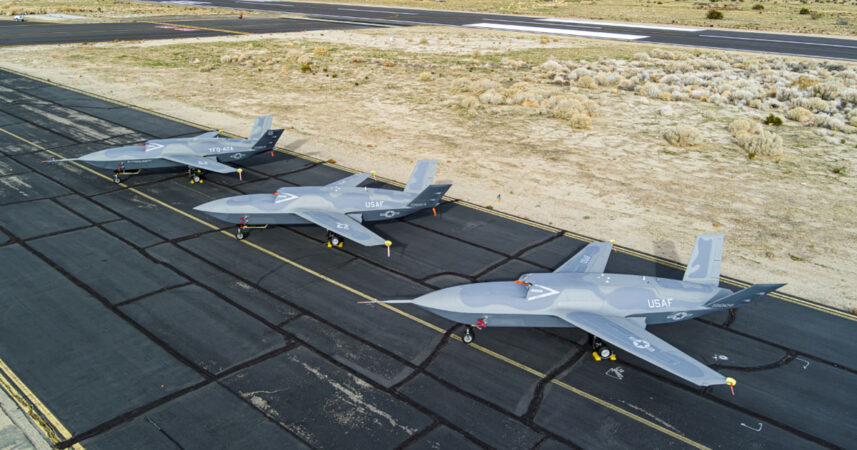
In June, the Air Force announced it awarded production contracts to General Atomics Aeronautical Systems and Anduril Industries to move their CCAs into production, as well as awarding contracts to three companies to provide mission autonomy software.
The Air Force aims for CCAs to cost roughly one-third as much as an F-35, or somewhere around $30 million apiece.
“When you tie CCAs with manned aircraft, the combat effectiveness goes up way more than just the cost would indicate,” Meink said. “The combat power they bring forward, you can almost think about it as a fighter. That’s essentially what it is, it’s an autonomous fighter that still needs a manned aircraft to guide it and tell it what to do.”
Another growing mission requirement is air-moving target indication. Meink said Operation Epic Fury underscored the need for an all-seeing, survivable battle management solution.
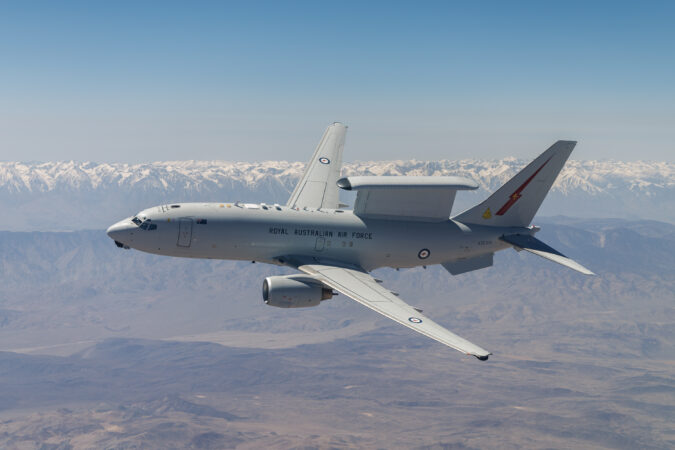
The DAF’s plan for achieving that coverage includes both airborne and on-orbit capabilities, with the Air Force fielding at least seven E-7s—he wouldn’t specify how many the Air Force might ultimately buy—and the Space Force investing in the space-based sensing needed to successfully do AMTI from space.
Meink also said the U.S. can do more to leverage allies who also fly E-7s, as it did in Operation Epic Fury with Australia. The UK also flies the aircraft.
“There are already international partners flying the E-7,” Meink said. “When we look at the number of platforms we need for any kind of conflict that we envision, … our international partners are … part of that. We expect E-7s to continue to be procured by some of our international partners.”
However, the U.S.’s shifting plans for the E-7 have already caused some allies and partner nations to consider whether they also want to buy the Wedgetail. On July 7, NATO announced it had chosen Saab’s GlobalEye surveillance plane to replace its aging AWACS, instead of Boeing’s Wedgetail.
The path ahead for space-based AMTI appears to be clearer. The Space Force’s fiscal 2027 budget request asks for $7 billion to procure satellites that can track moving targets, and it awarded SpaceX a $4 billion contract in late May to field a constellation of AMTI satellites by 2028.
Meink indicated a sense of urgency to being able to transmit satellite data to air operators and provide a more complete battlespace picture. As if to underscore that urgency, an additional $4 billion for space-based AMTI and the satellite-based Space Data Network is included in the defense supplemental budget request submitted in June.
“You have to have that air picture, but you have to be able to get that air picture into every single cockpit,” Meink said. “And there’s a big push to deliver that on the space side of the house.”
The planned AMTI constellation aligns with the Space Force’s adoption of a more proliferated satellite architecture. SDN, for which SpaceX is also a lead contractor, is envisioned as hundreds of satellites in low Earth orbit, and the service is also building out a missile warning and tracking fleet in both LEO and medium Earth orbit for the Pentagon’s Golden Dome missile defense program.
Meink said both Pentagon and Congressional leaders are broadly supportive of expanding the Space Force’s satellite fleet and its Guardian and civilian operators. The service’s $71 billion fiscal 2027 budget request represents a 124 percent increase over the prior year. Its research and development accounts are projected to grow to $40 billion, and its procurement funding to $19 billion—more than five times what it asked for in fiscal ‘26.
“There’s a realization all the way up that some of the space systems that we’re talking about delivering or already delivering and delivering into the future are really some of the most critical [defense capabilities] across the board—and you see that in the budget submission,” he said. “That takes a Department of War-level decision to increase the budgets that much.”
Still, many of the Air Force’s and Space Force’s top priorities hinge on passage of not one, but three defense funding bills. That includes a roughly $1 trillion defense appropriation; a $350 billion reconciliation bill; and the $67 billion supplemental, mostly to replenish arms and expenses tied to the Iran war.
The Air Force’s fiscal 2027 reconciliation request includes about $16 billion for some of its most important programs, including $2.3 billion for 14 F-35s and nearly $3 billion for missile and munition production. Meanwhile, most of the Space Force’s $12 billion reconciliation request would go to Space-Based AMTI and SDN.
Meink acknowledged that dependency, and said navigating this year’s appropriations process, like most of the challenges the DAF faces, will require flexibility and collaboration.
“Flexibility is the key to airpower, right?” Meink said, quoting an Air Force mantra. “So, we’re going to have to maintain flexibility.”