
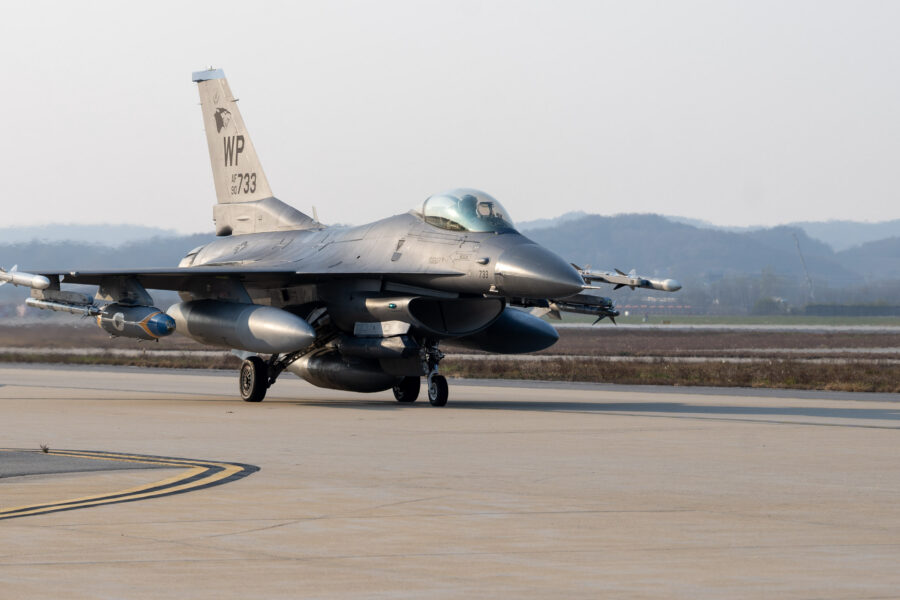
The incoming head of the 7th Air Force will face an intense mission while relying on fourth-generation fighters to stave off looming threats from North Korea and China.
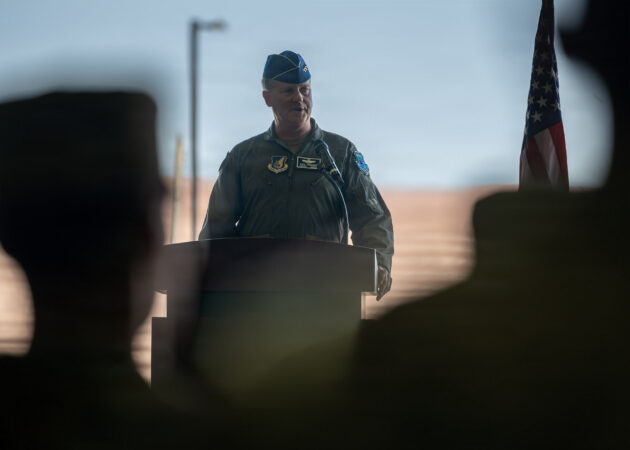
Recently promoted Lt. Gen. David G. Shoemaker took command of the pivotal post during a ceremony held Aug. 7 at Osan Air Base, South Korea, where the 7th’s headquarters is located.
As head of the 7th Air Force, Shoemaker will oversee the 51st Fighter Wing at Osan and the 8th Fighter Wing at Kunsan, which fly F-16s alongside South Korean allies’ F-35s. The Air Force is also incorporating lessons from a multiyear series of “Super Squadron” experiments in which F-16s were consolidated from Kunsan to Osan to see whether larger squadrons would more efficiently launch and maintain the jets.
Shoemaker previously served as director of operations for Air Combat Command. He is an experienced F-16 pilot with more than 3,900 flight hours, and has commanded units including the 421st Fighter Squadron, also known as the “Black Widows,” and the 8th Fighter Wing, nicknamed the “Wolf Pack.”
He initially served as an air surveillance officer following his 1994 commission from the Air Force Academy.
The 7th Air Force currently relies on rotational deployments for U.S. fifth-generation aircraft such as the F-35 Lightning II and F-22 Raptor. F-35s most recently deployed to the peninsula in August 2025 for the Ulchi Freedom Shield exercise, in which 10 Joint Strike Fighters took part. F-22s from the 19th and 199th Expeditionary Fighter Squadrons also practiced dogfights with Republic of Korea F-35s in 2024.
Korea and China
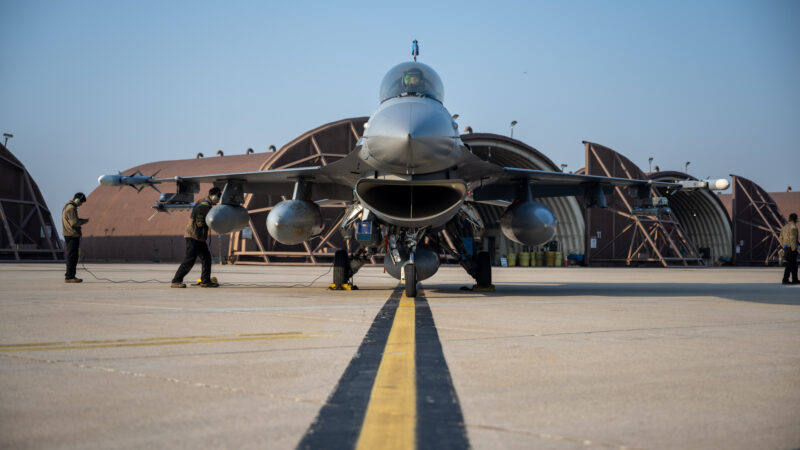
That paucity of fifth-generation aircraft and reliance on rotations are problems for advanced U.S. airpower in more than just Korea.
Kadena Air Base, Japan, is a year behind schedule to receive its contingent of F-15EXs, an updated version of the F-15 that is slated to arrive in 2027, Secretary of the Air Force Troy E. Meink said in May.
Misawa Air Base, Japan, received its first four permanent F-35s in March and continues to rely upon the F-16 for its mission set.
A more permanent presence of advanced aircraft is needed to foil the military ambitions of both North Korea and, more broadly, China, said retired Air Force Col. John “JV” Venable, senior resident fellow at the Mitchell Institute for Aerospace Studies.
“Korea is one of two nations where US fighters can be permanently stationed within the first island chain,” said Venable, a former F-16 pilot and commander. “Fighters based in either Korea or Japan could sortie to thwart a surprise move by either China or North Korea as soon as it happens.”
He noted that the next-closest locations outside that island chain are Hawaii and Alaska, which require at least a day to mobilize and deploy to the region before the fight.
Another Mitchell expert, retired Navy Cmdr. J. Michael Dahm, senior fellow for Aerospace and China Studies, noted that the mere presence of additional fighter aircraft has an effect.
“Just having more forces in theater makes them available to the PACAF commander on short notice, even if they’re not fighting from the peninsula,” Dahm said, in a nod to the wider Agile Combat Employment concept the Air Force is incorporating in the Pacific region.
Agile Combat Employment is a strategy for quickly dispersing aircraft and personnel across multiple locations to avoid enemy strikes.
“If they deployed out of Korea and were flying out of the Philippines or somewhere else in Southeast Asia, they could get there in a relatively short period of time, and that could have a deterrent effect,” Dahm continued. “China would need to consider the U.S. presence in theater beyond Okinawa, Yokota, or Guam.”
Super Squadron
The Super Squadron experiment worked in two phases. The first phase in 2024 saw a batch of nine F-16s and 150 Airmen move from Kunsan Air Base, home of the 8th Fighter Wing and its 80th and 35th Fighter Squadrons, to Osan Air Base, home of the 51st Fighter Wing, about 50 miles from the North Korean border.
Then, in the second phase, starting in October 2025, another 22 F-16s moved from Kunsan to Osan, bringing the total to 31 Kunsan fighters alongside the Osan F-16 squadrons.
The experiment, dubbed “a force optimization” test to generate more combat power and operate more efficiently, examined whether a larger unit would be more efficient at employing and maintaining the fighters, Capt. Bryce Hughe said in a July 2025 release.
The Super Squadron experiment had been slated to run until October, but in April, Pacific Air Forces commander Gen. Kevin Schneider concluded it early. The Air Force said lessons from the test “are informing readiness enhancements across PACAF and USAF F-16 enterprise.”
The F-16s returned to their pre-existing three-squadron structure at both Osan and Kunsan.
The Super Squadron experiment was separate from two F-16s that moved permanently from Misawa Air Base, Japan to Osan in June 2025. Long-term plans call for all of the F-16s at Misawa to move to Korea as F-35s arrive in Japan.
The Misawa F-16s, which replaced legacy F-15C/Ds and A-10s under Osan’s 51st Fighter Wing, feature upgraded features such as a new active electronically scanned array radar.