
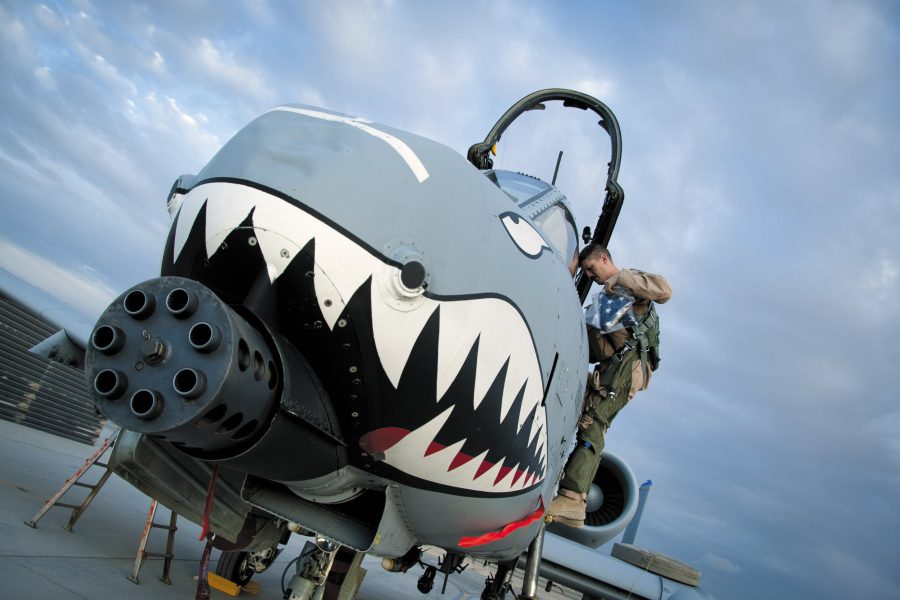
Air Force Chief of Staff Gen. Kenneth S. Wilsbach told lawmakers this week there will be no gap in the service’s close air support capabilities under its latest plan to retire the venerable A-10 Thunderbolt II at the start of the next decade.
The decision in April to once again delay the retirement of the low-flying “Warthog” until at least 2030 has galvanized supporters of the Cold-War era aircraft; when Wilsbach and Air Force Secretary Troy E. Meink testified before the House Armed Services Committee on May 20, five different lawmakers asked about the A-10 and the Air Force’s long-term plans to replace its capabilities.
Enthusiasm for the A-10 has risen in recent months as it has proven useful in enforcing a U.S. blockade against Iranian ports, as well as supporting the combat search and rescue mission of two downed American Airmen from an F-15E Strike Eagle shot down over Iran in early April.
Wilsbach and Meink said modern, survivable, multirole fighters like the F-35 Lightning II and the F-15EX Eagle II would replace the A-10 in providing close air support. But at least some lawmakers questioned whether these fighters are properly equipped to deliver sustained close air support as effectively as the A-10.
Retired Navy SEAL Rep. Derrick Van Orden (R-Wisc.) argued that the A-10 is considerably less expensive to fly and can loiter above ground troops in need of support longer than an F-35. He also pointed out that the A-10 is equipped with a 30mm GAU-8/A Gatling gun and carries a maximum load of roughly 1,200 rounds of ammunition, while the F-35 is armed with a 25mm GAU-22/A cannon with about 200 rounds of ammo.
“We have to have the ability to have somebody sitting around with a GAU-8/A with 1,200 rounds, versus a GAU-22 Alpha on F-35 with 200 rounds,” Van Orden said. “We cannot have a gap in a close air support platform that will be able to kill the enemy that is in that hallway [versus] dropping something from an F-35.”
The F-35 is designed to penetrate advanced anti-access, aerial-denial threats to strike heavily defended targets and can carry up to 22,000 pounds of munitions. A-10s fly low over targets at far slower speeds but can carry an array of munitions such as JDAM-guided bombs, AGM-65 Maverick air-to-ground missiles, and APKWS II laser-guided rockets.
The Air Force Joint Strike Operational Test Team conducted a comparative test from April 2018 to March 2019 between the F-35A and the A-10C to assess their effectiveness for missions such as close air support and combat search and rescue. The test results, published by the Project on Government Oversight, are heavily redacted to include the report’s findings and recommendations.
Meink acknowledged that the A-10 “is a great platform, and we keep it around, in many cases, to provide that capability … as we replace it with even more combat-effective aircraft.” But Meink also said the main challenge with the A-10 is that is not survivable in a high-threat environment. During the rescue of the two downed Airmen, callsign DUDE 44, one A-10 crashed after being hit by Iranian fire, but the pilot was able to eject over friendly territory.
Wilsbach added that the reason the A-10 is “really good” at close air support for CSAR is because that is a “core mission of that platform.” As the A-10 transitions into retirement, the Air Force will ensure that CSAR becomes a core mission of F-35s and F-15s, he said.
“It’s unacceptable to have a gap, if you have somebody down behind enemy lines like we saw with DUDE 44 Bravo, you have to go get them,” Wilsbach said. “It’s our duty. We will not have a gap in support of CSAR.”
As of fiscal 2026, there were 162 A-10s in the Air Force inventory, which the service originally planned to retire all at once. Congress reined in that effort, and Wilsbach said the service will keep three squadrons of A-10s into 2030.
The Air Force’s 2027 budget request includes funds for 62 new fighters, including 38 F-35As and 24 F-15EXs. The service is also doubling the planned fleet size of the new F-15EX from 129 to 267.
Slowing down the retirement of the A-10s is allowing the Air Force “to backfill those units with more capable, survivable combat aircraft,” Meink said.