
Software shortcomings, spare parts shortages, and corrosion problems mean only about one in four F-35 stealth fighters were ready to carry out all their possible missions at any given time in fiscal 2025, according to a new Government Accountability Office report.
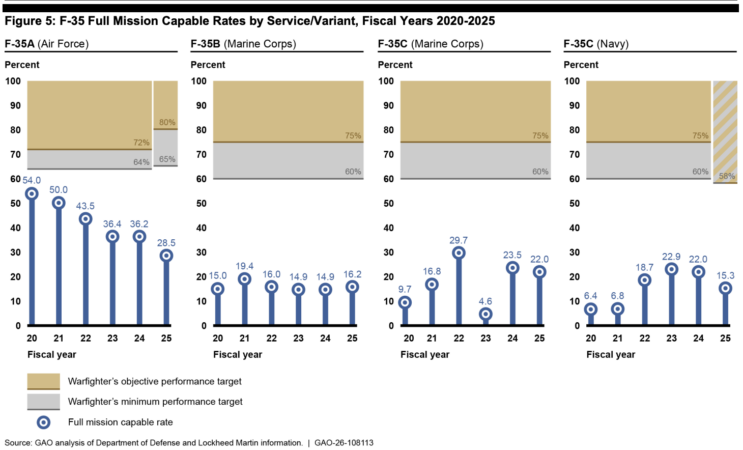
Air Force F-35As generated the highest full mission-capable rates among the three F-35 variants, nearly double the rate of Marine Corps F-35Bs and Navy F-35Cs, according to GAO, but still just 28.5 percent. The Air Force’s full mission capable rates have generally been higher than the other services over the past five years but trending downward overall.
For general mission-capable rates—the percentage of time that a jet could carry out at least one of its tasked missions—the F-35As were at 38.6 percent in 2025, below the B and C’s rates, which ranged from about 54 percent to 64 percent. That stands in contrast to 2020-2021, when the Air Force led the other services in MC rates.
The F-35 program office said fixing F-35 readiness could cost $13.7 billion over the next five years, GAO wrote in a June 11 report on F-35 Sustainment.
Readiness challenges have plagued the F-35 program for years, with GAO auditors consistently raising alarms and the F-35 Joint Program Office making repeated efforts to improve the jets’ availability. But the latest report on Lockheed Martin’s F-35 shows mounting problems, excacerbated by delayed upgrades, soaring sustainment costs, and an influx of jets that, while delivered, are not yet mission capable.
The root of the problems, JPO officials told auditors, is that the F-35 program and U.S. services prioritized procuring more jets early in the program’s life cycle instead of creating critical depot and repair capability, “historically underinvesting in sustainment.”
As a result, the sustainment system as it stands “cannot fully support the F-35 fleet,” the report said. And JPO officials warned that unless significant changes are made, the F-35’s already-inadequate sustainment structure will worsen over time as the fleet grows.
The F-35’s performance in recent missions, such as Operation Epic Fury, have demonstrated the aircraft’s capability when parts and attention are prioritized, noted Douglas Birkey, Executive Director of the Mitchell Institute for Aerospace Studies. But the intense focus needed to maintain jets for combat operations inevitably stresses the remaining F-35 fleet, and overall readiness rates could slip further in 2026.
“The aircraft delivered in combat like none other,” Birkey said. “Those tails were properly [supplied with spare parts], supported by seasoned maintainers, and readiness was a top priority. This proves the jet can deliver when the support is aligned.”
In fiscal 2021, the F-35 mission-capable rate was 66.8 percent. That figure plunged in 2025 to 44.1 percent. Full mission-capable rates—the share of time an F-35 could carry out all of its missions—dropped from 38.1 percent in 2021 to 24.6 percent in 2025.
The F-35 JPO said in a statement to Air & Space Forces Magazine after this article’s initial publication that it concurs with the GAO’s findings and supports its recommendations to develop plans to mitigate risk on sustainment improvement initiatives, ensure future incentive programs lead to better performance, and put strict financial quality controls in place.
“Through our Global Support Solution Reset initiative, the JPO remains focused on achieving our 2030 readiness goals and ensuring strict fiscal accountability for every sustainment dollar spent,” the JPO said.
A Lockheed Martin spokesperson also commented on the report. “Lockheed Martin continues to partner with the Joint Program Office and our industry partners to ensure we are delivering efficient and effective sustainment for the warfighter,” wrote a Lockheed Martin spokesperson in an email response to Air & Space Forces Magazine. “We have recently invested more than $2 billion in advanced funding to accelerate spare parts to increase readiness rates across the F-35 fleet.”

The Air Force now operates more than 500 F-35As, the majority of the total 800-plus F-35s belonging to the U.S. military. The Air Force, Navy and Marine Corps plans to buy about 1,700 more by the mid-2040s.
The Air Force jets are the simplest and least expensive of the three variants. Full mission-capable rates for Air Force F-35As were 54 percent in 2021 and dropped to 36.2 percent in fiscal 2024, then fell further to 28.5 percent in 2025—well below the service’s 2025 goal of having 65 percent of F-35As able to carry out all its missions.
“Since 2020, the F-35 has not met the minimum performance goals desired by the U.S. military services by wide margins and performance has generally trended down for [full mission-capable] rates and [mission-capable] rates, particularly for the Air Force F-35A,” the GAO report said.
In a footnote, GAO noted that, according to Air Force officials, the 2025 decline was driven in part by the acceptance of new F-35s that were not yet able to carry out all their missions because of software problems.The F-35’s Technology Refresh 3 upgrades, which previously led to a yearlong suspension of deliveries, was lifted last year after once an interim software release was completed. But TR-3 jets were initially limited to flying only basic training flights. Even now, those newer jets still cannot fly in combat.
Ongoing spare parts shortages and corrosion problems also contributed to declining readiness, Air Force officials told GAO auditors.
The Pentagon’s Global Support Solution, or GSS, manages F-35 sustainment, sharing spare parts among all the JPO’s international and U.S. customers. The F-35 supplier base has also struggled to find alternative sources for canopies and other key parts. And the introduction of new configurations has added “high technical complexity” to ongoing sustainment challenges.
The JPO promised a Global Support Solution Reset last year with the intent of raising mission-capable rates to 80 percent and full mission-capable rates up to 65 percent by 2030. The GSS Reset calls for buying more spare parts and consumables, investing in repairs, changing its system for allocating spare parts so they can be moved around more efficiently, expanding and speeding up depots’ repair capabilities, and making the most troublesome spare parts more available. It also would streamline maintenance processes and staffing, and adopt new maintenance tools and best practices.
GAO said the JPO will need $13.7 billion in additional funding through fiscal 2031 to fix its problems, however, including solving the parts shortages, improving maintenance practices, and relying less on its constrained supplier base. JPO officials specified saud $2.2 billion of that will be invested in fiscal 2026 and 2027, half for spare parts. The remaining $11.5 billion would start in fiscal 2027 and cover shortfalls in planned sustainment funding, essentially acknowledging the original math left the services short.
About $7.3 billion of the $13.7 billion would be for depot-level spare parts and materials, while $3.1 billion would be used to expand the military’s depot capacity. The balance of $3.3 billion is to fund maintenance and fuel.
If those issues are improved, GAO said, the F-35’s sustainment should improve. But it’s far from certain the GSS Reset will succeed, the report said—and a lack of enough funding could present a major roadblock.
GAO said the Air Force expects it can afford its share of the GSS Reset budget, but the Navy and Marine Corps were uncertain.
The program office acknowledged to GAO that funding poses a risk, and predicted that underfunding would dampen its potential improvements and drive the costs. JPO officials were reportedly “optimistic,” however, that 2027 and later budgets would largely cover the bill.
Still, GAO stated that the GSS Reset plan does not address the JPO’s lack of access to critical technical data needed for the military to fix the jets on its own. That data belongs to the contractors.
Plans to create a working capital fund to manage spare parts purchasing for the F-35 program are in development. Creating a working capital fund would allow the JPO to stock more parts and shorten lead times, and it could help work as a hedge against inflation. But it will be October 2028 at the earliest before such a fund is in place, GAO said.
Birkey said the Air Force’s yearslong pattern of underfunding spare parts and maintenance that has hurt other programs is now showing up more plainly. “I can’t emphasize how consequential underinvestment in readiness for many years was to the health of the F-35 and the entire [Air Force] aircraft inventory,” Birkey said. “That was driven by austere budgets, which made for impossible decisions.”
The Air Force is planning a massive investment in readiness and spare parts as part of its fiscal 2027 budget. That includes $1.3 billion for “initial spares [and] depot activation/material lay-in” for the F-35.