


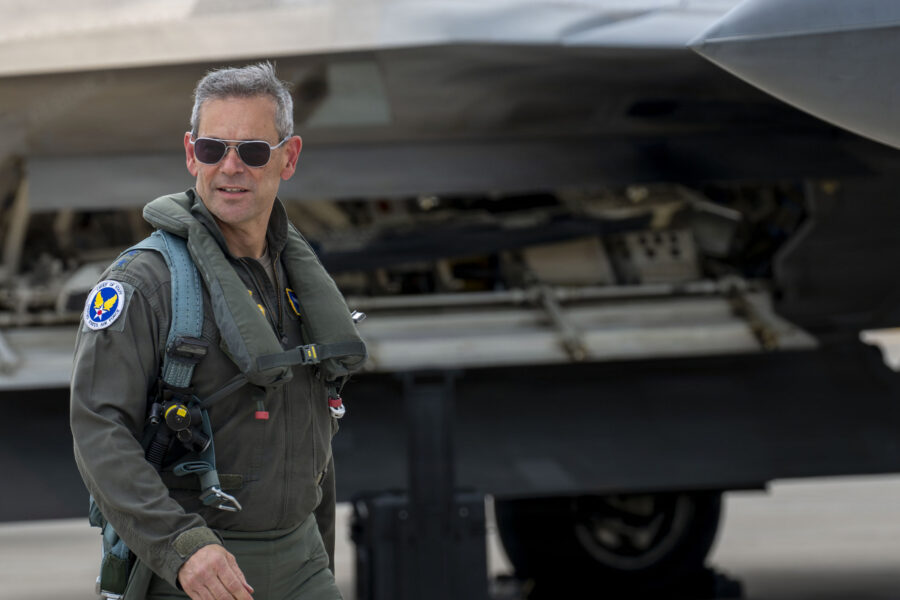
LONDON—When Gen. Kenneth S. Wilsbach became Chief of Staff of the Air Force in November 2025, he coined a simple motto: “Fly and Fix”—so you can fight if necessary. In the nine months since, Airmen have been flying, fixing, and fighting—a lot.
The Air Force has been flying almost continuous combat operations since the start of the year. Its fighter, bomber, and airlift fleet supported the removal of Venezuela’s Nicolas Maduro in January, then pivoted to round-the-clock combat operations in the largest air war in a generation against Iran, and has been conducting operations in the Western Hemisphere, and flying in the Western Pacific throughout.
All of which puts Wilsbach’s vow to improve readiness to the test.
“You’ve heard the stories of stressed readiness and maintenance availability,” Wilsbach said. “Not true for the jets that are deployed. They’ve been performing marvelously, largely because you know we focused on spare parts and sustainability forward.”
“We didn’t have jets sitting around doing nothing,” he added. “We needed them in the air to execute missions.”
Wilsbach sat down with Air & Space Forces Magazine in July after delivering keynote remarks at the Global Air and Space Chiefs Conference in London.
“When we commit U.S. forces to a conflict, the only reasonable outcome, in my view, is winning,” Wilsbach said.
The air war with Iran has focused new attention on air-base defense, as well as modernization and readiness for an air chief whose career included two tours as a Major Command leader in the Air Force: Pacific Air Forces, first, followed by Air Combat Command.
Beginning his career flying the F-15C Eagle and later the F-22 Raptor, Wilsbach has gone on to fly more than 6,200 hours.
Keeping the Air Force ready for operations against Iran is the most pressing challenge Wilsbach has had to face. Operation Epic Fury is the biggest air campaign since 1991’s Operation Desert Storm against Iraq. The Air Force has employed nearly every platform in its fleet: F-22 Raptors and F-35 Lightning II fifth-generation fighters, F-15E Strike Eagle, F-16 Fighting Falcon multi-role fighters, A-10 Thunderbolt II attack planes, and uncrewed MQ-9 Reaper drones. The combat aircraft have been supported by six-decade-old KC-135 Stratotankers and newer KC-46 Pegasus tankers, as well as a variety of transport and other support aircraft.
The fighting has come at a cost. The Defense Department’s official casualty figures count over 50 Airmen who have been wounded in action due to hostile fire during Operation Epic Fury and “overseas operations.” Eighteen service members have been killed in the conflict—including six Airmen who died when a KC-135 crashed in Iraq after a midair collision with another tanker, officially a “non-hostile” incident despite the fact it was the result of wartime operating conditions. KC-135 Stratotankers have been damaged on the ground and an E-3 Sentry AWACS was destroyed, Wilsbach and other U.S. officials have previously acknowledged, and multiple fighters have been shot down due to a combination of Iranian and friendly fire. Roughly 30 Reaper drones have also been lost.
Wilsbach praised the Air Force fighters that have performed well, including the F-35, despite maintenance challenges. As recently as last year, according to the Government Accountability Office, only one in four F-35s was fully mission capable at a given time.
The problem is more parts shortage than anything else, he suggested.
“What happens normally when you’re not prioritizing the parts is if the jet comes back and it’s not flyable, the part is not on the base—and so we have to order the part, and then it takes a couple of days to get there,” Wilsbach said. “So what we’ve learned is buy the parts, have them on the shelves, and have those spares available for our folks. Because we’re not short on maintainers, but we are short on parts for the F-35 and many other things.”
Buying and stocking parts boosts availability, the Chief said.
“When you invest in those things and they’re available, the jet flies really good,” Wilsbach said. “When it flies, it’s also extremely effective. We’ve done really well with the F -35. So has Israel. So we are creating some fantastic effects with the F-35.”
Defending Bases
Iran’s missile and drone attacks on installations in the Middle East proved a wake-up call for Airmen overseas, underscoring the need to strengthen air base defense abroad and at home.
“As the base has had attacks, they’ve repaired the base, and they’ve kept moving,” Wilsbach said. “And fortunately, we’ve had minimal casualties. Part of that’s because our Airmen are really good at what they do.”
Iran’s drone and missile attacks highlight the value of the Air Force’s Agile Combat Employment concept, in which U.S. forces would disperse to multiple operating locations from large, fixed bases in the Pacific or Europe if called to fight.
After decades of operating with impunity in uncontested airspace over the Middle East, the risks and challenges have changed.
“I think that if you pile up like we did during Desert Storm with … several hundred aircraft on one base because it’s a sanctuary—I believe those days are largely gone,” Wilsbach said. “We’ve seen Iran shoot missiles a pretty long way. Certainly, other countries can definitely shoot farther than Iran.”
The growing range and size of rival missile arsenals means the U.S. can no longer be sure the continental U.S. will forever remain insulated from threats coming over the oceans on its East and West Coasts.
“Perhaps … even McConnell Air Force Base, Kan., could be in a threat ring in the future,” Wilsbach said.
Wilsbach is focusing on what the Air Force can do to complement the Army’s role in base defense, particularly “point defense” against one-way attack drones.
He’s launched an effort to create a new career field for defending air bases against attack, a role that goes beyond the perimeter defense duties of security forces Airmen. Wilsbach said the Pentagon’s counter-drone Joint Task Force 401 will help kit out those Airmen with defensive systems.
Defenses will need to include tactics, weapons, and low-cost passive protection, such as nets over aircraft and other critical gear. Costly hardened shelters are not only expensive, but time-consuming to build.
“It’s not either or,” Wilsbach said. “You may have seen us just putting nets up around the sun shelters”—which provide shade over aircraft and the maintainers working on them. “The net keeps the small UAS from getting close to an aircraft that you’re trying to protect… That’s a very inexpensive way to give you some modicum of protection without killing your checkbook on really exquisite defensive systems.”
But Wilsbach is also of the mind that a good offense is sometimes the very best defense: “I’m much more interested in shooting down that small UAS before it gets close [than] spending a bunch of money to protect an asset that can’t move,” he said.
Modernizing an Aging Force
The Air Force Wilsbach leads is the smallest and oldest in the service’s history, but also on the verge of major modernization to virtually every category of aircraft in the fleet.
“We’re actually in the midst of the largest modernization we’ve ever had in the United States Air Force—at least concurrently—with things like B-21 and T-7; KC 46 ; upgrades to the F-22, F-35; F-47, CCA, Sentinel; and there are many, many other things,” Wilsbach said. Among them: Renewing the B-52 bomber with a major overhaul, acquiring new E-7 battle management aircraft, increasing and expanding the arsenal of weapons, and scaling the force in response to China’s rapid growth as a potential military adversary.
The Air Force and contractor Northrop Grumman are planning to build 100 B-21 bombers, but that number is likely a floor, not a ceiling.
“At some point in the future, we’ll consider additional buys,” Wilsbach said. “So one of the things we’re talking to Northrop about is how could we do that in a way that doesn’t stretch out. So let’s just assume that maybe you wanted to double the buy to go from 100 to 200. Can Northrop do that? That’s a big question to ask because, what I don’t want to do is, [say] ‘OK, I’ve got 100 and now the next 100 comes but by the time we get the last one it’s 2060. It’ll be obsolete by then, right? If we’re going to buy some more, we’ve got to figure out a way to compress.”
Wilsbach is pushing for multi-year procurement for jets as well as weapons, a more to strengthen the defense industrial base and drive the cost curve down.
“I think multi-year procurement gives a much more stable environment for the defense industrial base to predict what their future is going to look like, and thereby they can line up the supply chain,” Wilsbach said
Budgets will never be big enough to answer every need, however. The Trump administration’s plan for a $1.5 trillion budget faces headwinds in Congress, where lawmakers are divided over whether to support the additional spending in a so-called reconciliation bill as well as a supplemental budget request to pay for war costs. “We are going to have to take risks in modernization and readiness,” without more funding, Wilsbach said. “And that is not what the American people want or expect from their Air Force. We’ve been tasked with many, many missions over the last several years. And we are going to not be able to live up to those taskings if the Air Force is not funded in an appropriate way. An appropriate way is to fund the supplemental, fund the base budget, fund reconciliation.”
Fitter Force
Wilsbach’s Air Force comprises nearly 700,000 Airmen, and the Chief has strong views on physical fitness, appearance standards, and old-fashioned discipline.
“I’m actually trying to spend some effort of tweaking the warrior culture in the Air Force.” he said—actually, not just the culture, but the reputation of his service. “Airmen have been performing under fire. Old jokes of oh, you’re the ‘Chair Force,’ all these jokes you’ve heard, they’re not true. I would welcome anybody to talk to our Airmen that have been downrange on the ground fighting or in the air fighting. It’s too bad that not everybody can see what they’re doing and how hard it is, how physical it is, and how they have to have toughness, mental toughness, physical toughness, and grit to do what they do. And I want to change the impression of Airmen to a gritty, tough warrior versus the ‘Chair Force.’”
Wilsbach wants his leaders flying, arguing that when general officers fly it’s not for fun or for show, but to learn about the platforms and see operators in their environment. During his time as chief, Wilsbach has flown F-22s and other aircraft, including the E-4B Nightwatch nuclear command-and-control aircraft.
“Every time I go fly, whether it’s in my aircraft that I’m qualified in, the F-22, or whether it’s one of the other platforms that I’ve had an opportunity to fly, I learn something that no one told me, and that I just discovered through the course of my day of flying,” he said. “I also believe that commanders that retain the ability in these areas have credibility and our Airmen respect that credibility. … For me, being a good fighter pilot, I can tell them to go … get out to the gym and do some workouts. They’re going to listen to me on those things because they respect my credibility to do the mission, because our Airmen respect what we do: fly and fight.”
But it’s the learning and working experience that brings things to light which drives him to fly. On one F-22 flight last year, Wilsbach said, he discovered a problem that had been dogging the maintenance crews.
“A specific component in the F-22 that we had a significant shortage of—I did not know this,” Wilsbach said. “What was happening was the maintenance guys were taking the limited number of that component, and they were constantly moving it around to put it in the jet that was flying that day.”
The shortage was creating a lot of extra maintenance work.
“And I came back to the Pentagon,” he recalled, and saw to it that the Air Force “go to the contractor, buy some more of those components, and get them out to the wings, so we can reduce the manpower requirement to fly the schedule.”
The payoff: Less fixing and more flying. Because, as Wilsbach will tell you, “we fix so we can fly.” And fly so the USAF can win.