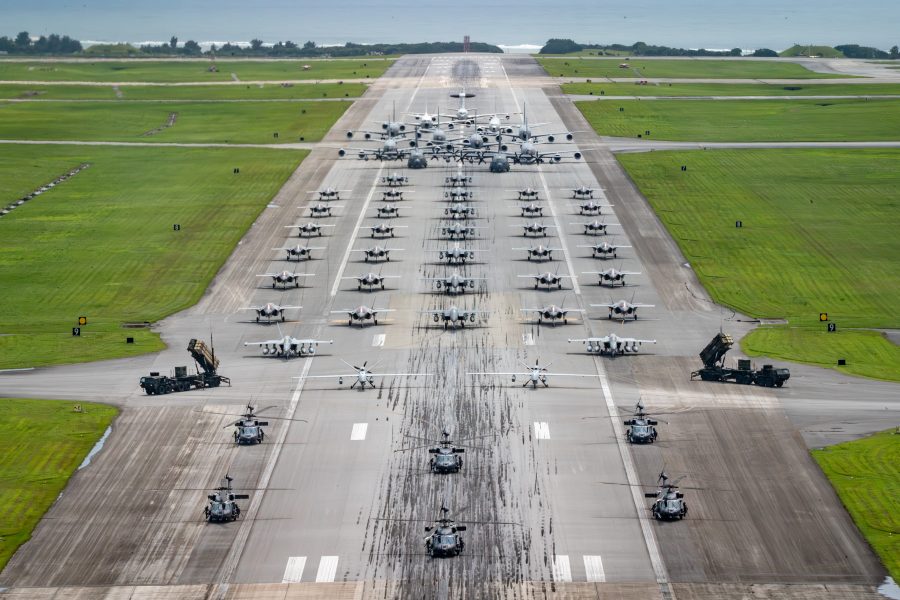
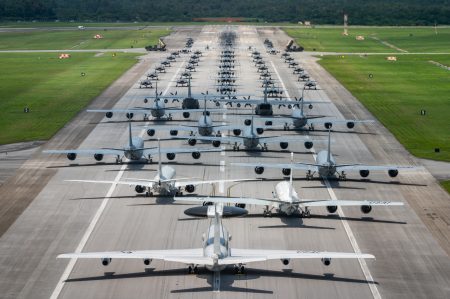
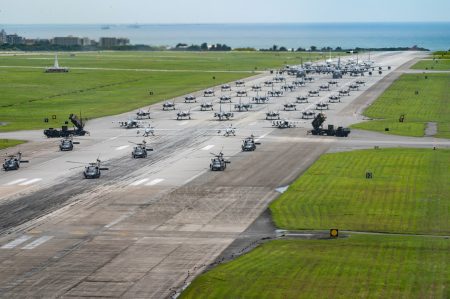
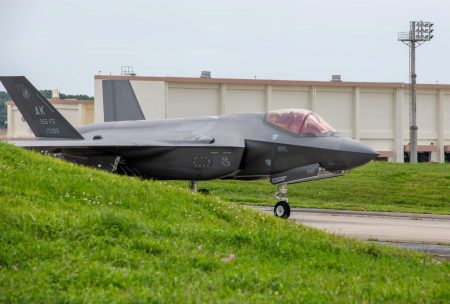
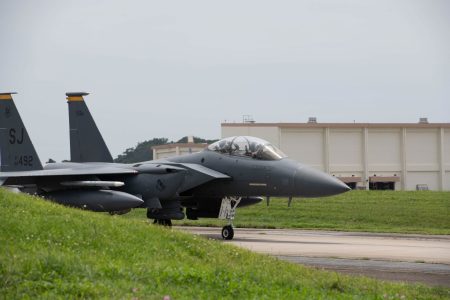
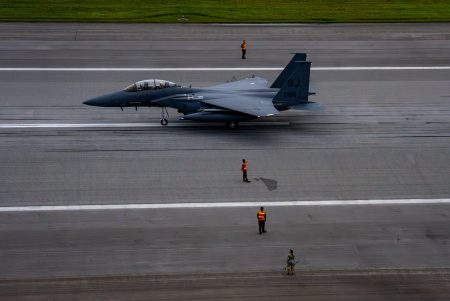
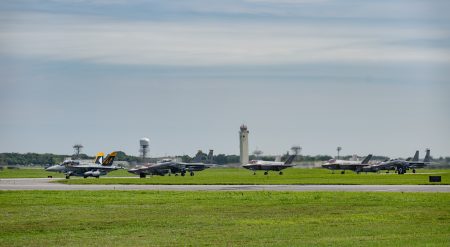
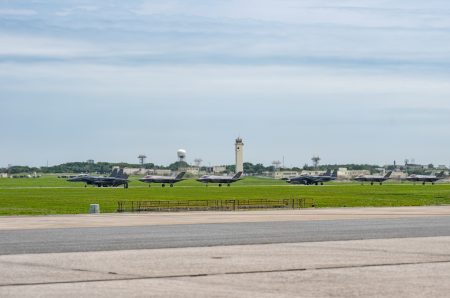
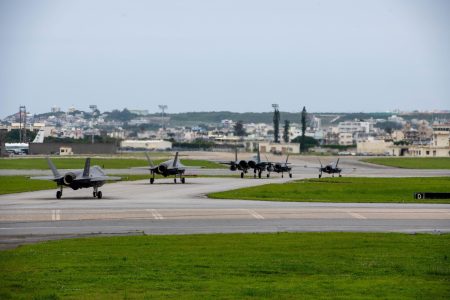
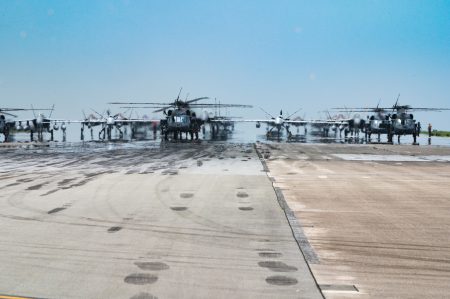
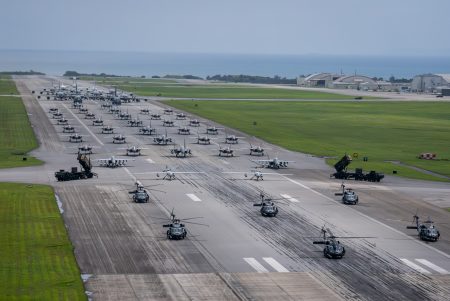
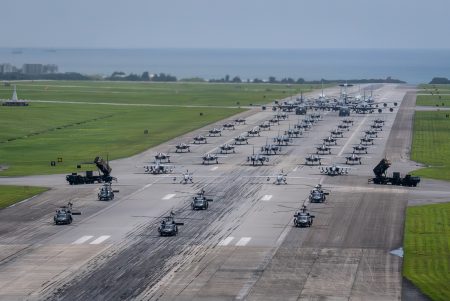
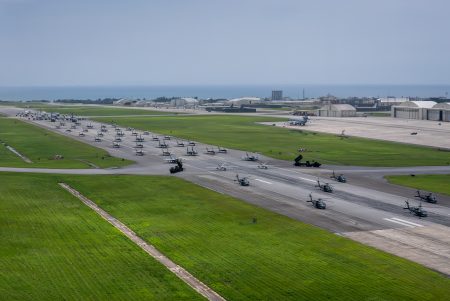
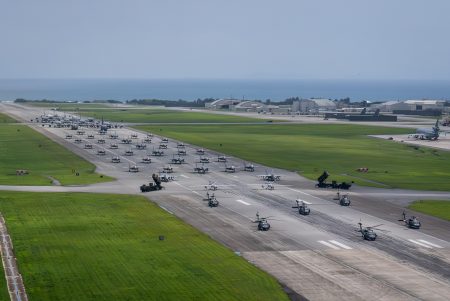
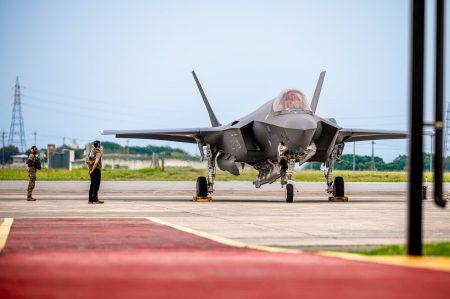
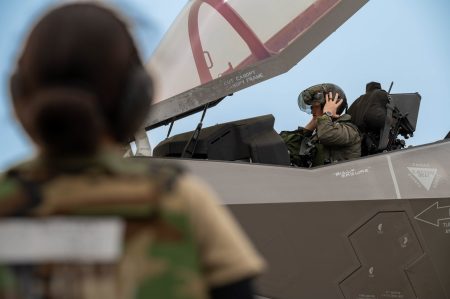
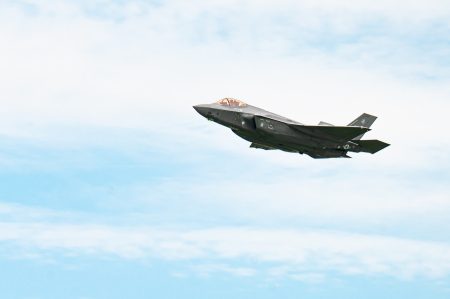
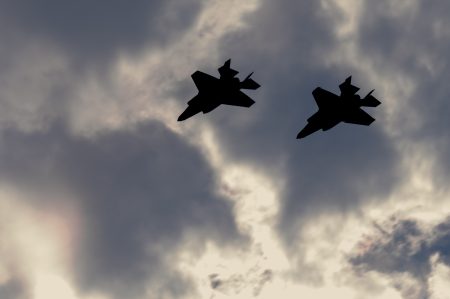
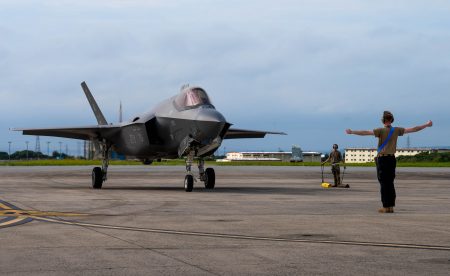
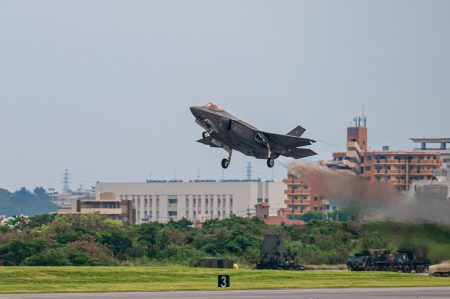
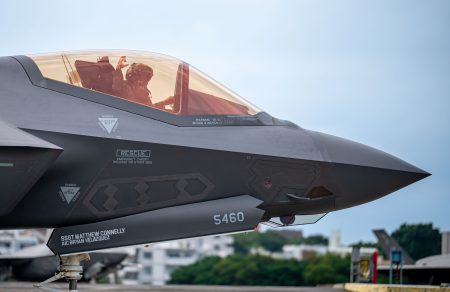
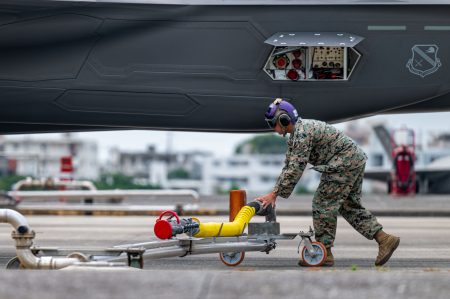
U.S. Air Force, U.S. Army and U.S. Navy assets line up on the runway for an elephant walk during a routine operational readiness exercise at Kadena Air Base, Japan, May 6, 2025. U.S. Air Force photo by Senior Airman Tylir Meyer
Audio of this article is brought to you by the Air & Space Forces Association, honoring and supporting our Airmen, Guardians, and their families. Find out more at afa.org
The Air Force displayed all the firepower it has amassed on Okinawa in an unusually diverse show of force this week.
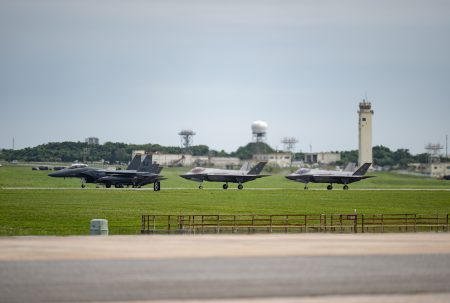
In a May 6 “Elephant Walk,” Kadena Air Base showcased 24 F-35A Lightning II stealth fighters, drawn from multiple fighter squadrons rotating through the region; eight F-15E Strike Eagles; and two U.S. Army Patriot anti-missile batteries near the runway.
The Patriot system, owned by the U.S. or foreign partners, is deployed to hotspots around the world with significant missile threats, including Ukraine and the Middle East. Their inclusion appeared intended to send the message that the U.S. was not only prepared to operate from the base but to defend it against Chinese missile attacks.
On Okinawa, Kadena is located in the so-called First Island Chain off the coast of mainland China, which includes Japan; Taiwan, the self-governing island China claims as its own; and the Philippines, a U.S. ally that has territorial disputes with Beijing.
In a release, Kadena’s 18th Wing said the “Elephant Walk” of aircraft and missile defense systems was a showcase of “combat readiness and regional deterrence” as part of the exercise Beverly High.
Other platforms also represented in the display:
An Air Force RC-135 Rivet Joint signals intelligence gathering aircraft;
A Navy P-8 Poseidon maritime patrol, reconnaissance, and anti-submarine warfare aircraft;
Two Navy EA-18 Growler electronic warfare attack planes;
The 18th Wing’s release called the display a “testament to the lethality Kadena AB can leverage to deter adversarial aggression in the Indo-Pacific region.” Chief Master Sgt. Brandon Wolfgang, the 18th Wing command chief master sergeant, said it “sends a message you can’t ignore.”
Obvious but unstated was who that message was for—China and North Korea.
Eventually, Kadena plans to receive F-15EX Eagle II advanced fourth-generation aircraft that will be permanently stationed at the base.
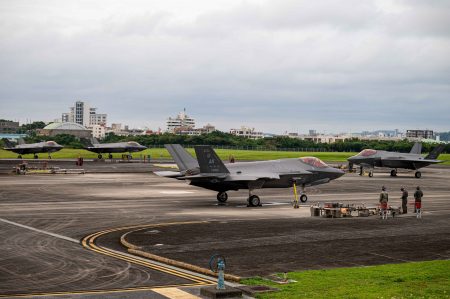
The aircraft from Kadena didn’t stay still. To practice the Air Force concept of Agile Combat Employment, under which aircraft will disperse to elude attack, Airmen and F-35s assigned to Eielson’s 355th Fighter Squadron and 355th Fighter Generation Squadron are staging out of Marine Corps Air Station Futenma, which is also on Okinawa, from May 6-9.
Marine Corps Air Station Futenma hosts its own F-35Bs, the short takeoff and vertical landing (STOVL) variant flown by the service. The USMC also operates the carrier-based F-35C.
Audio of this article is brought to you by the Air & Space Forces Association, honoring and supporting our Airmen, Guardians, and their families. Find out more at afa.org
BAE Systems has received a contract from Lockheed Martin to install an upgraded Block 4 electronic warfare system into new F-35 Joint Strike Fighters, as well as to retrofit some older jets.
The Air Force has figured out a way for maintainers to inspect what had been a “blind spot” in F-16 engines, after problems in that area led to the catastrophic crashes of two jets in recent years.
The Air Force has begun evacuating stealth fighters, gunships, and special operations planes ahead of Hurricane Isaias expected landfall over the Gulf Coast this weekend.
The Air Force’s B-52 bomber may soon be able to carry up to 20 stealthy long-range anti-ship missiles to strike moving targets at sea, a key capability in a potential fight with China.
A reported surge of MQ-9 Reaper drones to Latin America could widen the scope of intelligence gathering and free up more strike options against cartels in the region, experts tell Air & Space Forces Magazine.
Northrop Grumman has broken ground on a major new production facility for the B-21 Raider, the company and the Air Force announced Oct. 6. The construction comes as a top service official said testing on the bomber is going well in the lead up to its planned introduction into the…
An OA-1K Skyraider II belonging to Air Force Special Operations Command went off the runway while landing at a small Oklahoma City airport Oct. 5 and is waiting to be moved, according to officials and flight tracking data.
More than two dozen F-35 Lightning II fighters are heading to Kingsley Field, Ore., after Air Force Secretary Troy Meink signed the official record of decision to base the jets there on Oct. 5, clearing the last bureaucratic hurdle for the Air National Guard base to host the service’s third…
✓
Thank You!
Check your inbox to verify your email address and finish setting up your AFA account.
★
Welcome Back!
An account with this email already exists. Please log in to continue.
Subscribe to the Air & Space Forces Daily Report
The latest news from Air & Space Forces Magazine, as well as news from other leading publications, delivered right to your inbox every morning!
We’re sorry, there has been an error. Please review your input or try again later.