
The F-35 Joint Program Office awarded Lockheed Martin a $1.6 billion contract for spare parts for the fighter jet last week, a record sum for the program, Lockheed officials confirmed July 23.
The Air Force is contributing the largest share of funds to the deal, according to the July 15 contract announcement: $754 million. But the exact number of parts the service will receive is less certain, given the F-35 program’s unusual shared approach to spares.
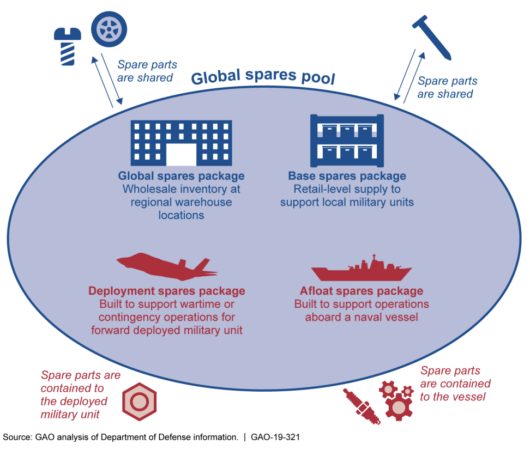
F-35 operators—including the Air Force, Navy, Marine Corps, as well as foreign partners—do not buy their own spare parts. Instead, the F-35 Joint Program Office procures spare parts for a global spares pool. Operators then “purchase access to parts in the shared pool based on how many F-35 aircraft they own and the number of flight hours they plan to fly,” according to a 2023 Government Accountability Office report.
Determining who gets what parts is complicated. “The F-35 program has developed a series of business rules that are intended to govern how parts within the F-35 global spares pool will be managed and shared, and how the costs of the parts will be allocated across participants,” the GAO report states. “The prime contractor manages the F-35 supply chain and is responsible for allocating parts to F-35 sites and participants based on contracted requirements, such as numbers of aircraft and planned flying hours, and program business rules.”
The global spares pool includes:
- Base spares packages: Parts positioned at each main F-35 operating base, with the exact amount depending on the number of jets and flying hours anticipated.
- Global spares packages: “Wholesale-level” supplies of parts in warehouses throughout the world, shipped to operators as needed.
- Deployment spares packages: Collections of parts purchased to support a forward-deployed F-35 unit for a certain amount of time. “The parts in this package are generally reserved for use only by the participant who purchased the package,” the GAO report notes.
- Afloat spares packages: Similar to the deployment packages, but for F-35s deployed aboard naval vessels. Like the deployment packages, these parts are usually reserved for those who paid for them.
The new $1.6 billion contract covers all four categories, according to the contract announcement.
In an earnings call, Lockheed CEO James Taiclet said the deal was “the largest such contract in F-35 history, reinforcing the Department of War’s heightened focus on keeping the world’s premier fighter fleet operational.”
For comparison, the Pentagon and Lockheed agreed to a $578 million spare parts deal in July 2025, $348 million in September 2024, and $382 million in December 2022.
The increase in contract value matches a growing investment by the Pentagon in F-35 sustainment and spare parts for all types of aircraft. In 2025, the Air Force budgeted $982 million for initial spares and repair parts across the fleet. In 2026, buoyed by extra money from the “One Big Beautiful Bill Act” reconciliation package, that more than doubled to $2.22 billion. In 2027, the service is seeking $2.57 billion.
Parts shortanges have undermined readiness, making them a central focus for Air Force Secretary Troy Meink and Chief of Staff Gen. Kenneth S. Wilsbach.
“We definitely have to invest in those accounts so that the parts are on the shelves when the aircraft flies,” Wilsbach said at his confirmation hearing to be CSAF last October.
F-35 readiness has been particularly low, with GAO citing in a June report that full mission capable rates for the three versions of the jet were all around 25 percent. The Air Force’s F-35As scored the best of the bunch at 28.5 percent, but have trended downward overall largely due to lack of parts.
Another GAO report, from 2023, faulted the Pentagon for poor oversight of millions of parts in the pool. The report said officials hand not been able to review losses worth tens of millions of dollars because they ceded control and oversight to Lockheed.
Lockheed, for its part, says it is increasing its investment in spares to match the Pentagon’s focus. In a January earnings call, Taiclet said the firm has “committed to an additional $1 billion of strategic internal investment for the F-35, with an emphasis on the aircraft sustainment system to improve mission-capable rates across the fleet.”
Taiclet claimed on the call that investment has paid off so that Lockheed can now better fulfill its new contract.
“Our upfront investment in spare parts and consumables has now been translated into immediate inventory that can be shipped to customers the moment their need arises,” he said.