
Brussels; Mons, Belgium; Bodø, Norway; Luleå, Sweden; and Rovaniemi, Finland—This is not your father’s NATO anymore. It’s changing. The question is whether it will make the alliance stronger or diminish its capabilities.
The North Atlantic Treaty Alliance is undergoing a major transformation, with European members taking more responsibility for their own defense and assuming airpower and other roles that, for decades, the United States had promised to fulfill. Trump administration officials claim the shift is necessary because the U.S. needs to allocate more forces for other commitments around the globe.
U.S. Air Force Gen. Alexus G. Grynkewich, NATO’s top military officer, said that the alliance is looking for “pragmatic and realistic outcomes” to fill the gaps as the Pentagon shifts greater focus to deterring China in the Pacific and its operations in the Western Hemisphere.
“We ought to, as a team of friends, hold each other to account,” Grynkewich, the Supreme Allied Commander Europe, known as the SACEUR, said in a recent interview at his headquarters near Mons, Belgium. “Are we meeting our Hague Summit commitments [to increase defense spending]? Are we meeting our capability targets? Do we have the right resilience that we’re building into our force? How are our plans looking?”
The Trump administration’s pointed disputes with long-time European allies has shaken their confidence in America’s commitment to the alliance. The disagreements have ranged from fights over military spending, threats about pulling out forces, trade and tariffs, and the war with Iran. Secretary of Defense Pete Hegseth has promised a comprehensive review of U.S. forces in Europe, worrying allies and Congress members in the U.S., who oppose further reductions of U.S. troops in Europe.
Grynkewich, who also leads U.S. European Command, said he and his NATO teammates are making progress. “And there will be some things as we do that—in that honest and open discussion—[partners can] celebrate,” he said. “And there’ll be other things where we need to hold ourselves to account and get everyone to row a little harder.” It will not be easy for the Europeans to fill all the gaps. Former military officers note that the U.S. is the only member of the alliance with long-range bombers and has much greater resources in terms of air mobility, fighters, and aerial refueling.
—Britain’s Air Chief Marshal, Johnny Stringer, NATO Deputy SACEUR“Achieving air superiority goes beyond just the air component.”
The Trump administration put the alliance on notice in May that it would scale back the number of forces earmarked to help defend the alliance in the event of a crisis. The objective was to ensure sufficient U.S. assets could be allocated to the Pacific and the Western Hemisphere. The U.S. faces regional demands in Europe, the Pacific, and the Middle East, and must be able to defend the U.S. homeland. As available airpower has diminished and demands increase, that’s become harder and harder, yet the Russian threat has not decreased.
Details about which responsibilities are shifting to European partners are being spelled out in classified discussions of the NATO Force Model. It specifies the forces and assets nations would provide during the first 10, 30, and 180 days of a conflict or crisis, including the numbers and types of aircraft that could be available to defend Europe in a contingency.
Adding to the challenge, U.S. officials stressed the reductions were immediate, with no transition period for European allies to adjust.
In an effort to fashion a workaround, allied officials say, plans are in the works to deploy more ground-based, long-range missiles and more fighter aircraft to take the place of strategic bombers. Replacing U.S. refueling tankers is trickier, requiring the allies to establish more airfields on the continent with fuel capacity.
To fill the gap, NATO is working to boost both air defense and the number of air-to-surface missiles in European arsenals.
Lt. Gen. Jason Hinds, the head of Allied Air Command and commander of U.S. Air Forces in Europe, explained his approach to helping allies adjust. “I drive them towards two things: The first is the right capacity and the right systems of integrated missile defense,” he said. “We always need more defense capacity. I guarantee there’s never enough, especially on the interceptor side. But we just can’t spend all of our money, especially on the alliance side, on defensive kit alone.”
Offensively—to combat an incursion into NATO territory—allies need “significant air-to-surface fires,” Hinds said, such as the Joint Strike Missile or JASSM cruise missiles including “surface-to-surface fires that are coordinated by airpower. Maybe it’s an F-35 communicating directly with the surface fire element, which we’re doing already.”
Hinds wants an effects-based approach. “I always ask them, don’t look at it just through a defensive side, and not always just through an airpower side,” he said. “You’re looking for the effect that the nations need.”
Some former officials question whether this will be good enough.
“Ground-based fires can act in some situations as a supplement, but they certainly cannot replace in any way, shape, or form the advantages that aircraft bring to a major conflict,” said retired Lt. Gen. David A. Deptula, the Dean of AFA’s Mitchell Institute for Aerospace Studies.
“The United States Air Force has the only bombers in the free world,” he added. “Why does this matter for NATO? It matters for NATO because Russia is the largest geographical country in the region, and bombers provide range and payload that exceeds any other kind of vehicle.”
The Trump administration is also reviewing the size and types of American forces deployed in Europe. The Pentagon has already reduced U.S. presence there by two Army brigades, both European and U.S. congressional leaders are complaining.
Rep. Don Bacon, a Nebraska Republican and retired Air Force brigadier general, told Air & Space Forces Magazine that the cuts in ground forces went too far and that the U.S. fighter force in Europe—a relative few F-16, F-15E, and F-35 squadrons at bases in England, Germany, and Italy—was limited compared to the airpower the U.S. deployed on the continent 30 years ago.
“It’s a very small fighter presence,” said Bacon, who was a wing commander at Ramstein Air Base while still in uniform. “I think we probably cut too much. I surely don’t recommend cutting more.”
The U.S. was already planning to replace F-15E Strike Eagles with F-35 Lightning II fifth-generation fighters at RAF Lakenheath, U.K., Hinds said, but otherwise the U.S. Air Force is not planning further reductions. “If there are any, it’s pre-decisional, but I’m not anticipating any—not at this moment in time,” he said.
The need to act quickly to narrow the gaps in capability is clear, given the threat of Russian aggression in the region. While Russia’s ground forces have been caught up in a grinding war of attrition in Ukraine, much of its air and missile forces are intact, Grynkewich said.
“I would say those have not been subject to the same level of attrition and attritional warfare that the Ukrainians have imposed on Russian ground forces,” Grynkewich said. “So they do still have the platforms and capabilities, whether it’s bombers or fighters or ballistic missiles.
“They, of course, are expending some munitions in Ukraine, but the platforms are there, and then their production for replacement ballistic missiles and cruise missiles continues. So, they have considerable firepower and considerable potential.”
European officials are saying they are doing what they can to narrow the gaps. Allied officials say that European nations have committed all of their new fighter aircraft to NATO’s defense instead of holding some back for their national missions.
Britain’s Air Chief Marshal Johnny Stringer, the Deputy SACEUR at NATO Supreme Headquarters Allied Powers Europe, said European air forces should focus on increasing capacity, the ability to support both maritime and air operations, and on improving their ability to suppress enemy air defenses—a capability in which they have made great strides in recent years.
“Building out the capability on mission sets needs to genuinely be multi-domain,” he said. “Achieving air superiority goes beyond just the air component, for example.”
Britain’s recently unveiled Defense Investment Plan includes funds for next-generation collaborative combat aircraft. The U.K. is pursuing its own sixth-generation fighter jets with other partners.
“As we continue to learn and apply the lessons of crewed and uncrewed systems, and you think of low-end capabilities in your force mix,” he said. The low end is not simply something cheap. “Low is very often the product of very high conceptual thinking,” Stringer continued. “It works because you’ve really thought about the capability it brings and you’ve integrated it with your more expensive, your more capable, your longer-range systems.”
NEW PARTNERS
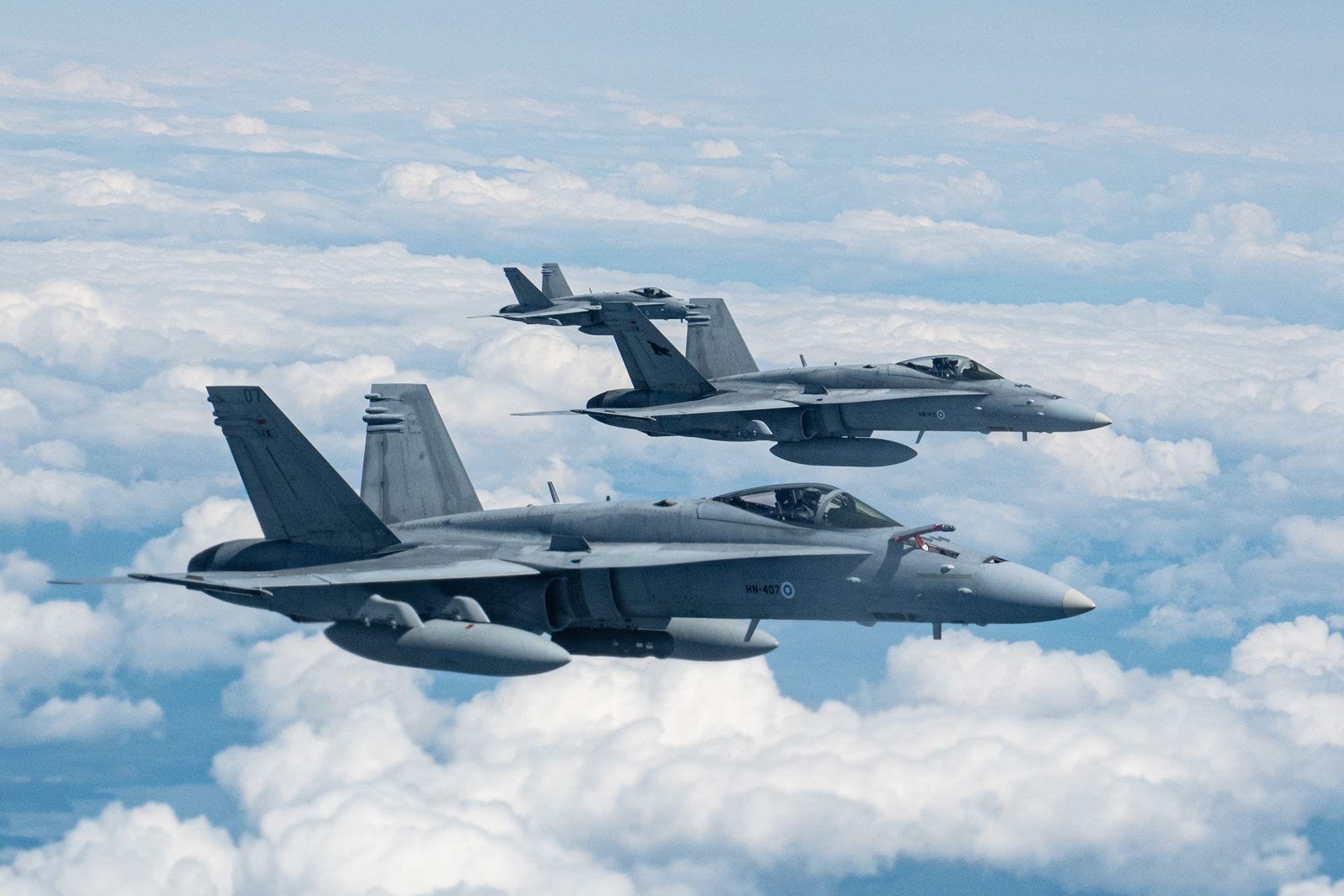
NATO officials praise the addition of Sweden and Finland into the alliance. The two asked to join NATO after Russia’s invasion of Ukraine. Both nations have long practiced dispersed operations, used hardened facilities, and focused on austere operations. Now the rest of the alliance is learning from their experience—prompting some to see the additions in new light.
“NATO joined Sweden and Finland,” quipped Vice Adm. James Morley, the British Deputy Commander of NATO’s Joint Force Command Norfolk, which oversees alliance operations in the Arctic, U.K., and Nordic countries. “The combat power that these nations brought into the alliance was significant at the time; it wasn’t that it was just an additional liability for NATO.”
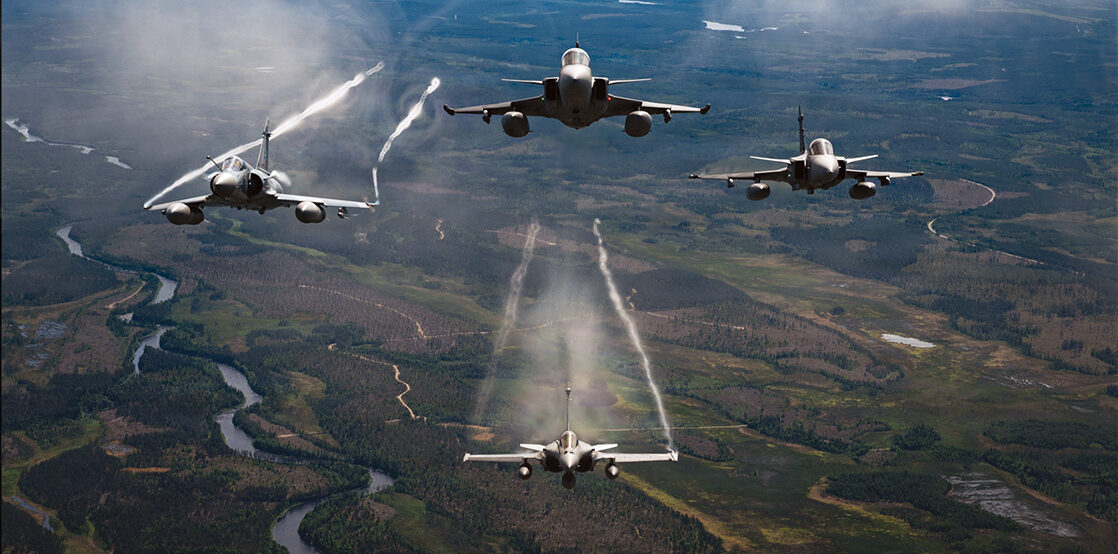
Europe’s airpower was on display in June during Ramstein Flag, a NATO exercise where allied air forces practiced defending Europe’s frontiers. Air & Space Forces Magazine observed the exercise, which was planned before the U.S. announced its European cutbacks.
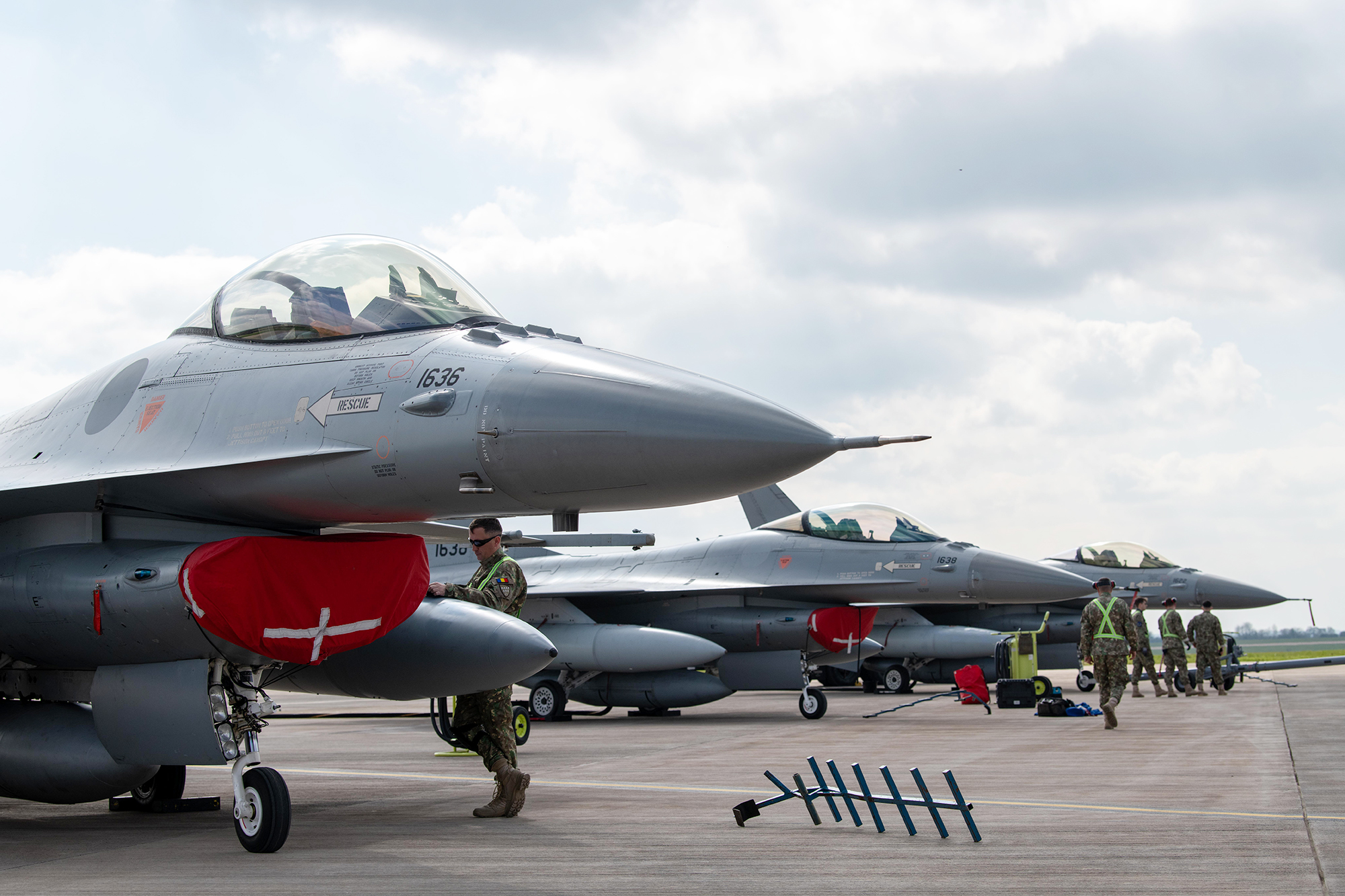
With many U.S. air assets supporting the war and post-war operations in Iran, European air forces fielded most of the 200-plus aircraft that took part in the exercise, with Norway, Sweden, and Finland playing the principal role in the north. Of some 180 fighter aircraft, only 20 were American F-35s—including 12 U.S. Air Force jets and eight from the Marine Corps. The remainder belonged to other NATO members. Many of NATO’s European allies are acquiring F-35s, including the United Kingdom, Italy, Norway, the Netherlands, Denmark, Belgium, Poland, Germany, Finland, Canada, the Czech Republic, Romania, and Greece. The scale of that buy across so many forces puts Europe in good position to pick up much of the slack. But replacing other non-fighter American assets, especially air-to-air refueling, is another matter.
That tanker crunch was evident during Ramstein Flag. With much of the U.S. tanker and bomber force supporting operations against Iran, just one Air Force KC-135 tanker took part in the exercise.
European partners’ Airbus A330 Multinational Multi-Role Tanker Transport (MRTT) aircraft picked up some of the slack, including ones operated by individual allies and alliance-
operated aircraft. NATO’s MRTT planes, which will eventually number a dozen aircraft, are part of a “pooling and sharing” arrangement among the allies. The alliance announced it is launching a similar plan for the Airbus A400 transport aircraft. To handle the rest of the refueling, operations took place on the ground, a model suited to the region’s geography, provided more bases can be set up to support it.
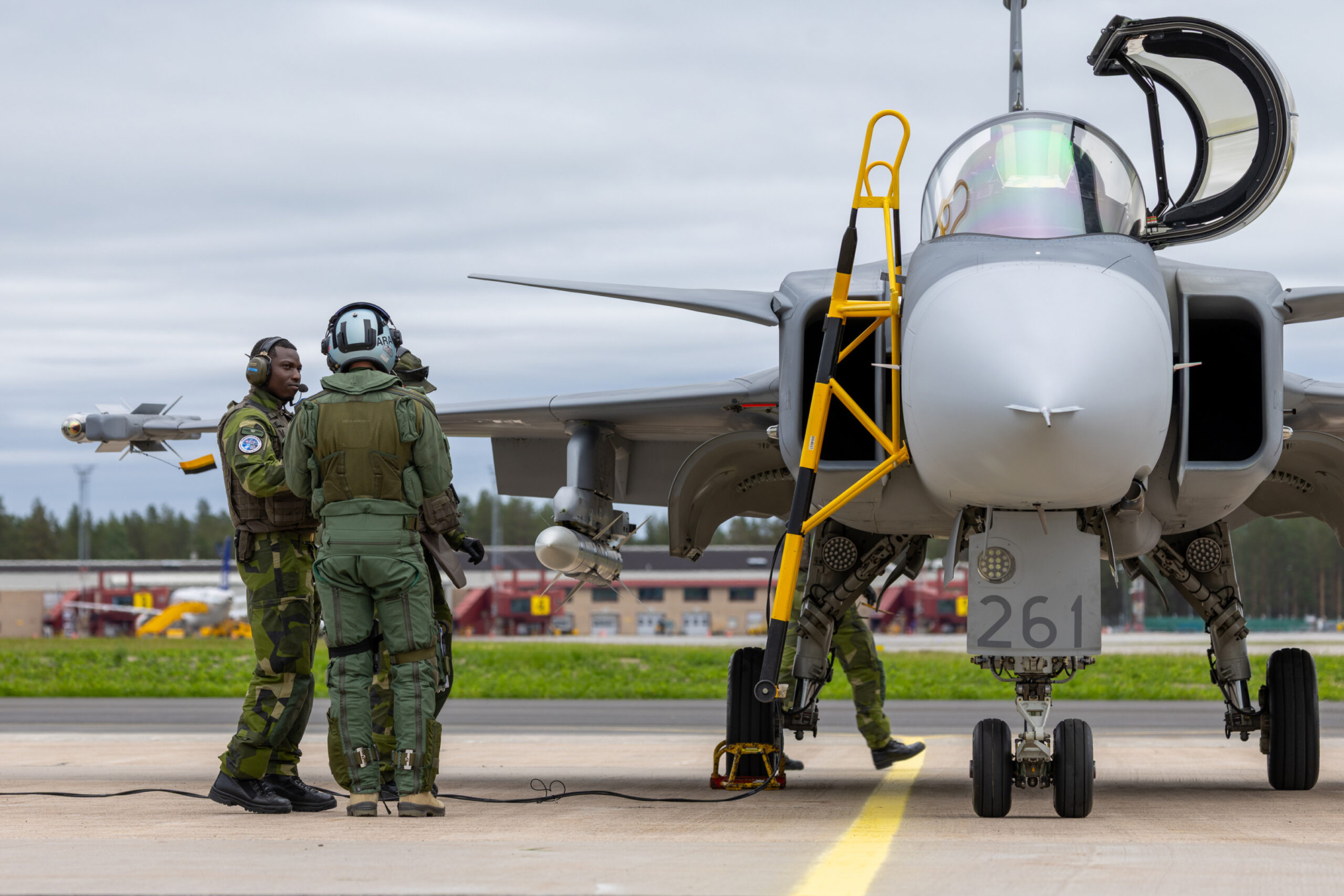
“When you have a shortfall of tankers, then we take advantage of 40 air refueling points that are scattered throughout the Scandinavian [nations] and also scattered throughout the center part of Europe,” said Hinds during the exercise, at a stop in Luleå Air Base in Sweden’s Arctic Circle. “That gives you the benefit of being able to fight, enter the combat zone, land at a different location, refuel, potentially even rearm.”
A short time earlier a Gripen fighter jet had been refueled and rearmed by a small team of personnel in less than 20 minutes, a demonstration of the kind of high-speed agile combat employment envisioned by U.S. forces, as well.
At the annual summit of alliance leaders in July in Ankara, NATO members reaffirmed their commitment to funding goals set a year earlier at The Hague, which committed NATO members to spend 3.5 percent of their gross domestic product on core military capabilities by 2035, plus 1.5 percent more for broader security needs, including cyber defense, hardening of critical infrastructure, and strengthening the industrial base.
Trump called the Summit “very successful” in comments to reporters after the meeting, an assessment Grynkewich said he shared.
“President Trump said there was a lot of love in the room at the Summit,” Grynkewich told Air & Space Forces Magazine after the Summit. “I was in the room, and it was an incredible display of unity.”
“Our allies are stepping up on their investments, and fielding and providing additional capabilities to Allied Command Operations,” Grynkewich added. “This will ultimately deliver the capabilities we need to better deter and defend every inch of alliance territory, not just today and tomorrow, but well into the future.”
Other changes are in the works
The JFC Norfolk commander is currently an American, but that role will rotate to the U.K. in the fall, part of a change in NATO’s command structure in which European officers will lead all three Joint Force Commands and U.S. officers will lead three component commands: air, land, and maritime.
“NATO is adapting,” said Italian Adm. Giuseppe Cavo Dragone, Chair of the NATO Military Committee. “Canada and European nations are taking more responsibility.”
NATO officials have noted they are actively defending alliance territory. Allies have responded to Russian drone incursions with Eastern Sentry, a joint mission to protect NATO airspace.
“Eastern Sentry really marked, I think, a transition from air policing into the air defense mindset,” Stringer said. “The activities we do are generating readiness and capability in forces. They reassure our nations and their people that actually the alliance is out there defending and deterring every day. And it’s making sure that our adversaries get the message that whilst we are a defensive alliance, we are deadly serious about protecting all our people.”
Another important shift, notes Gen. Markus Laubenthal, Grynkewich’s German chief of staff at SHAPE, is allies’ recognition of the urgency for change. The time for action is now, he said.
“Transformation for us never stops. This permanently continues—but as Chief of Staff, I need to give the staff and the [Allied Command Operations] commands clear direction and guidance,” Laubenthal said. “Therefore, I declared the ‘transition to warfighting headquarters’ over. I said we are a warfighting headquarters—if you wish or not. If you are asked tonight, we must perform tonight.”