
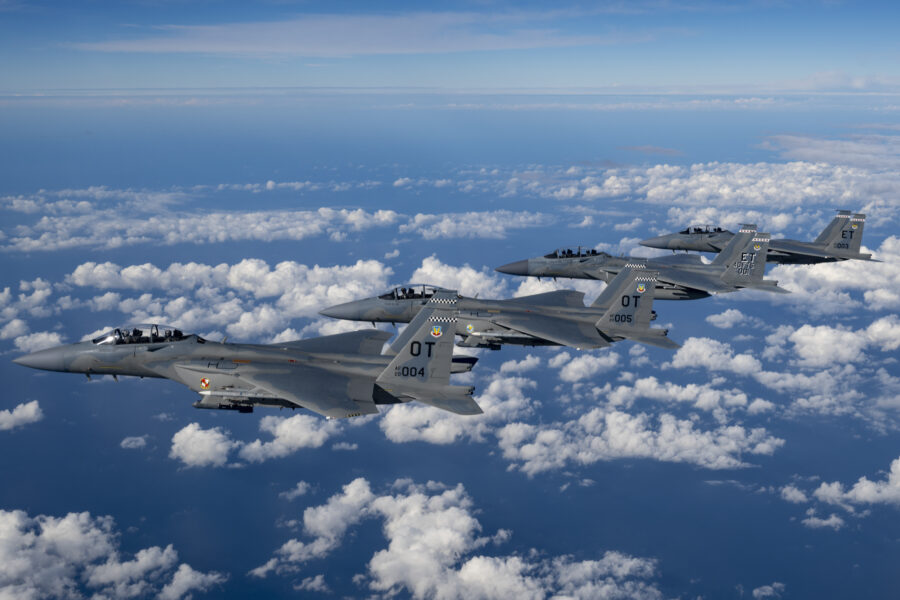
A new bipartisan bill would increase the minimum number of fighter jets the Air Force must keep and give service leaders more flexibility to buy additional jets.
The Airpower Acceleration Act, sponsored by Sen. Ted Budd (R-N.C.) and Sen. Jeanne Shaheen (D-N.H.), is part of a trio of bills intended to strengthen the combat air forces. The other measures focus on improving incentives to retain trained aircrew and to increase career flexibility for certain in-demand Airmen.
“The future of American military dominance relies on maintaining our air superiority, and the path forward is clear—rebuild our Defense Industrial Base through restoring our combat aircraft forces and retaining experienced aviators,” Budd said in a release.
The Airpwer Acceleration bill would:
- Empower the Air Force with the authority to award multiyear procurement contracts for the F-35 and F-15EX fighters, enabling the service to drive down cost by providing suppliers with greater predictabilit.
- Extend until Oct. 1, 2035 the requirement that the Air Force must have 1,800 total fighter aircraft it its inventory. The measure had been set to expire on Oct. 1, 2026.
- Set 1,369 as the minimum number of combat-coded fighters the Air Force must have by the end of 2030 and raise that figure to 1,558 by the end of 2035,
- Authorize the Air Force to acquire up to 329 F-15EXs, nearly 100 more than now planned.
Christian McMullen, a spokesperson in Budd’s office, told Air & Space Forces Magazine that the bill is necessary because significant advances in China’s military capabilities, especially in sixth-generation fighter production, threaten U.S. air superiority.
“There is bipartisan concern about the overall state of our fighting force in the air, especially as it would pertain to a China threat,” McMullen said.
That bipartisan support is evident in the bill’s cosponsors, which include Sens. Angus King (I-Maine), Eric Schmitt (R-Mo.), Tim Sheehy (R-Mont.), Mike Rounds (R-S.D.), and Kevin Cramer (R-N.D.).
Air Force Secretary Troy Meink thanked the senators for the legislative package in a social media post, writing that “these measures will close critical gaps in both equipment & manpower while enhancing the quality of life for the entire force.”
Combat-Coded Aircraft
The Air Force fighter inventory enshrined in law requires the service to maintain a force of 1,800 fighter aircraft, 1,145 of which must be in the “Primary Mission Aircraft Inventory.”
The PMAI is “what you’re going to take to war,” summed up Matt Donovan, former Undersecretary and Acting Secretary of the Air Force and a former professional staff member for the Senate Armed Services Committee who helped craft the original requirement.
In an August 2025 report to Congress, however, the Air Force adopted a different measure for its count, which it dubbed Combat-Coded Total Aircraft Inventory. The new metric lumps together PMAI, backup aircraft inventory, and attrition reserve into a single category.
While Donovan and others critiqued the change, saying it appeared to mask the true state of the fighter fleet, Budd and Shaheen accepted the combat-coded metric for their bill. McMullen said lawmakers are simply aligning their language with the Air Force’s combat-coded terminology to indicate how many aircraft would be on hand in a national crisis.
The size of the combat-coded inventory required by the bill, however, is greater than the projected numbers from the Air Force’s 2025 report; in that document, officials predicted a combat-coded inventory of 1,304 fighters in fiscal 2030, which would be 65 short of the 1,369-airframe requirement in the bill.
The Air Force projection did not include the F-47, which is scheduled to have its first flight in 2028 and seems likely to still be in development by 2030, or the A-10, which the service just extended to 2030 and could help it meet the minimum, noted Donovan.
While lawmakers are using the combat-coded metric, McMullen said the bill would not change the Air Force’s model for calculating personnel, parts, and all funding to sustain aircraft using PMAI. That’s important, Donovan said, given the need to improve readiness.
“It really comes down to readiness and aircraft availability, right?” Donovan said. “You can have 10,000 airplanes, but if you can only fly, say, 2,000 because that’s all the parts you have and all the maintainers you have to take care of them, then the overall aircraft inventory is kind of moot.”
Multiyear Procurement
The bill’s provision to permit multiyear procurement for the F-35 and F-15EX could save money and strengthen the defense industrial base with a more predictable record.
Multiyear procurement allows the Pentagon to award contracts covering two to five years’ worth of procurement for a piece of equipment.
The Pentagon has been ramping up its use of multiyear procurement as of late, focusing mostly on boosting munitions production. In an April 21 budget briefing, Maj. Gen. Frank R. Verdugo, deputy assistant secretary of the Air Force for budget, said the service is “sending an unmistakable demand signal to industry and expanding multiyear contracts for next-generation technology.”
A week prior, Air Force Secretary Troy E. Meink told reporters at the Space Symposium that the department was exploring multiyear procurement for aircraft as well, and nearly two dozen National Guard adjutants general signed a letter to Congress earlier this month endorsing multiyear procurement for the Air Force to acquire between 72 and 100 new F-35s and F-15EXs annually.
According to a 2025 Congressional Research Service report, multiyear contracts can save the government between 5 and 15 percent. The forthcoming deal for Lot 20 of F-35 aircraft could be a multiyear contract, but that is not confirmed.
F-15EX
The final section of the Airpower Acceleration Act focuses specifically on the F-15EX, the upgraded version of the fourth-generation F-15 that features advanced avionics, fly-by-wire controls, and improved electronic warfare capabilities.
The bill says the Air Force “may” increase the F-15EX fleet size to 329 aircraft, but also includes further direction on how the Air Force must allocate any extra F-15EXs it buys.
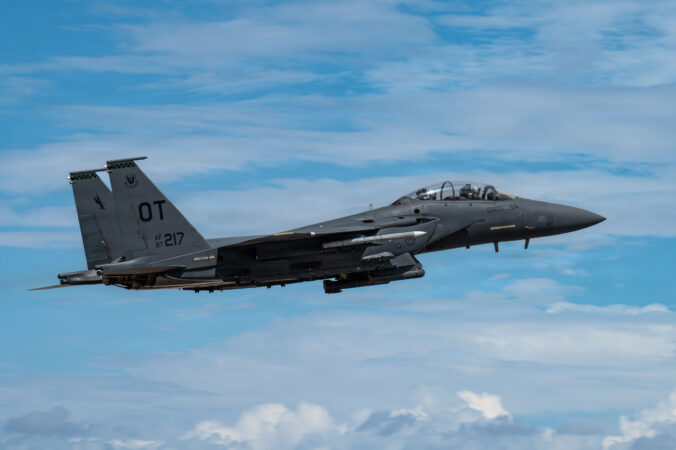
Any EXs beyond the initial 129 the service has put on contract must go toward replacing the F-15E, the bill states.
“This aligns with where the Air Force wants to take the Strike Eagle fleet,” McMullen said.
Indeed, a service spokesperson told Air & Space Forces Magazine this week that the Air Force is increasing its planned F-15EX fleet to 267 airframes, to “complete building existing F-15EX units and then begin to recapitalize the aging F-15E fleet.”
The service currently has 216 F-15Es in its inventory and previously outlined plans to retire all but 99 of them, keeping only E models with the newer F100-PW-229 engines. Budd, who represents an F-15E base in Seymour Johnson Air Force Base, and other lawmakers moved to block those retirements, but in its fiscal 2027 budget request, the Air Force is trying once again to divest 20 F-15Es.
The new bill signals Budd is willing to permit those retirements to go through if the jets are replaced by F-15EXs.
“For the F-15EXs, there is a downstream effect,” McMullen said. “According to the Air Force’s plans, the F-15EX will hopefully arrive at Seymour Johnson in the early 2030s. But we need more EXs now, given the China buildup and a potential invasion of Taiwan.”
Next Steps
While Budd and Shaheen have amassed five cosponsors on the Airpower Acceleration Act, the bill is unlikely to proceed as a standalone piece of legislation. Rather, Donovan noted that it’s more likely the lawmakers will try to get the bill’s text into this year’s version of the annual defense policy bill.
Members of Congress are expected to mark up that National Defense Authorization bill in the coming weeks, starting a process that can take months. The NDAA, as the bill is often called, is considered must-pass legislation.
