
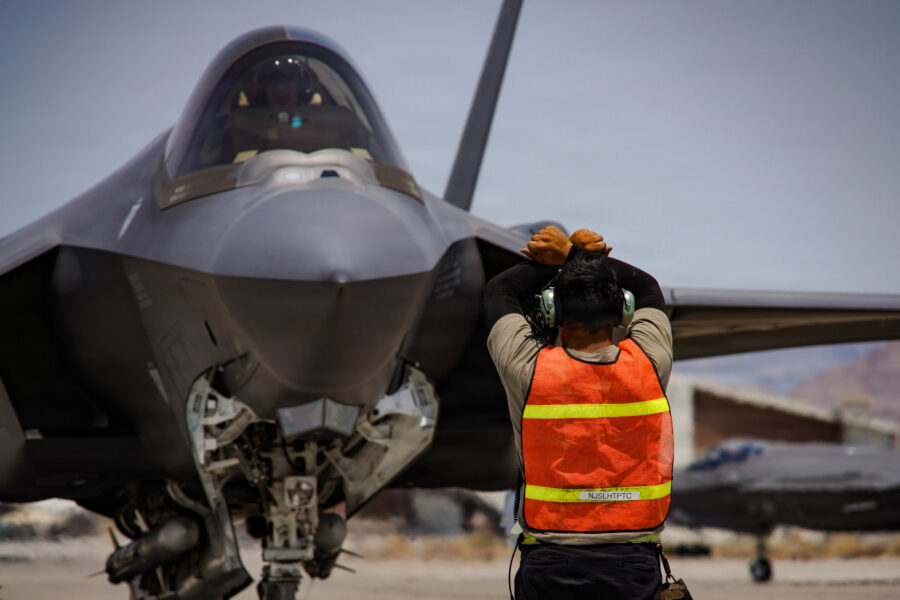
The base cost of an F-35A, the Air Force variant of the Joint Strike Fighter, is going up 11.5 percent from $82.5 million to $92 million for the latest lots of the fifth-generation aircraft, Air & Space Forces Magazine has confirmed.
A spokesperson for the F-35 Joint Program Office gave cost estimates for each F-35 variant, averaged across Lots 18 and 19, in current-year dollars. A recent Pentagon acquisition report gave the estimates in 2012 dollars, when the program was rebaselined. The new figures give insight how inflation is affecting the program.
Manufacturer Lockheed Martin lists the price of F-35 variants for Lots 15 through 17 on its website.
| Variant | Lots 15-17 | Lots 18-19 | % Change |
|---|---|---|---|
| F-35A | $82.5 million | $92.0 million | 11.52% |
| F-35B | $109 million | $121.4 million | 11.38% |
| F-35C | $102.1 million | $110.8 million | 8.52% |
The totals are average flyaway costs, which refer to all the basic costs it takes to produce one aircraft. The JPO confirmed those price tags include the cost of the jets’ engines and radars, which are provided to manufacturer Lockheed Martin as government-furnished equipment.
The cost of the F-35A went up the most in recent lots, at 11.5 percent, with the F-35B almost identical in terms of percentage growth. The F-35C went up the least, at just 8.5 percent.
But the F-35A remains the cheapest and least complex variant of the three. The F-35B—the short takeoff and vertical landing variant flown by the Marine Corps—is the most expensive and complicated, given its unique swiveling engine nozzle and hovering capabilities. And the F-35C, flown by both the Marine Corps and the Navy, is closer in price to the F-35B and has bigger wings than the F-35A to help with carrier landings, as well as folding wingtips to help with storage in close quarters.
The revelation of the price tags for the F-35s’ upcoming lots—the highest in the nearly $2 trillion program’s history—follows the Pentagon’s release of a modernized selected acquisition report which said the total estimated acquisition cost for the F-35, including both airframes and engines, had grown more than 10 percent to $536.2 billion.
The selected acquisition report, which was released in August, pointed to inflation and critical upgrades as causes of the F-35’s cost growth. But the report only included flyways costs for the three variants in 2012 dollars, leaving the full effects of inflation unclear. Those costs were:
- $78 million for the F-35A, up 7.3 percent from the previous report in 2023.
- $110.3 million for the F-35B, up 10.5 percent from the previous report.
- $93.4 million for the F-35C, up 6.6 percent from the previous report.
The fact that the actual costs are seeing greater percentage increases could suggest inflation is having a significant effect on the jet’s price tag.
Lockheed officials have been sounding warnings about the growing effects of inflation on the F-35 for some time now.
Greg Ulmer, then-president of Lockheed Martin Aeronautics, told Defense One in July 2024 that keeping the F-35’s price under the rate of inflation would be challenging for Lots 18 and 19.
“Inflation is real,” Ulmer said at the Farnborough Air Show in England. “The cost of raw materials has gone up. The cost of everything has gone up, so there is just inflation pressure in the system.”
The JPO, Lockheed, and other F-35 contractors have also been working on adding more capabilities to the jet, including additional computing and processing power under the Technology Refresh 3 program and additional weapons, sensor, and sensor fusion capabilities as part of the Block 4 effort.
The JPO pointed to information in the selected acquisition report when asked for comment on the Lots 18 and 19 cost growth. Lockheed Martin said in a response to a query that the recent acquisition report shows the program is moving into full-rate production, resuming high-volume development deliveries, and growing globally.
“It also shows that the hard work has shifted from proving the basic aircraft to executing major modernization, improving fleet readiness, and controlling long-term sustainment and integration costs,” a Lockheed spokesperson said.
The JPO had previously declined to release the cost for each variant in current-year dollars and said those numbers were considered controlled unclassified information. The office eventually released the figures after further queries from Air & Space Forces Magazine.
The JPO and Lockheed Martin in September 2025 struck a final “definitized” deal for Lots 18 and 19, which would buy 296 fighters for nearly $24.3 billion. That deal was for just the airframe and did not include engine costs, meaning the average cost of just the airframe across all variants will be $82.4 million.
