
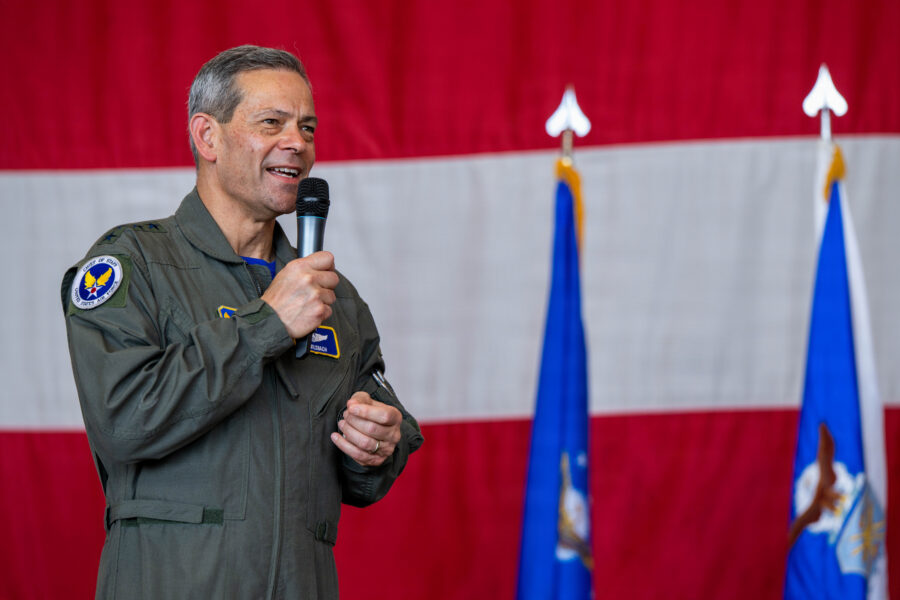
LONDON—Air Force Chief of Staff Gen. Kenneth S. Wilsbach said July 16 that the airpower contribution of allied nations is vital for deterring adversaries and endorsed deeper interoperability between the U.S. and its partners.
“The most effective airpower is combined airpower,” Wilsbach told the assembled military brass at the Global Air and Space Chiefs Conference here. “When allied and partner air forces operate together, we create options, dilemmas, and effects that no nation can generate independently.”
Wilsbach spoke as NATO is going through a major transformation, with European nations trying to backfill reduced American air and ground force contributions to defense of the continent.
Those steps are in line with the National Defense Strategy, which stated in January that the U.S. allies were in a position to assume “primary responsibility for Europe’s conventional defense, with critical but more limited U.S. support.”
Yet Wilsbach signaled the U.S. will remain involved in defending the alliance and that ensuring interoperability is fundamental to NATO’s success.
“Deterrence is often measured in numbers of aircraft, missiles, satellites, or military personnel,” said Wilsbach.
For example, the number of high-end military aircraft in Europe is increasing. Currently, there are 254 F-35s in Europe—54 of them American—a number which is projected to rise to around 720, at least based on current plans.
But Wilsbach said the alliance is about more than exquisite platforms.
“One of the most powerful deterrent signals we can send is demonstrating that free nations are united, capable, and prepared to act together,” he said. “A coalition that can rapidly generate combat power across multiple domains and theaters presents a challenge that any potential adversary must carefully consider.”
Interoperability, Wilbach added, has long been focused on ensuring that nations have common procedures, tactics, and communications that are compatible. But he underscored that it is more than that.
“Future conflict demands that we expand our thinking, to include how we share information, make decisions, and how quickly we can translate awareness into action,” said. “In an increasingly contested environment, speed is critical. The force that can understand a situation, make better decisions, and act first will possess the advantage.”
Touting the value of interoperability, Wilsback pointed to an example from the Pacific theater, where Koku Jieitai refuelers in Japan were recently certified to perform hot-pit refueling of U.S. aircraft. “The capability reduces turnaround times, streamlines logistics, and increases operational tempo.”
Citing an example in Europe, he also noted Exercise Steadfast Dart, which he said “validated the ability of European allies to rapidly mobilize, command, and sustain combat forces.
“By successfully deploying forces across multiple borders and merging land, maritime, and air capabilities, the exercise proved that common procedures and [command and control] structures enable a cohesive, combat-ready force,” he added.
Wilsbach also noted that air operations are enabled by other domains—when asked about the future of air superiority, he quickly cited the need to invest in space capabilities, a focus heavily championed by outgoing Chief of Space Operations Gen. B. Chance Saltzman.
“I’m his biggest cheerleader because I need him to get those capabilities because there are so many things that the Air Force requires the Space Force to do,” Wilsbach said in an interview with Air & Space Forces Magazine, citing GPS, data links and satellite communication, intelligence, and more space capabilities that “finish the kill chain.”
“All those things are happening in space in the 21st century, and if you don’t have that, then you’re going to have difficulty doing any kind of military operation,” Wilsbach said.
