
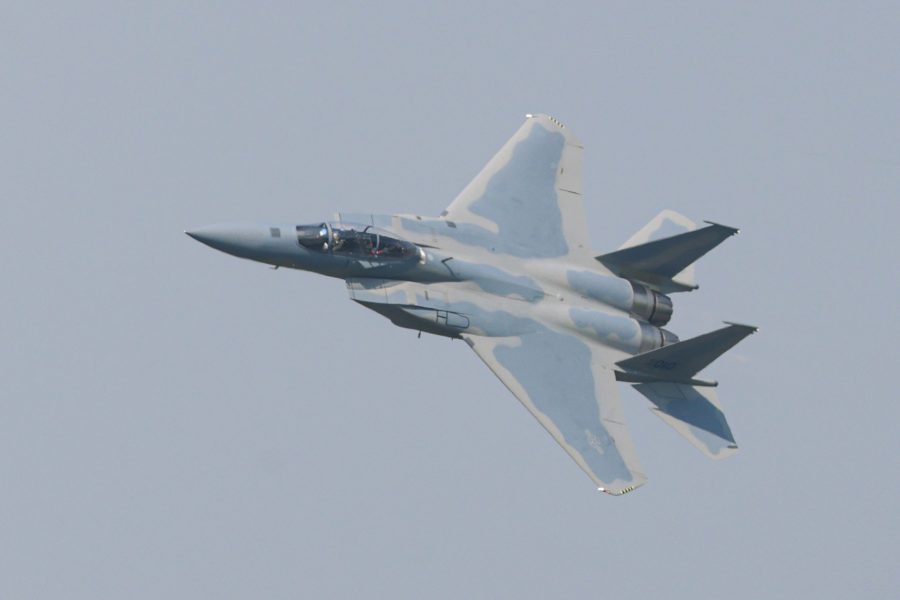
Repeated delays to critical F-35 upgrades helped drive the Air Force to more than double its planned fleet of F-15EX Eagle II fighters, a top official said May 12.
The total buy of F-15EXs—an advanced version of the F-15E Strike Eagle made by Boeing—has fluctuated in recent years, most recently increasing from 129 to 267 as part of the fiscal 2027 budget proposal.
When the budget was released in April, an Air Force official said the service needed to buy both F-15EXs and F-35A Joint Strike Fighters to have a balanced fighter portfolio, with a range of capabilities including differing weapons capacities and ability to respond to a fight in the Pacific theater.
In a May 12 Senate Armed Services air-land subcommittee hearing, Lt. Gen. David Tabor, deputy chief of staff for plans and programs, expanded on the Air Force’s decision to boost its F-15EX fleet, and said the F-35’s behind-schedule Technology Refresh 3, or TR-3, and Block 4 upgrades were a factor.
“As we encountered some slowdowns in deliveries of F-35s due to the previously discussed TR-3 and Block 4 upgrade issues, it became apparent to us that we needed another fighter capacity,” Tabor said. “This, in conjunction with a lot of the work that has been done in force design and the capabilities of the F-15 and what that provides to us in the pacing challenge, [or China,] made it a very obvious choice.”
The F-15EX production line is already up and running, which he said will allow the service to replace some of its older F-15Es.
“So, that all kind of came together to lead to this decision,” Tabor said.
The Air Force originally planned to buy up to 144 F-15EXs when it awarded Boeing the first contract in 2020. But since then, its procurement forecasts have varied considerably, first down to 80, then to 104, and then to 129 before the most recent change.
Tabor said the Air Force’s plan to buy 104 F-15EXs was derived from an intention to replace the aging F-15Cs at Air National Guard bases, and described that limit as one “we kind of artificially held ourselves to.”
But factors including a monthslong strike in 2025 at Boeing’s St. Louis, Mo., plant, where F-15EXs are built, have slowed deliveries of the Eagle IIs. That has in turn had follow-on effects, such as requiring the Air Force to temporarily deploy F-22 Raptors to Kadena Air Base in Japan while the base awaits its permanent F-15EXs.
Tabor told lawmakers that the Air Force, the Pentagon, and Boeing are now in the middle of negotiations to find ways to accelerate F-15EX production as much as possible.
Lt. Gen. Luke Cropsey, military deputy to the Assistant Secretary of the Air Force for Acquisition, Technology and Logistics, said Boeing is not yet able to produce two F-15EXs a month on its single production line, as required under contract, but the service is having conversations with the firm on how to reach that cadence.
Cropsey said Boeing has offered a plan to get to two a month, which he called “a well thought-out plan.” The company also has a roadmap to eventually get to three or four fighters a month, with the help of additional infrastructure and capital investments in St. Louis. That plan includes standing up one or two additional production lines, he said.
“From an acquisition standpoint, we’ve got some work to do ahead of us to be able to get to the ramp rates that we’re talking about,” Cropsey said. “But I think Boeing is actively in good faith working with us to figure out what that would look like.”
