
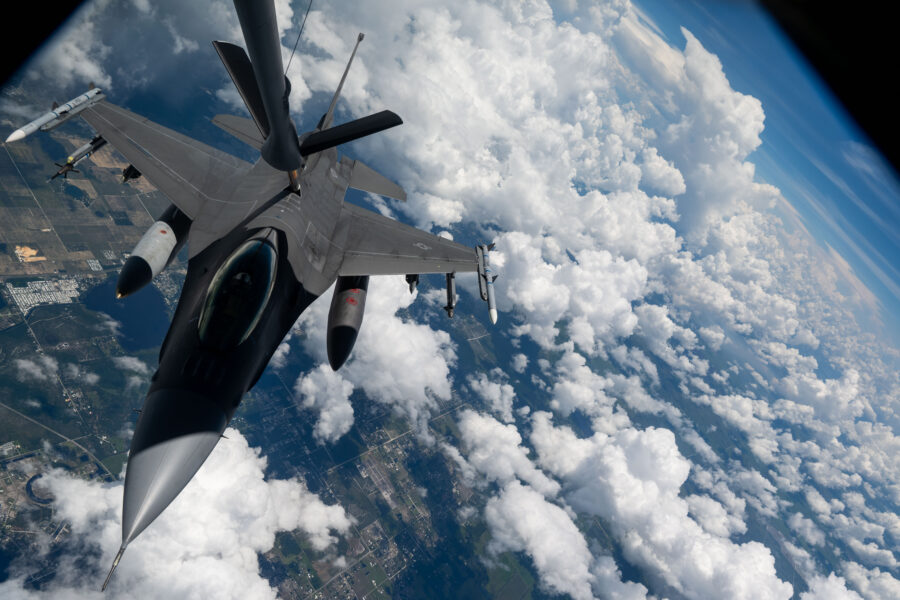
The Air Force wants to replace 24 F-16 Fighting Falcons at Homestead Air Reserve Base in Florida with an equal number of F-35A Lightning IIs.
The Department of the Air Force tapped Homestead as its top candidate for to host the next round of Air Force Reserve F-35s, it said in a May 8 release. Now, it will go through the strategic basing process and an environmental impact analysis to evaluate the potential recapitalization of the two dozen Reserve F-16s at Homestead.
If the Air Force ultimately decides to replace Homestead’s F-16s with F-35s, the plan is to reach initial operational capability in fall 2034 and full operational capability the following year.
Homestead, located near Miami on the southeastern tip of Florida, is the home of the 482nd Fighter Wing and its F-16Cs, as well as more than 1,700 personnel.
The office of Rep. Carlos Gimenez, R-Fla., who represents the district containing Homestead, said in a May 8 statement that the announcement is “a major step toward recapitalizing the 482nd Fighter Wing and strengthening South Florida’s national security infrastructure.”
“When I was first elected to Congress, there were disturbing plans to scale back operations at Homestead Air Reserve Base in our district,” Gimenez said in the statement. “I joined the [House] Armed Services Committee, worked with the Air Force and the Trump administration to secure a new mission at the base.”
The 482nd’s F-16s are “aging,” Gimenez said, and recapitalizing the wing with two dozen F-35s is necessary to “ensure our community is protected from any nefarious threats posed by foreign adversaries,” such as Cuba.
Currently, the 301st Fighter Wing at Naval Air Station Joint Reserve Base Fort Worth, Texas, is the only standalone unit in the Reserve to have the F-35A.
The fighter units of the Air Force Reserve, as well as the Air National Guard, are critical to the Air Force’s ability to project airpower around the globe. But their aircraft are increasingly old and out of date, and have not been modernized at the same pace as the Active-Duty.
Air Force Reserve Chief Lt. Gen. John P. Healy said at AFA’s Warfare Symposium in February that more than 80 percent of Reserve aircraft have limited lifespans. Some Reserve units—including units with extensive combat experience—are scheduled to see their fighters retire without any plan to replace those tails, Healy said.
In April, nearly two dozen National Guard adjutants general signed a letter to lawmakers urging Congress to provide the Air Force multiyear funding to buy between 72 and 100 new fighters annually, to modernize the Air Force’s active duty, Guard, and Reserve units.
Air Force F-35 Locations
| Edwards Air Force Base | California | Active | 2011 |
| Eglin Air Force Base | Florida | Active | 2011 |
| Nellis Air Force Base | Nevada | Active | 2013 |
| Luke Air Force Base | Arizona | Active | 2014 |
| Hill Air Force Base | Utah | Active | 2015 |
| Burlington Air National Guard Base | Vermont | Guard | 2019 |
| Eielson Air Force Base | Alaska | Active | 2020 |
| Royal Air Force Lakenheath | UK | Active | 2021 |
| Truax Field Air National Guard Base | Wisconsin | Guard | 2023 |
| Dannelly Field | Alabama | Guard | 2023 |
| Tyndall Air Force Base | Florida | Active | 2024 |
| NAS-JRB Fort Worth | Texas | Reserve | 2024 |
| Jacksonville Air National Guard Base | Florida | Guard | 2025 |
| Misawa Air Base | Japan | Active | 2026 |
| Barnes Air National Guard Base | Massachusetts | Guard | 2026 |
| Kingsley Field | Oregon | Guard | 2027 |
| Moody Air Force Base | Georgia | Active | 2030 |
| Homestead Air Reserve Base | Florida | Reserve | 2034 |
Locations in bold are planned
