
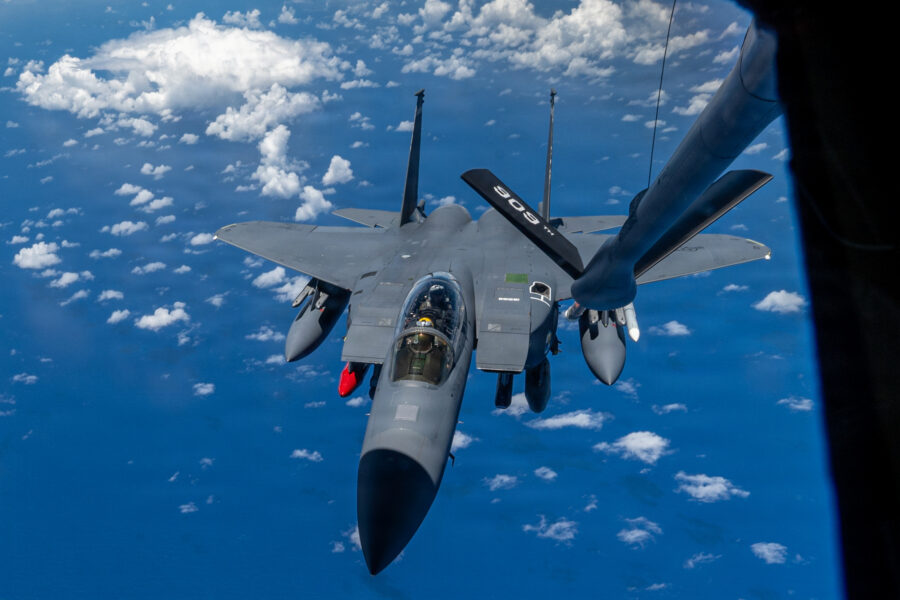
An F-15EX fighter touched down at Kadena Air Base, Japan, this week—though still not on a permanent basis.
The Eagle II is on a “visit” to the crucial Pacific base on Okinawa, according to a July 1 release from the 18th Wing, as personnel there make preparations for EXs to be permanently stationed there. That process was originally supposed to start this spring but has been pushed back to 2027.
Two F-15Es accompanied the F-15EX as it arrived June 29. It was not clear from the release how long the visit will last.
The arrival of the aircraft “marks the next phase” of the Pentagon’s initiative to replace the aging F-15C/D Eagle fleet on the island, per the release. The Air Force announced in 2024 that it would replace 48 C/Ds on Kadena with 36 F-15 EXs.
This is the second time an F-15EX has visited Kadena. Back in July 2025, two Eagle IIs arrived for integration and familiarization training.
In both cases, the visiting F-15EXs have belonged to the 85th Test and Evaluation Squadron at Eglin Air Force Base, Fla.
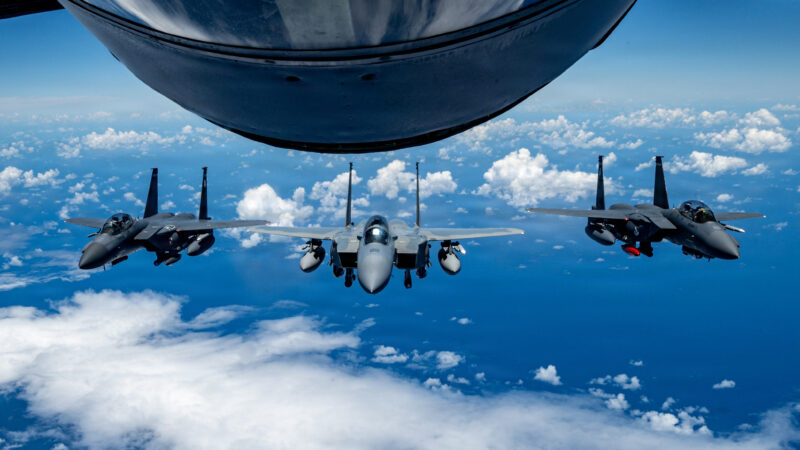
Eventually, though, the first operational EX unit at Kadena will be the 67th Fighter Squadron. That unit was all set to receive its first jets this spring and summer, but strikes at contractor Boeing’s factory from August to November 2025 caused a “significant disruption” in the fighter’s delivery schedule, Air & Space Forces Magazine previously reported.
Boeing eventually resumed deliveries of the F-15EX to the Air Force, sending numbers 14 and 15 to Portland Air National Guard Base, Ore., on Aug. 19 and Nov. 16, according to the release. The company delivered number 16 in December.
In May, Air Force Secretary Troy Meink said the first jet’s arrival at Kadena is now scheduled for 2027, with the final jet coming in 2028.
For now, the F-15EX visiting Kadena will allow pilots, maintainers, and mission support personnel to advance “tactics, maintenance procedures, and sustainment” to support the fighter jet’s future missions in the region, according to the 18th Wing release.
“The F-15EX represents the next chapter of airpower at Kadena,” said 18th Wing Commander Brig. Gen. John Gallemore. “Our Airmen have the opportunity to train with the aircraft, build confidence in its capabilities and ensure we’re ready to project lethality and integrate into operations as we continue providing combat power in support of a free and open Indo-Pacific.”
“Building familiarity with the aircraft now will help ensure a smooth transition as the Eagle II becomes part of Kadena’s long-term mission and strengthens combat readiness across the Indo-Pacific,” said Lt. Col. Casey Watts, commander of the 85th Test and Evaluation Squadron.
Boeing did not immediately respond to queries from Air & Space Forces Magazine regarding the ongoing status of deliveries and quantities of aircraft expected to be delivered in fiscal 2026 and 2027. An Air Force spokesperson also did not immediately respond to a query.
The final flight of permanently stationed F-15C/Ds out of Kadena was in January 2025. Those were the last of their kind operated by the Active-Duty Air Force. The C/D models joined the Air Force fleet in 1979 and arrived at Kadena in the 1980s.
Since 2022, in place of permanent F-15EXs, the Air Force has been rotating units through Kadena on a six-month basis with a mix of F-15Es, F-16s, F-35s, and F-22s.
The F-15EX is the newest, heavily upgraded variant of the Eagle family, with digital fly-by-wire flight controls, a large area display glass-cockpit, and a touchscreen interface. It uses the APG-82 AESA radar, EPAWSS self-defense suite, and the Joint Helmet-Mounted cueing system.
The jet is faster than earlier variants, with a longer range and a 29,000-pound payload capacity and two more weapons stations than its predecessor.
In early June, the Senate Armed Services Committee voted 18-9 to advance its fiscal 2027 National Defense Authorization bill, which included approval for the Pentagon to pursue multiyear contracts for both the F-15EX and the F-35A Joint Strike Fighter.
The advanced bill awaits a full vote by the Senate .
But the Senate committee’s language stipulated that those multiyear contracts, key to a steady flow of funding and aircraft delivery, would only be approved if the Secretary of the Air Force can ensure that Boeing will meet delivery schedules.
