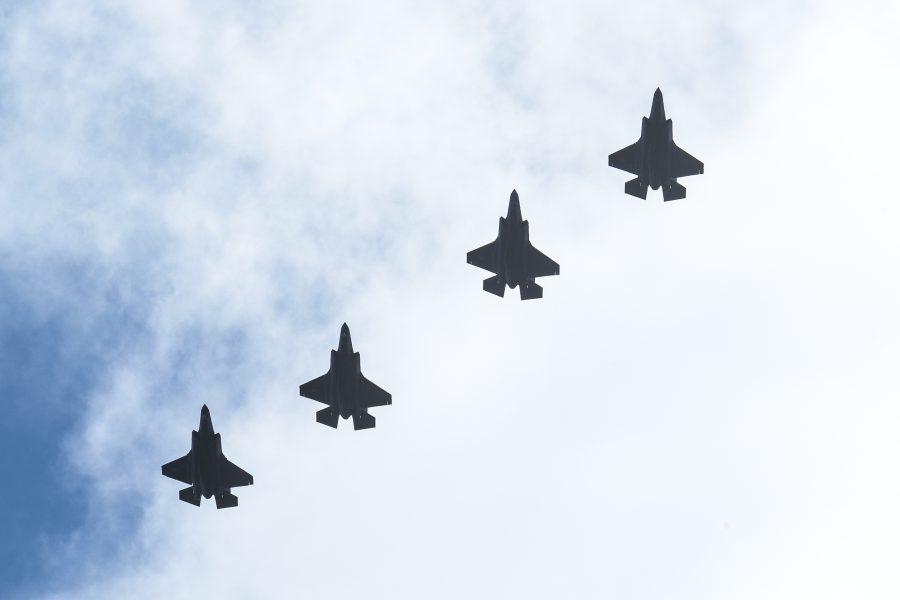
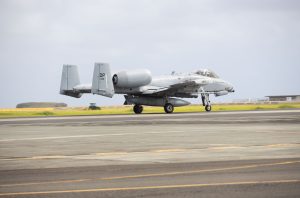
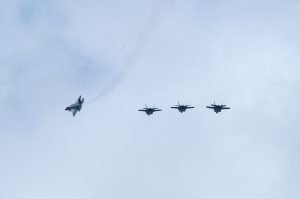
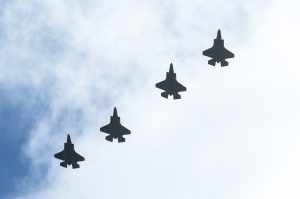
F-35A Lightning IIs, assigned to the 422nd Test and Evaluation Squadron, fly in formation above Joint Base Pearl Harbor-Hickam, Hawaii, June 3, 2024. (U.S. Air National Guard photo by Tech. Sgt. John Linzmeier)
Audio of this article is brought to you by the Air & Space Forces Association, honoring and supporting our Airmen, Guardians, and their families. Find out more at afa.org
A combination of fourth- and fifth-generation fighters will wrap up a large-scale simulated combat exercise around Hawaii in the coming days.
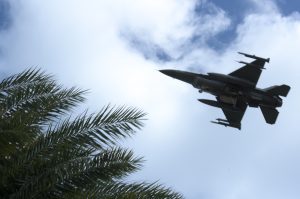
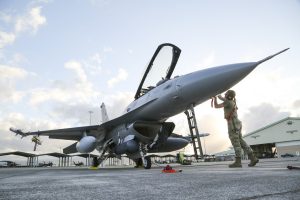
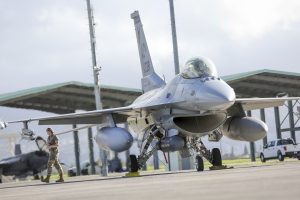
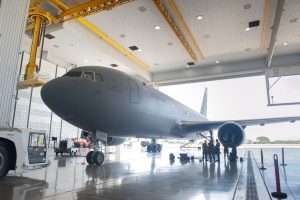
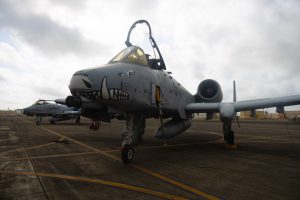
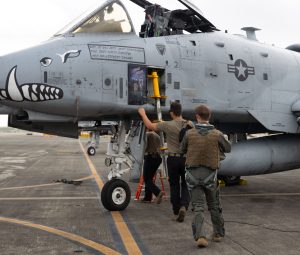
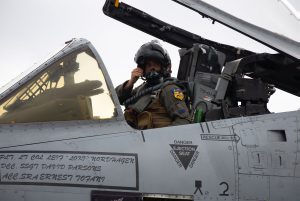
Sentry Aloha, which first began more than 20 years ago, is a fighter-focused exercise hosted by the Hawaii Air National Guard. The latest edition began May 29 and will last through June 12. F-22s from the 199th and 19th Fighter Squadrons at Joint Base Pearl Harbor-Hickam are flying alongside F-16 Fighting Falcons, F-35 Lightning IIs and A-10 Thunderbolt IIs, as well as KC-135 and KC-46 tankers and some C-130s.
The biannual fifth and fourth-gen combat training returned in January this year after a two-year break. Hawaii’s strategic Pacific location makes it an ideal military training ground as Sentry Aloha keeps growing and evolving with each iteration.
This iteration had a total of 42 aircraft from nine states, with 1,060 personnel participating. A spokesperson for the Hawaii Air National Guard’d 154th Wing confirmed the participating aircraft with Air & Space Forces Magazine:
F-22 and KC-135 from Joint Base Pearl Harbor-Hickam, Hawaii.
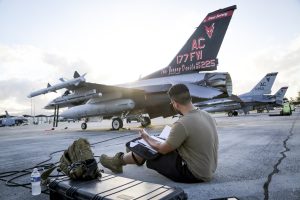
F-16 from the 177th Fighter Wing, Atlantic City Air National Guard Base, N.J.
F-35 from the 422nd Test and Evaluation Squadron, Nellis Air Force Base, Nev.
F-16 from the 162nd Wing, Tucson Air National Guard Base, Ariz.
F-16, A-10, KC-135, and HC-130J from the Air National Guard Air Force Reserve Test Center, Ariz.
KC-46 from the 157th Air Refueling Wing, Pease Air National Guard Base, N.H.
HC-130 from the 129th Rescue Wing, Moffett Air National Guard Base, Calif.
MQ-9 from Marine Unmanned Aerial Vehicle Squadron 3, Marine Corps Base Hawaii, Hawaii.
C-130H aircraft from the Air National Guard Air Force Reserve Test Center and the 189th Airlift Wing, Little Rock Air Force Base, Ark.
KC-135 from the 186th Air Refueling Wing, Key Field Air National Guard Base, Miss.
The spokesperson declined to say the number of each aircraft type, citing operational security.
The fighters and other aircraft are manuevering through Daniel K. Inouye International Airport in Honolulu, with additional operations occurring around Marine Corps Base Hawaii in Kaneohe Bay and Kona International Airport in Kalaoa, where the aircraft are staged for the training.
“The state offers great airspace and weather to maximize training such as Agile Combat Employment and distributed operations,” Maj. Michael Oliver, the exercise director and a pilot of the 154th Wing, said in a release.
The 154th Wing is the largest wing in the Air National Guard, hosting Raptors, Stratotankers, and C-17 Globemasters, backed by some 2,500 personnel. In April, the 199th and 19th Fighter Squadrons of the Wing deployed their F-22s to Kadena Air Base in Japan as part of the rotation to maintain a constant fighter presence at the key location.
Audio of this article is brought to you by the Air & Space Forces Association, honoring and supporting our Airmen, Guardians, and their families. Find out more at afa.org
Roughly two of every five fighters in the Air Force fleet could be F-35As by 2035, according to a new fighter force structure report the service submitted to Congress on Oct. 16. Lt. Gen. David Tabor, deputy chief of staff for plans and programs, revealed the new estimate during an…
The Air Force Life Cycle Management Center is moving forward with a program to upgrade a quarter-century-old computing system for some F-16 fighter jets.
The U.S. Navy on Oct. 15 accepted a C-130J-30 Super Hercules plane that it will modify to become the first of its new nuclear command, control, and communications aircraft—a route the Air Force is considering for a similar NC3 mission under congressional direction.
More than 40 years after the original YF-117 operational prototype flew test runs from a Lockheed Martin Skunk Works facility, an F-117 returned for a $1 million refurbishment to look its best when it assumes its place in history alongside other iconic aircraft on permanent exhibit at the National Air…
A U.S. Air Force F-22 pilot controlled a YFQ-44A Fury Collaborative Combat Aircraft this month while both aircraft were in flight, according to an Oct. 16 release, another milestone in the service’s ambitious CCA efforts.
The Marine Corps recently conducted its first-ever “ripple” release of eight Small Diameter Bomb IIs from an F-35B, a key early step in proving out the capability for all F-35 variants.
The Air Force will field operational prototypes for an autonomous drone to replace its MQ-9 Reaper in 2028, Secretary of the Air Force Troy Meink said Oct. 14.
One of the Air Force’s critical B-2 Spirit stealth bombers has returned to Whiteman Air Force Base, Mo., after an extensive course of maintenance to restore its stealth coating and preserve its structural integrity.
BAE Systems has received a contract from Lockheed Martin to install an upgraded Block 4 electronic warfare system into new F-35 Joint Strike Fighters, as well as to retrofit some older jets.
✓
Thank You!
Check your inbox to verify your email address and finish setting up your AFA account.
★
Welcome Back!
An account with this email already exists. Please log in to continue.
Subscribe to the Air & Space Forces Daily Report
The latest news from Air & Space Forces Magazine, as well as news from other leading publications, delivered right to your inbox every morning!
We’re sorry, there has been an error. Please review your input or try again later.