
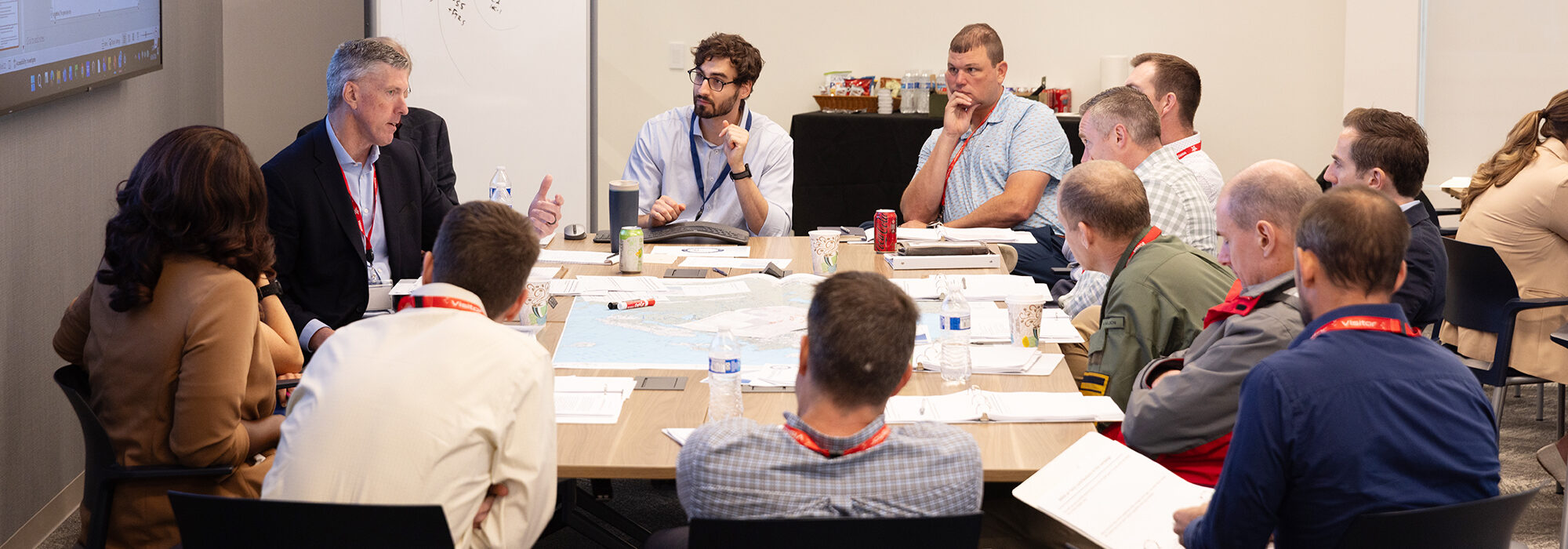
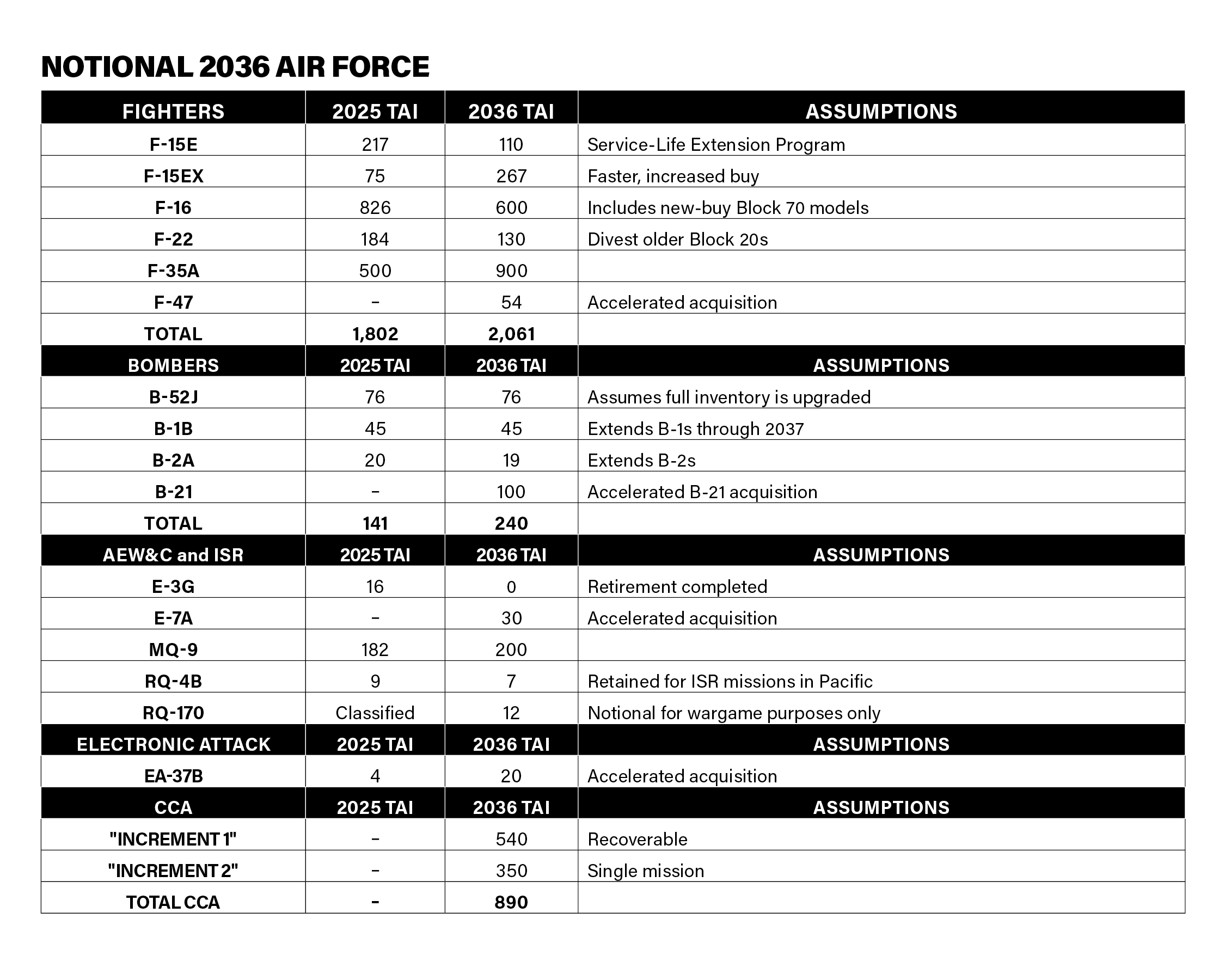
In June 2026, airpower experts from the U.S. Air Force, seven allied air forces, and industry convened for a three-day wargame designed to stress notional 2036 USAF combat forces in a series of concurrent crises: a Russian assault against NATO allies in Europe, opportunistic aggression by China in the Pacific, and attacks on the United States and Canada.
The scenario, conceived by AFA’s Mitchell Institute for Aerospace Studies, led participants to the stunning conclusion that fielding today’s planned modernization programs and modestly growing the U.S. Air Force’s size will not provide the airpower the United States would need in the event something similar came to pass. Without major investments to dramatically accelerate and increase production of the next-generation F-47 air dominance fighter, B-21 bomber, and collaborative combat aircraft (CCA), the nation may find itself grossly unprepared for future wars. The result could mean choosing between losing a major conflict in Europe, the Pacific, or both—and potentially failing to defend the United States from air attacks at the same time.
The Mitchell Institute based its wargame on the premise that deepening alignment between China and Russia today heightens the risk of multi-theater conflict in the future. These great-power aspirants are coordinating their foreign policies and defense priorities to undermine U.S. security and reshape the global order around their strategic interests. The likelihood is increasing that they will coordinate their actions to take advantage of a major U.S. military response to a crisis in Europe, the Pacific, or the Middle East. Today’s U.S. Air Force—which now operates the smallest and oldest combat force in its history—is no longer sized to fight in multiple theaters simultaneously.
The wargame did not include U.S. Navy or U.S. Marine combat aircraft.
THREE TEAMS COMPETED FOR RESOURCES
The first two days of the wargame asked players to identify USAF forces they needed to defeat aggression in their theaters and the risks created by shortfalls in available resources. Seventy airpower strategists, planners, operators, and technologists divided into three regional teams. These teams then planned air campaigns to defeat a Russian assault on NATO, deter and then counter a Chinese joint island landing campaign against Taiwan, and defend North America at the same time. Team Europe, Team Pacific, and Team North America developed operating concepts for their campaigns and requested forces and munitions from a shared pool of aircraft, including F-47, F-35A, F-15EX, CCA, B-21, B-52, E-7A, and EA-37B aircraft; as well as legacy fighters, bombers, and tankers. Allied players added their air forces to the mix to conduct combined air campaigns.
As would be the case today, the teams’ cumulative force requests far exceeded available combat aircraft inventories. Even with the nominally boosted projected future Air Force, the number of combat-capable aircraft and munitions available to the teams was far too small.
Day 1 gameplay began when Russia launched an offensive to seize a land corridor linking its Kaliningrad enclave with Belarus and cut NATO’s access to the Baltics. In the wargame’s Day 2 scenario, the PLA took advantage of U.S. force deployments to Europe to launch a campaign to forcibly unify Taiwan with China’s mainland. A third front emerged when Russian bombers launched a limited conventional cruise missile attack against targets in the United States to coerce the U.S. government into withdrawing from the fight in Europe and degrade its ability to deploy and sustain forces abroad.
On the wargame’s final day, a “strategic choices exercise” tasked each team with independently investing in U.S. Air Force capabilities over the next decade to address the highest-priority operational risks identified during the game’s first two days. The Mitchell Institute gave each team an identical 10-year budget profile that assumed the Air Force would receive annual plus-ups of $25 billion to modernize and recapitalize its forces. Investment choices available to the teams spanned the Air Force’s capability portfolios, including options to acquire additional combat and air mobility aircraft, munitions, personnel, basing infrastructure, missile defenses, and other capabilities essential to modern air warfare.
Team Europe
Team Europe’s air campaign plan prioritized rapidly suppressing Russia’s integrated air defense systems in Kaliningrad and Belarus to achieve air superiority and interdict ground forces invading Lithuania. As their campaign progressed, Team Europe planned to extend allied air superiority over the battlespace and ramp up penetrating strikes against enemy command and control nodes, logistics centers, and other high-value targets critical to Russia’s offensive.
The team estimated they would have enough forces to launch up to five surges of fighters—complemented by CCA—per day, interspersed with two or three surges of bomber strikes. Team Europe used their stealthy fighters and bombers for penetrating strikes and employed F-15EX and other nonstealthy fighters for standoff strikes and to defend against UAV and missile threats. The team assessed that they might have enough combat aircraft, munitions, and logistics to maintain their planned surges for about seven days, after which resource shortfalls would slow their tempo.
Team Pacific
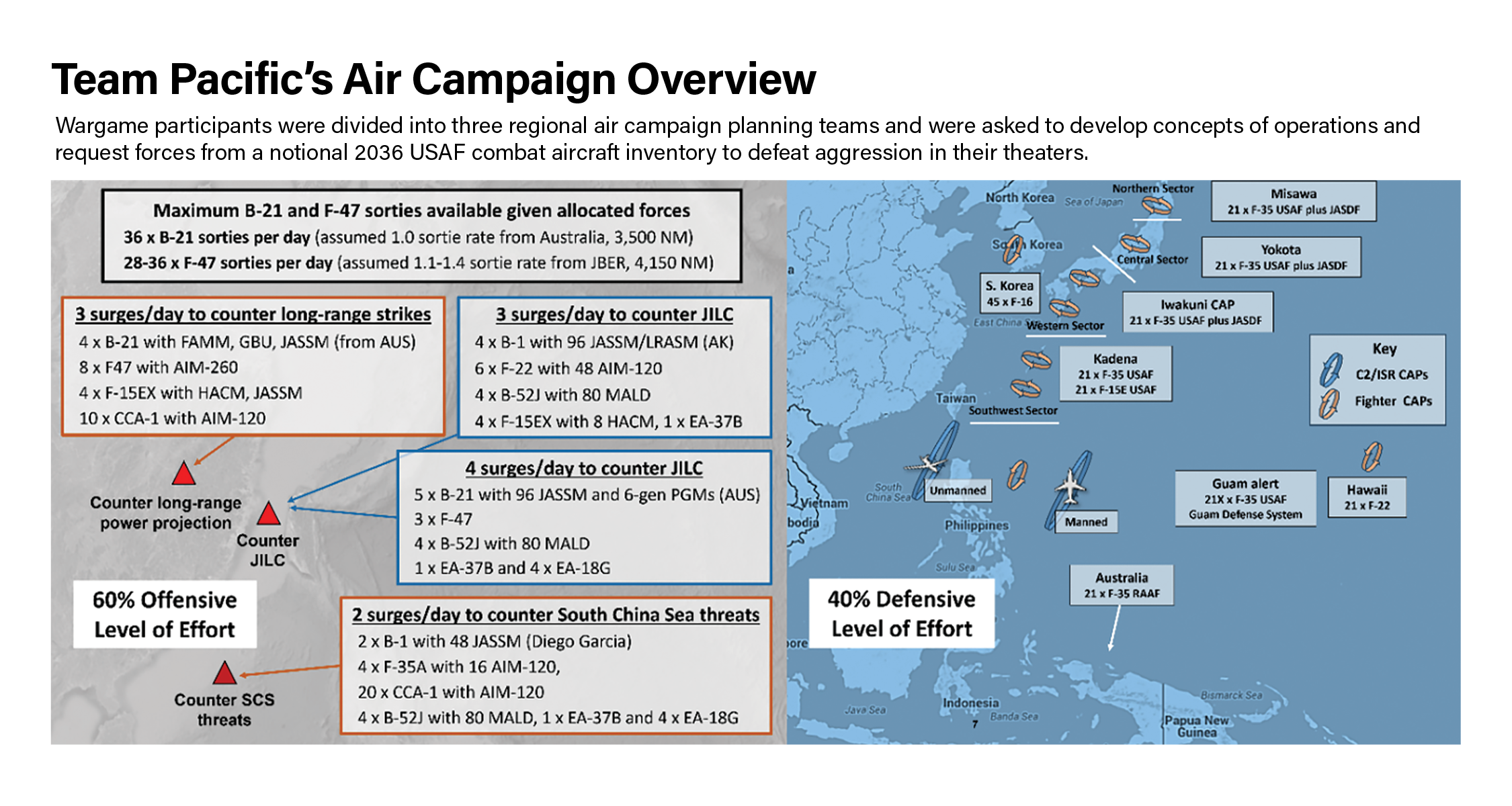
After the PLA initiated a joint island landing campaign (JILC), Team Pacific allocated most of their fighter, bomber, and electronic warfare sorties toward blunting the adversary’s offensive strikes and conducting preventive strikes to reduce long-range air and missile attacks against allied bases. The team’s priority targets included AEW&C aircraft that are critical nodes in China’s long-range kill chains, coastal IADS, PLA Navy surface action groups surrounding Taiwan, and ships transporting PLA troops to Taiwan’s shores. The team also attacked targets on China’s mainland, acknowledging that an effective integrated air and missile defense must include offensive strikes to degrade the adversary’s ability to launch bomber sorties and missile salvos from operational sanctuaries.
Team Pacific used their remaining fighters to defend allied air bases from air and cruise missile attacks and intercept threats to allied air refueling tankers, E-7A Wedgetails, and other high-value allied aircraft. The Air Force’s E-7A and MQ-9 Reapers provided a picture of the battlespace east of Taiwan and overwatch of PLA air avenues of attack against Guam. However, air operations in Europe, homeland defense requirements, and combat attrition prevented Team Pacific from achieving the attack tempo, density, and mass needed to suppress PLA operations.
Team North America
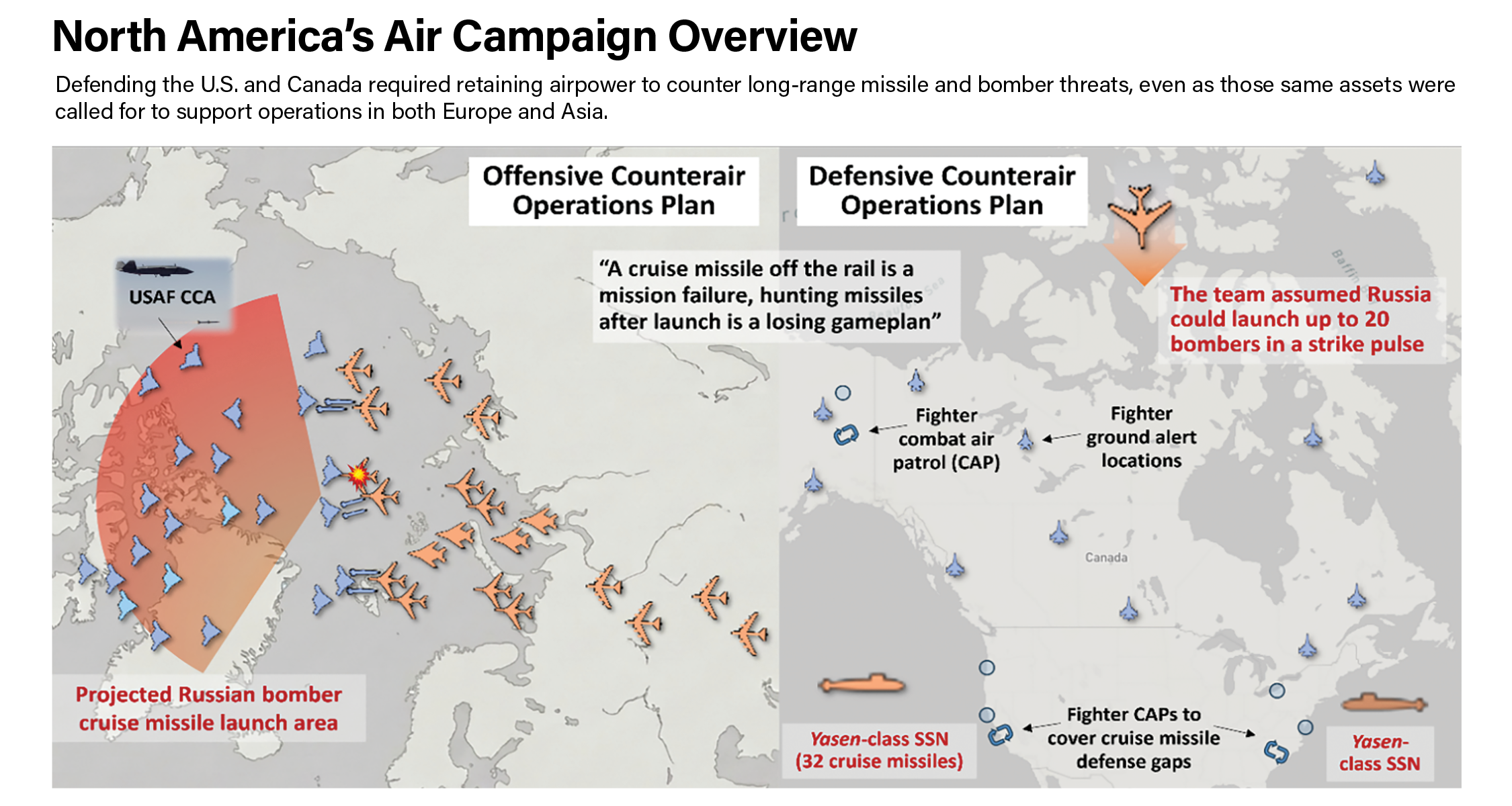
To defend U.S. and Canadian territory, Team North America prioritized offensive counterair operations to “kill the archers,” before Russian bombers could launch their “arrows.” The team used large numbers of expendable CCA as one-way, long-range aircraft to intercept inbound bombers before they could launch their cruise missiles. Given force structure shortfalls, Team North America worked across geographic boundaries to coordinate with Team Europe and Team Pacific to support the defense of North America, assigning B-21 bombers to strike bomber bases in northern and eastern Russia, respectively.
Team North America also deployed fighters across the United States and Canada to defend against air attacks. Originally, the team assessed they would need 19 continuous airborne fighter combat air patrols (CAPs) to cover gaps in cruise missile defense coverage along the southwest and southeast coastlines of the United States and over large areas in Canada’s high north. But with U.S. and Canadian forces deployed to the crises in Europe and the Pacific, Team North America found they could sustain only three CAPs. To partially make up for the shortfall, the team distributed its remaining fighters to multiple locations in Canada and the United States to act as ground alert forces capable of quickly responding to attacks.
Shortfalls and Attrition
The Mitchell Institute’s wargame adjudication modeling indicated that allied air forces successfully halted Russia’s attack in Europe. But due to shortfalls in the U.S. Air Force’s fighter, bomber, CCA, and logistics inventories—combined with high combat attrition against a capable adversary—the allied campaign failed in the Pacific.
After two weeks of fighting in the Baltics, adjudication indicated that allied air forces had achieved air superiority over the Suwalki Gap and suppressed most of Russia’s IADS in Kaliningrad and Belarus. Allied air operations were assessed to have reduced Russian air and ground forces engaged in the Baltics by more than 70 percent, bringing Russia’s offensive to a halt.
The war in the Pacific, however, quickly ran into headwinds. By the ninth day of the campaign, allied air forces had destroyed only about 25 percent of the PLA’s IADS, airborne aircraft, and naval forces supporting its assault on Taiwan. Air superiority was still in question, and China continued to reinforce its JILC. Meanwhile, the allied team’s attrition and munitions expenditures had reduced their remaining air forces to the minimum they believed necessary to defend the first island chain and deter China from expanding its offensive. Team Pacific thus shifted their air operations to defend Japan, the Philippines, and other territory in the first island chain. This was a crucial decision. After failing to stop China from gaining Taiwan, the team agreed that preventing China from dominating the Western Pacific should be their highest priority.
These outcomes were the direct result of the U.S. Air Force’s capacity shortfalls: Its combat forces were simply too small to counter opportunistic aggression in a second theater.
The defense of North America also suffered from similar shortfalls. While Russia’s Baltics campaign failed, it retained enough bombers and weapons to launch attacks against the United States and Canada. Team North America, meanwhile, lacked enough sensors, E-7A aircraft, fighters, CCA, and other forces to adequately cover against Russia’s multiple avenues of air attack. The same would be the case for countering PLA bombers carrying long-range cruise missiles and hypersonic weapons with the range to strike North American targets.
Risks of an Undersized Air Force
During the wargame’s first two days, Team Europe, Team Pacific, and Team North America assessed their most significant capability shortfalls and the risks those gaps would create in peer conflicts. There was a great deal of overlap in their independent assessments, most notably in the risks created by fighting on multiple fronts with undersized fighter, bomber, and munitions inventories and the Air Force’s lack of air base missile defenses.
The U.S. Air Force’s fighter force is hollow, players concluded. Both Team Europe and Team Pacific wanted to employ far more sixth-generation F-47s than were available in their projected 2036 forces. The inability to achieve air superiority over a peer adversary would affect all allied operations and lead to unsustainable loss rates in the air, on the ground, and at sea. Team Europe used both U.S. and allied F-35s and a much smaller inventory of U.S. F-22s to partially compensate for insufficient F-47 sorties. The Pacific team also employed F-35A and CCA to partially offset their F-47 shortfalls, but the vast distances in their theater constrained the effects that shorter-range fighters could create.
All three teams agreed that increasing the size of the Air Force’s fighter force is the only viable approach to reducing operational risks created by their fighter sortie deficits. As players observed, the U.S. Air Force’s “current fighter shortfall [presents] too large a gap to meet the service’s global operational requirements.” Participants also volunteered that “a divest-to-invest fighter force development approach will not create a fighter force that can hold the line in multiple theaters simultaneously.”
Wargame players agreed that CCA are needed at scale but will have operational limitations. The three allied air campaign planning teams cumulatively desired to use far more CCA than were available in the wargame’s notional 2036 Air Force inventory. Overall, players believed the wargame’s inventory of about 800 CCA might have been sufficient for a major conflict in one theater, but in a scenario where fighting turns into a multi-theater conflict, they lacked the volume of CCA needed to support their campaigns. CCA shortfalls limited the teams’ ability to use both expendable single-mission CCA and recoverable uncrewed aircraft as force multipliers. They had too few CCA to achieve the weapons density they needed in contested battlespaces, and not enough munitions with the right sizes, ranges, and costs to pair with CCA. Moreover, they did not assess CCA as viable replacements for fighters, since CCA were less capable, and therefore less flexible aircraft. As a result, the teams employed CCA in novel ways that would disrupt and deplete the PLA’s air defenses and otherwise complement, but not replace, allied fighter sorties.
The Air Force’s range limitations reduced options. All three teams found the range limitations of their air forces significantly affected their campaigns. This was especially true for the Pacific and North American teams, who prioritized attacking adversary air forces in the air, at range, and before they could launch their weapons. Even a modestly larger U.S. bomber force, which the Mitchell Institute projected to include 85 combat-coded B-21s by 2036, failed to meet the teams’ cumulative needs for long-range penetrating strikes while maintaining enough bombers in the United States to deter attacks by two nuclear peer adversaries. The other allied air forces, lacking bombers, could not compensate for this long-range strike deficit. In 2036, as today, the U.S. Air Force will be the only military in the free world with a bomber force.
Constrained munitions inventories increased operational risk. The wargame teams were concerned that undersized inventories of long- and medium-range munitions would result in campaign failures. Players believed their planned operations would quickly exhaust available inventories of JASSMs, LRASMs, SiAWs, and the Air Force’s Family of Affordable Mass Munitions (FAMM) well before they achieved their campaign objectives. In their words, “concurrent fights would empty the munitions magazine with no surge base,” and some munitions “could be exhausted in less than a week of high-intensity combat and require four or five years to replace.” Shortfalls of long-range munitions would leave the Air Force with little option but to use very-short-range weapons like the Joint Direct Attack Munition (JDAM), increasing the risk that aircraft could be shot down by IADS threats, raising attrition rates.
Overreliance on complex kill chains poses a risk. U.S. and allied players cautioned against becoming too reliant on sophisticated battle management, command, control, and ISR (BMC2ISR) networks to cue long-range air-to-air engagements and standoff strikes. They argued that a future USAF force mix overly dependent on “inorganic” kill chain networks would play into the PLA’s warfighting strategy, which prioritizes attacking U.S. nodes, links, and other elements of U.S. information networks. As one team wrote, a future force dependent on small numbers of exquisite air, space, and terrestrial nodes could enable a handful of adversary nodal attacks to “collapse U.S. kill chains across every theater.”
Insufficient base defenses drove up attrition, participants found. The teams anticipated they would suffer significant losses of aircraft and personnel on the ground during wargame play due to their lack of air base missile defenses—and their fears proved correct. Adjudication indicated that U.S. aircraft losses on the ground in Europe were less than losses during aerial combat engagements, but in the Pacific, ground losses exceeded air losses. This result is consistent with findings from multiple wargames led by the Mitchell Institute and other think tanks. High attrition threatens the U.S. Air Force’s staying power in a major air campaign, especially since the service lacks both a viable combat attrition reserve and the depth of combat aircrew required for peer conflicts.
Air Force sustainment shortfalls could decisively shape future conflicts, wargame teams agreed. Participants said the Air Force now lacks the staying power needed for a war with peer adversaries. Decades of force structure reductions, underinvesting in munitions, and declining readiness created by insufficient funding have taken their toll. Moreover, the Air Force’s airlift aircraft inventory, air refueling tanker force, and other logistics capabilities are not sized to sustain the highly distributed force postures in Europe and the Pacific needed to reduce adversaries’ ability to concentrate missile and UAV attacks. These sustainment limitations would also encourage adversaries to pursue warfighting strategies designed to exhaust the USAF’s resources to the point where it loses the initiative in the air. This is exactly what happened to Team Pacific during the wargame.
North American defense requirements greatly exceeded fighter, CCA, and AEW&C aircraft sorties available in the notional 2036 force. The North American team determined they could not generate enough fighter and AEW&C aircraft sorties to cover major gaps in U.S. and Canadian ground-based sensing and air defenses.
The team stressed that North American defense is an additive force-sizing requirement for the U.S. Air Force that is not fully addressed in current planning. This means that fighters, E-7A, CCA, air refueling tankers, and other capabilities required for homeland defense must be added, not taken away from the USAF’s other warfighting requirements. The same is true for sizing the USAF’s bomber and tanker force to sustain nuclear deterrence. The wargame teams worried that recalling significant numbers of aircraft and aircrews to bolster U.S. homeland defense and nuclear deterrence during a crisis in the Pacific or Europe would invite disasters that could forever change the international order.
Rethinking Investment
Presented with the opportunity to rethink future force planning with $25 billion in annual additional budget capital, all three wargame teams invested in building a more resilient U.S. Air Force for multi-theater conflict. Their priorities included:
- Improving Air Force readiness. All three teams prioritized investing in Air Force weapon system sustainment, spare parts, operations and maintenance, and other foundational readiness programs. The teams were determined to increase the USAF’s mission readiness rates, which are now about 50 percent or lower for multiple types of combat aircraft. The teams viewed improving readiness as a fundamental force multiplier that would increase the Air Force’s capacity to deter crises in multiple theaters and respond decisively should deterrence fail.
- Creating a more resilient munitions inventory. The wargame teams sought to increase the U.S. Air Force’s munitions inventories as rapidly as possible but faced the same roadblock the service faces today: The cycle of manufacturing, testing, and delivering advanced munitions can take many months to complete—even years for some weapons. The teams addressed this constraint by allocating Air Force funding toward expanding industry’s munitions production capacity. These investments allowed them to significantly increase their weapon acquisitions within a few years. Players also prioritized funding to acquire “fifth-generation munitions for fifth-generation aircraft” that are designed to maximize stealthy fighter and bomber payloads, including large numbers of lower-cost FAMM, anti-radiation weapons to counter IADS threats, maritime strike munitions, and a much smaller number of higher-cost air-launched hypersonic missiles.
- Accelerating the transition to the next-generation family of air combat systems. The teams’ force design strategies accelerated the Air Force’s transition to the next generation of long-range, penetrating counterair and strike aircraft. These include multi-mission F-47s and B-21s complemented by large numbers of CCA for air-to-air engagements, air-to-ground strikes, electronic warfare, and other missions. These CCA investments mirrored results from earlier Mitchell Institute wargames where airpower experts sought to expand CCA functions beyond acting as “loyal wingmen” for fighters. To hedge against technological and production risks typical of new acquisition programs, the teams maximized F-15EX production and retained stealthy B-2 bombers and F-22 air dominance fighters now in the Air Force’s inventory. The teams also acquired more E-7As than currently planned and penetrating ISR aircraft to create a more resilient, layered airborne and space-based BMC2ISR system of systems.
- Growing the U.S. combat aircraft industrial base. During the strategic choices exercise, the teams encountered industrial base production limitations that have constrained the number of new combat aircraft the Air Force has requested in its recent budget submissions to Congress. Instead of accepting these limitations, the teams invested in expanding the industrial base, including opening a second production line to double the Air Force’s B-21 acquisition rate. This allowed the teams to increase their B-21, F-47, and munitions acquisition rates within the first FYDP (Future Years Defense Program) of the strategic choices exercise and achieve fully accelerated rates during the second FYDP.
- BMC2ISR and electronic warfare were priorities. The teams invested in larger inventories of E-7As, EA-37B electronic warfare aircraft, and CCA capable of more EW missions than currently planned. This runs counter to the Air Force’s current resource-limited plan that will barely acquire enough E-7As and EA-37Bs for a single conflict with a peer adversary. The wargame’s airpower experts understood that winning the fight for the electromagnetic spectrum and achieving information superiority will be critical to the success of future air campaigns. This conclusion is supported by lessons learned from Russia’s ongoing war of aggression against Ukraine and Operation Epic Fury.
- Air base air and missile defenses for the U.S. Air Force. To address concerns over potential U.S. Air Force losses to adversary UAV, ballistic missile, and cruise missile attacks, the teams bought kinetic and non-kinetic (directed energy) ground-based point defenses for the service’s theater air bases. Their intent was to acquire these defenses with Air Force funding and man them with Air Force personnel, since the U.S. Army continues to grossly under-resource its core mission of defending the USAF’s air bases from missile attacks. The teams also invested in hardened shelters for aircraft and air base facilities, additional forward operating locations, and other capabilities to maintain the Air Force’s sortie generation capacity while under attack.
- All teams maximized the acquisition of KC-46s and accelerated the U.S. Air Force’s Next Generation Air-Refueling System (NGAS) and Next-Generation Airlift (NGAL) programs. Although airlift and aerial refueling were not played in the game, all teams understood that the deployment and operations of their combat forces would depend on the USAF’s airlift and tanker forces. Team Pacific specifically noted that their combat operations would be impossible without increasing every element of their air mobility fleet, which also led them to restart the C-17 production line. Every team decided to maximize its KC-46 buy rates over both FYDPs and accelerate NGAS and NGAL development and production. The teams noted that without these investments, the USAF’s air mobility force will remain too old and undersized to support a single peer conflict.
Difficult Trade-offs
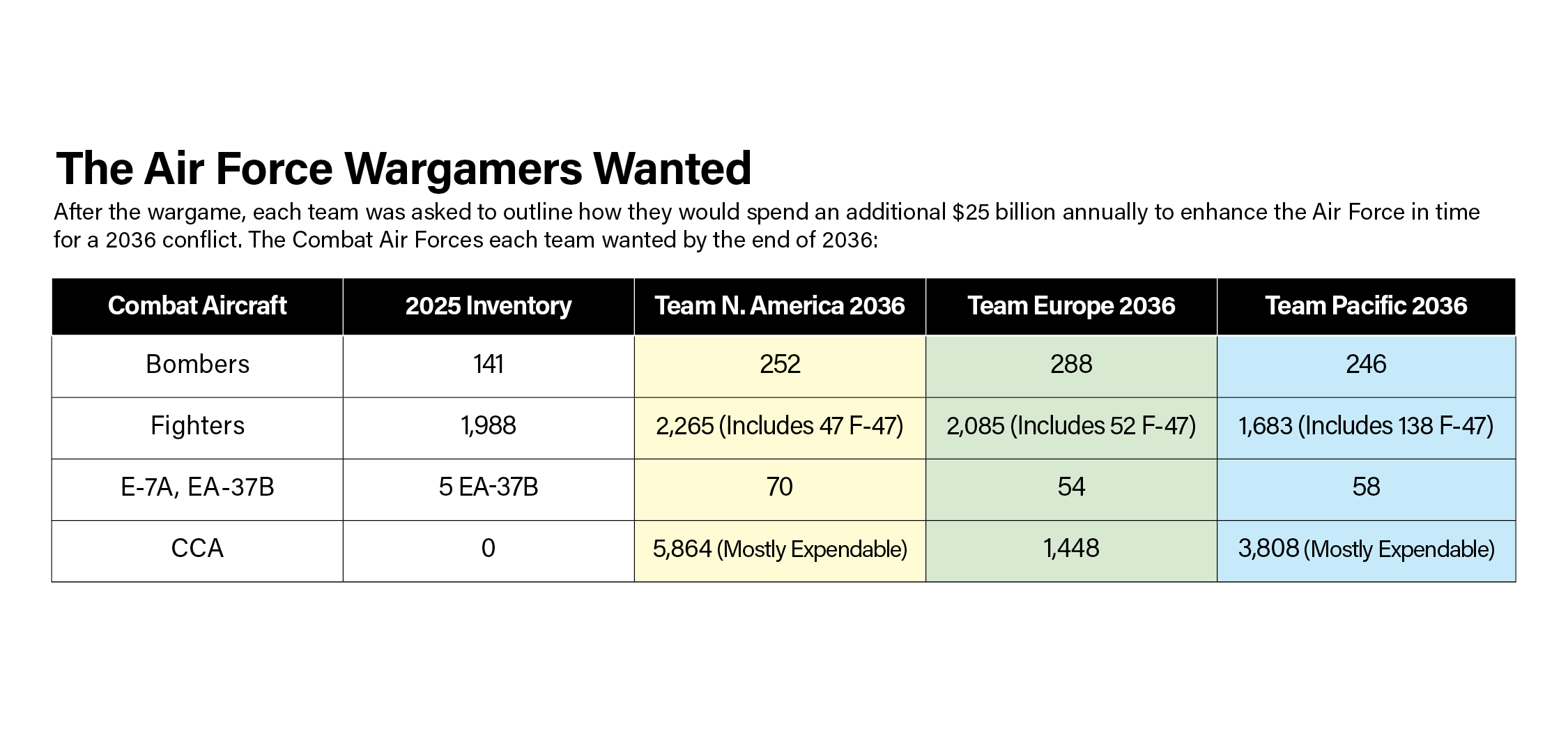
Two of the three wargame teams chose to retire the Air Force’s B-1B bombers to free their maintainers and aircrews to stand up a larger B-21 force. Team Pacific slightly decreased their planned F-35A buys and reduced the size of their F-16 inventory to acquire more F-47s.
The Pacific team ultimately bought more F-47s—138 by 2036—well over double the number of F-47s acquired by the wargame’s other teams. This trade-off was intended to create a future force with the greater range and persistence needed to achieve air superiority and conduct long-range penetrating strikes over vast distances of the Pacific. Overall, the teams’ trade-off decisions were driven by insufficient funding.
Even the $25 billion annual plus-ups provided to the teams fell short of meeting requirements to increase the Air Force’s readiness, modernize and recapitalize its forces, rebuild an attrition base, and address other shortfalls created by 30 years of “trading capacity for future capabilities.” Despite insufficient funding, each team’s investments would have created a more ready, resilient U.S. Air Force.
Throughout the Mitchell Institute’s June wargame, U.S. and allied airpower experts offered their candid insights on priorities for sizing and shaping the future U.S. Air Force. Sizing the Air Force for a single peer conflict will not cover warfighting requirements if concurrent conflicts occur in two or more regions. In the words of the experts, “this failure would invite opportunistic aggression.” Moreover, post-game analysis conclusively determined that the Department of War and Congress must substantially increase the U.S. Air Force’s budgets for at least a decade to address today’s critically low readiness, modernize its aging forces, and grow its combat capacity.
The wargame’s strategic choices exercise indicated that an additional $25 billion per year over the next decade would be a step in the right direction, yet still fall short of what is needed to reverse the Air Force’s decline. The need to invest in air base defense will further increase budget requirements, as the Air Force assumes a mission that has long been the U.S. Army’s responsibility—defending the Air Force’s air bases from air and missile attacks.
The same is true for rethinking the Air Force’s nuclear deterrence forces, which are now sized for a single nuclear peer adversary instead of today’s threat from two nuclear peers. Doubling the amount provided to the teams—$50 billion per year, as recommended by previous Mitchell Institute analyses, would help restore the service’s operational readiness and allow it to acquire new aircraft, munitions, and other forces at a scale that matches global demand for U.S. Air Force airpower.
The last 30 years were characterized by the lack of a credible peer threat to the United States’ status as the sole superpower, coupled with a myopic focus on low-intensity conflicts in the Middle East. These dynamics resulted in decisions to downsize the U.S. Air Force, defer and sometimes cancel core recapitalization programs, and shift Air Force funds to the Army—to the tune of over $1.3 trillion—and nearly $1 trillion to the Navy over that period. While the aggressive rise of China as an aspiring global power and pacing threat has drawn the attention of recent administrations and created a long-overdue sense of urgency, it also led to policies that restricted the Air Force to sizing its forces for a conflict with a single adversary in a single theater.
The Mitchell Institute’s wargame illustrated the dangers associated with decades of underinvesting in the Air Force coupled with a one-war force-sizing policy. Without sustained and significant additional resources over the next decade, the Air Force will not recover from the nosedive it has been in for many years, and the result will be an increasingly undersized, less ready force that cannot defend the homeland, cannot deter opportunistic aggressors, and cannot succeed in conflicts that span multiple theaters.
Col. Mark Gunzinger, USAF (Ret.), is the Director of Future Concepts and Capability Assessments and Heather Penney is the Director of Studies and Research at AFA’s Mitchell Institute for Aerospace Studies.