
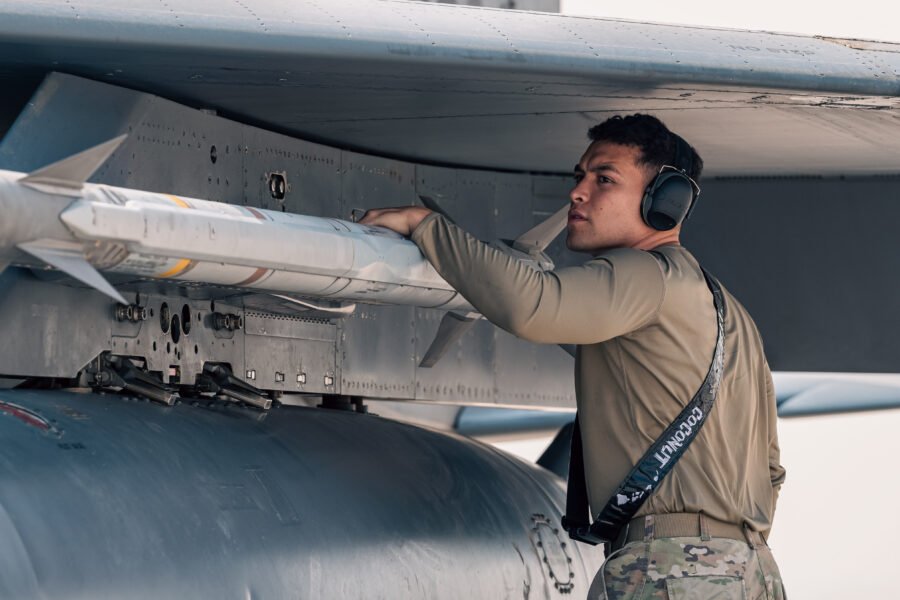
A combined Navy and Air Force program is seeking to build a smaller version of a ubiquitous air-to-air missile that could give advanced aircraft, such as the Collaborative Combat Aircraft, greater magazine depth in a high-end fight.
The Navy’s fiscal 2027 budget request included $83.3 million in research funding to build a compact variant of the AIM-9X Sidewinder missile. The Air Force is planning to make contributions to the program in 2028.
This effort is aimed specifically at repackaging the legacy missile system’s technology into a “compact airframe optimized for internal carriage on advanced aircraft with improved kinematic performance.”
That goal falls neatly in line with work on the CCA, USAF’s autonomous drone wingman plan for future air combat. The service is asking for nearly $1 billion in 2027 to start buying the advanced drone.
Planners have spoken of a host of missions for the future drone, but key among them is serving as a missile truck, carrying additional firepower for their manned partners: the F-35, F-22, and the future F-47.
Giving CCAs an entirely new weapon like a smaller Sidewinder could enhance their effectiveness, said retired Col. John “JV” Venable, a former F-16 pilot.
“It opens the aperture, a smaller munition does a lot of things for you with regard to your carriage capacity on things that are in the design phase,” said Venable, now a senior resident fellow at AFA’s Mitchell Institute for Aerospace Studies.
Both the drone and its accompanying weaponry are key tools in how the service expects to fight in crowded airspace against the firepower China possesses.
The AIM-9X is the newest version of the AIM-9 family of infrared-guided, short-range, supersonic missiles commonly used by fighter aircraft such as the F-15, F-16, F-22, and F-35.
The Air Force, Navy, Marine Corps, and foreign partners have bought thousands of AIM-9s over the years. Early versions were used in the Vietnam War, and more recently, an F-22 pilot used one to down a Chinese spy balloon on Feb. 4, 2023, flying off the South Carolina coast.
The current variant measures 9.4 feet long, compared with the 12-foot AIM-120 Advanced Medium-Range Air-to-Air Missile. Budget documents did not specify the length of the compact variant.
CCAs have already carried inert AMRAAMs, an Air Force spokesperson previously told Air & Space Forces Magazine. Two prototype aircraft, General Atomics’ YFQ-42A “Dark Merlin” and Andruil’s YFQ-44A “Fury,” are competing for the first increment of the Air Force program.
Fury carries its missile externally, while Dark Merlin carries its payload internally.
That kind of space could allow for perhaps four or more compact Sidewinders, Venable said.
The compact variant effort will increase the weapon’s capability, giving the user greater standoff range and a deeper magazine while maintaining the missile’s ability to hit targets close to the aircraft.
The Navy already funded AIM-9X CV risk reduction work in 2025 that will continue in 2027 to advance hardware and software designs, according to budget documents.
For the F-15 and F-16, shrinking down the size of the Sidewinder won’t make a big difference because their missiles are mounted externally and the aircraft already have designed space for the racks that hold them, Venable said.
The stealthy F-22 can carry the missile internally but must use a “trapeze”-type system to deploy it externally from its side weapons bay to find its target.
The Block I version of the Sidewinder still used a “lock-on-before-launch” method, which required it to either be mounted or exposed externally to “see” its target before firing. That’s contrasted with the Block II variant’s “lock-on-after-launch” ability.
The AIM-9X Block II variant has updated electronics, including a lock-on-after-launch capability that uses a datalink to support beyond-visual-range engagements, according to missile manufacturer Raytheon.
While the technology holds promise, Venable said he is skeptical that the Sidewinder will be usable from an internal mount on the CCA without being exposed externally until it’s proven in testing. He did note, however, that a compact Sidewinder could offer options to beef up the MQ-9 Reaper drone’s defensive and offensive capabilities.
