
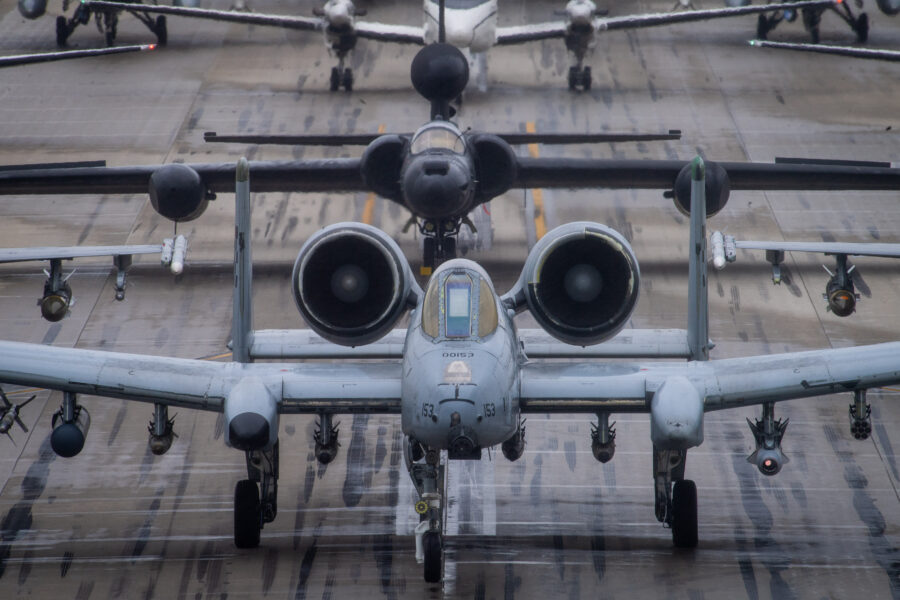
The Air Force wants to divest 149 older aircraft and buy 108 new ones in fiscal 2027, continuing a trend that shrinks the overall fleet.
Among the planes to be divested are the last 23 U-2 Dragon Lady spy planes in the inventory and nearly half of the remaining A-10 Thunderbolt IIs, leaving just 54 of the iconic jets, enough to keep three squadrons flying. The decision ensures the Warthogs remain until 2030.
If approved, the Air Force said the new plan would also retire:
- 20 KC-135 Stratotankers
- 16 C-130H Hercules transports
- 15 training aircraft
- More than two dozen aging jets
The Air Force has sought to retire the iconic U-2s before, but Congress stepped in to block the move. The 2027 budget will reignite that debate as Pentagon officials seek to retire the entire fleet by the end of the fiscal year.
Despite averaging more than 43 years of age, the U-2 remains a unique high-flying capability that continues to offer valuable intelligence to complement other sources. The planes contributed to Operation Epic Fury against Iran, according to U.S. Central Command, and have supported other U.S. military operations over the past year.
The Air Force did not say what might be available as a substitute for those missions.
Beyond the A-10s, the Air Force is also slowing plans to retire other fighters. After repeated attempts to divest its older Block 20 F-22 Raptors failed, officials did not renew that effort this year. Instead, they will keep those plans and hold the F-22 fleet steady at 184 jets. Similarly, the Air Force will not retire more F-15C/D aircraft, retaining the 42 aircraft still flying after divesting 74 F-15C/Ds over the past few years.
While the Air Force plans to retire many aircraft in 2027, it also wants to spend $30.7 billion to buy at least 108 new aircraft, including:
- 38 F-35As
- 24 F-15EX Eagle II fighters
- 23 T-7A Red Hawk trainer aircraft
- 15 KC-46 Pegasus refueling tankers
The proposed 2027 Air Force budget request totals $338.8 billion, an all-time high that is 38 percent more than the approved 2026 funding of $246.3 billion.
“The Department of the Air Force’s fiscal year 2027 budget request moves beyond the trade-off between modernization and readiness,” Air Force Sec. Troy Meink said in an April 21 statement. “We are funding both as concurrent priorities to ensure the force is ready to fight tonight, tomorrow, next week, next year, and next decade.”
The Air Force’s A-10 decision came late and details are not yet set, officials said. Three A-10 squadrons will remain, with one Active-Duty squadron at Moody Air Force Base, Ga., scheduled for shutdown in 2029, and two others—a second Active-Duty squadron at Moody and a Reserve squadron at Whiteman Air Force Base, Mo., holding out until 2030. Each squadron is expected to keep 18 Warthogs.
Verdugo said the service is still assessing the impact of the change on next year’s budget.
The Warthog has been flying since the 1970s and has survived numerous attempts to retire the planes dating back to the 1990s. The jets proved invaluable for close air support during the anti-insurgency campaigns of Iraq and Afghanistan in the early 2000s and have more recently been adapted for other missions in the Middle East. Flying low and slow and sporting a punishing GAU-8 Gatling gun and an armored underbelly, they have proven a favorite of Soldiers and Marines, as well as nostalgic airplane fans.
The same attributes that make the jets effective for close air support make them vulnerable to sophisticated air defenses such as those employed to defend China. Lawmakers have consistently blocked efforts to retire the A-10 but finally relented in the 2025 defense legislation, agreeing to let the Air Force retire its last A-10s in 2028. Now it is the Air Force saying “not so fast.”
Operation Epic Fury once again showed off the utility and flexibility of the A-10, which was employed repeatedly to keep enemy forces at bay during the Easter weekend rescue of two F-15E Strike Eagle aviators. One A-10 was damaged by ground fire and ultimately lost, but the pilot safely ejected in friendly territory.
Defense Secretary Pete Hegseth, a former Army infantryman himself, lauded the A-10 pilots after the rescue, and Meink referenced the secretary in his announcement that some A-10s would remain until 2030, saying the decision was made “in consultation with” Hegseth.
A-10s have also been used against Iranian-aligned militia groups in Iraq and against armed Iranian small boats in the Strait of Hormuz during the conflict with Iran, according to U.S. officials. A-10s are among the aircraft being used to enforce a U.S. blockade against Iranian ports.
In retiring 20 KC-135s, the Air Force will be losing more tankers than it will acquire, as it takes in just 15 new KC-46s to replace them. The 16 retiring C-130Hs will be replaced with an unspecified number of C-130J Super Hercules mobility aircraft.
The Air Force is also planning to retire 20 F-15Es fitted with older engines, and will focus on maintaining only its most-capable Strike Eagles. In addition, it plans to divest 6 of its oldest F-16 Fighting Falcons, 14 T-6 Texan trainer aircraft, and one T-38 Talon trainer.
Overall, the Air Force’s plans to invest $30.7 billion in new aircraft, a modest 2 percent increase over its 2026 aircraft procurement budget of $30.1 billion. Included in that is $7.4 billion for 38 new F-35As, $1.1 billion to start production of an undeclared number of semi-autonomous Collaborative Combat Aircraft, and $3 billion for 24 F-15EXs. The 15 KC-46s would total $3.9 billion in cost.
The Air Force would also invest $3.2 billion for an unspecified number of B-21 Raider bombers, plus $2.9 billion for Raider research and development. If approved, that would be a total of $6.1 billion for the sixth-generation stealth bomber program.
The Navy and Marine Corps will also acquire F-35s, with the Navy and Marines getting 37 carrier-based F-35Cs and the Marines buying 10 F-35Bs. That is far more than the 47 F-35s the military bought in 2026. But the Air Force purchased 48 F-35As in 2023 and 2024 and has not returned to that number since. Defense officials told reporters April 21 the budget would fund upgrades to the long-awaited Block 4 upgrades to the F-35 and invest in the supply chain and spare parts to improve the platform’s overall readiness.
“Expanded capacity should serve to maximize readiness, bolstering our ability to achieve air superiority in a conflict,” said Space Force Lt. Gen. Steven P. Whitney, the Joint Staff’s director for force structure, resources, and assessment.
Future aircraft capabilities remain a focal point for Air Force planners, who want to spend $57.6 billion on research, development, test, and evaluation in 2027—up 27 percent over 2026 levels. If approved, their budget would include $5 billion to accelerate development of the sixth-generation F-47 fighter, a boost of $1.5 billion over 2026, and another $1.4 billion to continue to develop CCAs—roughly a $900 million increase.
