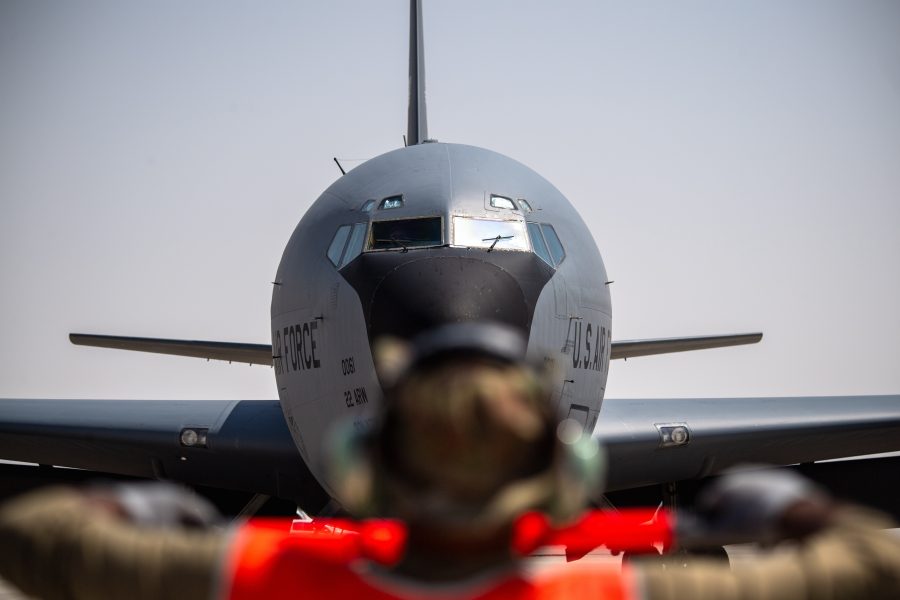
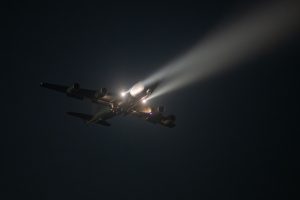
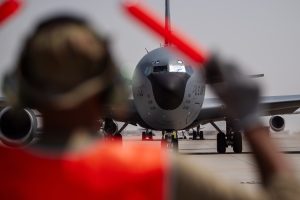
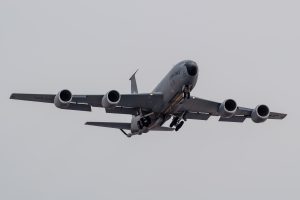
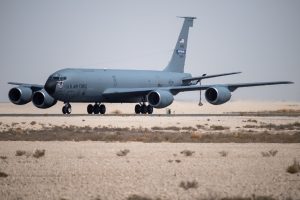
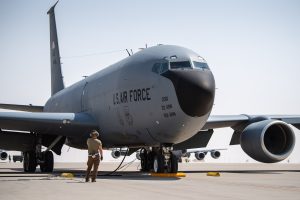
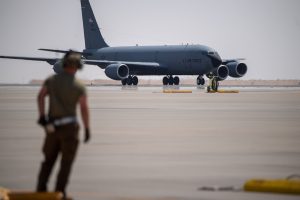
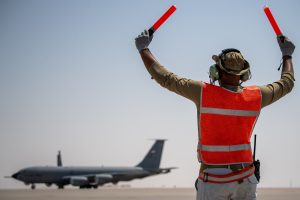
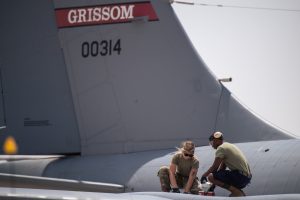
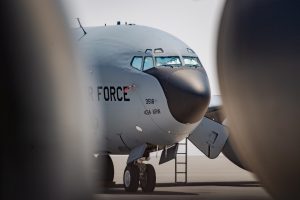
A maintainer assigned to the 350th Expeditionary Air Refueling Squadron marshals a KC-135 Stratotanker at an undisclosed location within the U.S. Central Command area of responsibility, Aug. 5th, 2024. U.S. Air Force photo
Audio of this article is brought to you by the Air & Space Forces Association, honoring and supporting our Airmen, Guardians, and their families. Find out more at afa.org
The U.S. military is flexing its airpower in response to Iran and Lebanese Hezbollah’s threats to attack Israel.
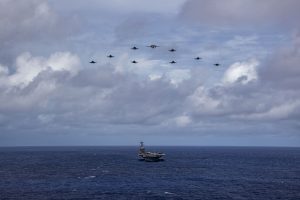
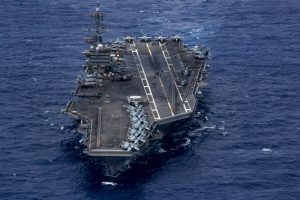
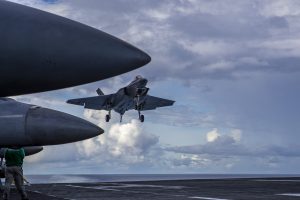
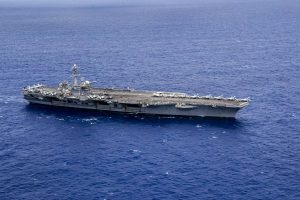
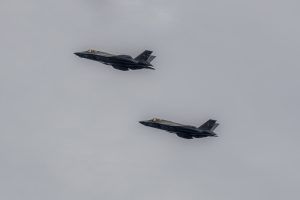
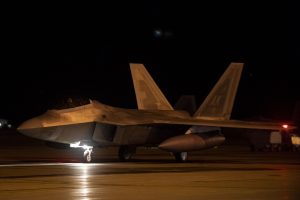
The Pentagon has already highlighted the deployment of stealthy, fifth-generation fighters to the Middle East, including roughly a dozen U.S. Air Force F-22 Raptors. On Aug 11, the Defense Department said it was accelerating the deployment of the USS Abraham Lincoln aircraft carrier, which was already steaming to the region, along with embarked squadrons of Marine Corps F-35Cs. And the Pentagon has sent additional aircraft as well.
The Pentagon bolstered U.S. forces in the region after Iran vowed to avenge the July 30 killing of Hamas political leader Ismail Haniyeh in Tehran. Iran says the attack was carried out by Israel, which has not publicly claimed or denied responsibility.
U.S. troops have also come under attack in Iraq and Syria in recent weeks, with the last attack in Syria on Aug. 9 causing several injuries, according to the Pentagon. The U.S. has some 2,500 troops in Iraq and 900 in Syria.
“Are we trying to send a message? Absolutely, we’re trying to send a message which is we’re looking to de-escalate the situation, that we’re looking to have capabilities in the region to protect our forces while also supporting the defense of Israel,” Pentagon Press Secretary Air Force Maj. Gen. Patrick S. Ryder told reporters on Aug. 12. “We do not want to see this broaden into a wider regional conflict. And so those capabilities bring real capacity for the U.S. to support all of those objectives. And so however you want to interpret it, whether it’s messaging or providing additional capabilities, I think the answer is yes on all accounts as it always has been.”
The Air Force has moved to bulk up its aerial refueling tanker presence because of the increased number of fighters in the region, U.S. officials say. USAF KC-135 tankers have been spotted on open-source flight tracking websites flying over Iraq and the Persian Gulf in recent days.
Most tankers in the region appear to be operating as the 350th Expeditionary Air Refueling Squadron. KC-135 Stratotankers from Air National Guard, Air Force Reserve Command, and Active-duty units have been spotted with that unit in August including:
KC-135s from McConnell Air Force Base, Kan, from the Active-duty 22nd Air Refueling Wing
KC-135s from Grissom Air Reserve Base, Ind., from Air Force Reserve Command
KC-135s from Tinker Air Force Base, Okla., from Air Force Reserve Command
At least one KC-135 from the 100th Air Refueling Wing at RAF Mildenhall, U.K.
At least one KC-135 from the Wisconsin Air National Guard
Some of those aircraft arrived in CENTCOM earlier this month, supporting the increased airpower Secretary of Defense Lloyd J. III ordered to the region on Aug. 2.
KC-135s from the 191st Expeditionary Air Refueling Squadron of the Utah Air National Guard have recently been operating in the region as well.
Around a dozen F-22s arrived at a base in the region on Aug. 8. Days earlier, roughly the same number of F/A-18s from the USS Theodore Roosevelt aircraft carrier arrived at an air base in the region in order to be closer to Israel and U.S. troops in the region. The Theodore Roosevelt was last spotted off the Gulf of Oman, where it had been operating for the last month, much farther away from the action.
The Lincoln has been ordered to “accelerate its transit to CENTCOM, adding to the capabilities already provided by the USS Theodore Roosevelt Carrier Strike Group,” Ryder told reporters Aug. 12.
The Pentagon previously said that Lincoln would replace Roosevelt when it ordered the carrier movement on Aug. 2. But the Defense Department’s Aug. 11 statement that Lincoln would be “adding to the capabilities” provided to Roosevelt raises the possibility that two carriers might simultaneously operate in the region.
On Aug. 13, Ryder told reporters the Lincoln is “going to move with all haste to get to the [Middle East] to provide this additional capability and capacity.” He declined to say whether the two carriers would operate in the Middle East at the same time. The amphibious assault ship USS Wasp, which is carrying some AV-8 Harrier fixed-wing warplanes, is in the Mediterranean Sea.
The U.S. has four Air Force fighter squadrons in the region in addition to the Navy fighters and incoming Marine Corps F-35s:
F-22s from the 90th Fighter Squadron deployed from Joint Base Emendorf-Richardson, Alaska.
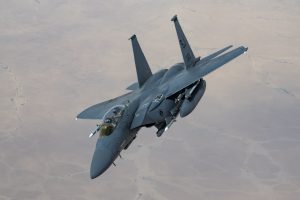
F-15Es from the 335th Fighter Squadron deployed from Seymour Johnson Air Force Base, N.C.
F-16s from the 510th Fighter Squadron deployed from Aviano Air Base, Italy.
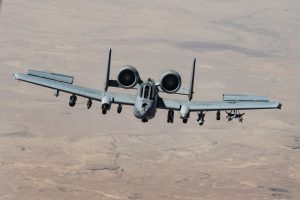
A-10s from the 107th Fighter Squadron at Selfridge Air National Guard Base, Mich.
Cargo aircraft have also continued to conduct missions in the Middle East, though it is unclear if there are more airlifters based in the region. The U.S. has some 30,000 troops deployed across CENTCOM, according to the Pentagon.
Austin also ordered the Ohio-class submarine USS Georgia to CENTCOM, the Pentagon said Aug. 11 in a rare disclosure of submarine movements. The Georgia carries over 150 Tomahawk land attack cruise missiles. The USS Florida, another Ohio-class guided-missile submarine, recently concluded a two-year deployment during which it fired Tomahawks at Houthi targets in Yemen earlier this year.
“The thing about the U.S. military, as you’re seeing this week, is that we have the ability to surge forces and capabilities to where we need them when we need them,” Ryder said Aug. 13.
Audio of this article is brought to you by the Air & Space Forces Association, honoring and supporting our Airmen, Guardians, and their families. Find out more at afa.org
Looking to make a quick start on Defense Secretary Pete Hegseth’s sweeping “FORTRESS America” program to make every military base in the U.S. more self sufficient, the Pentagon is dialing up its efforts in an area the Air Force has been working for several years: energy resilience and independence.
Secretary of Defense Pete Hegseth took his Arsenal of Freedom tour to the swing states of Ohio and Wisconsin on Oct. 20, highlighting efforts to boost defense manufacturing before the midterm elections next month, including by visiting future E-4C "Doomsday" planes.
Roughly two of every five fighters in the Air Force fleet could be F-35As by 2035, according to a new fighter force structure report the service submitted to Congress on Oct. 16. Lt. Gen. David Tabor, deputy chief of staff for plans and programs, revealed the new estimate during an…
The Air Force Life Cycle Management Center is moving forward with a program to upgrade a quarter-century-old computing system for some F-16 fighter jets.
The U.S. Navy on Oct. 15 accepted a C-130J-30 Super Hercules plane that it will modify to become the first of its new nuclear command, control, and communications aircraft—a route the Air Force is considering for a similar NC3 mission under congressional direction.
More than 40 years after the original YF-117 operational prototype flew test runs from a Lockheed Martin Skunk Works facility, an F-117 returned for a $1 million refurbishment to look its best when it assumes its place in history alongside other iconic aircraft on permanent exhibit at the National Air…
A U.S. Air Force F-22 pilot controlled a YFQ-44A Fury Collaborative Combat Aircraft this month while both aircraft were in flight, according to an Oct. 16 release, another milestone in the service’s ambitious CCA efforts.
The Marine Corps recently conducted its first-ever “ripple” release of eight Small Diameter Bomb IIs from an F-35B, a key early step in proving out the capability for all F-35 variants.
The Air Force will field operational prototypes for an autonomous drone to replace its MQ-9 Reaper in 2028, Secretary of the Air Force Troy Meink said Oct. 14.
✓
Thank You!
Check your inbox to verify your email address and finish setting up your AFA account.
★
Welcome Back!
An account with this email already exists. Please log in to continue.
Subscribe to the Air & Space Forces Daily Report
The latest news from Air & Space Forces Magazine, as well as news from other leading publications, delivered right to your inbox every morning!
We’re sorry, there has been an error. Please review your input or try again later.