

Inside the $1.5T Budget Request
By Greg Hadley, Matthew Cox, Steve Losey
The Trump administration’s record-breaking $1.5 trillion defense budget request for fiscal 2027 would represent a $441 billion increase over the fiscal 2026 budget, a 44 percent jump that would eclipse the Reagan buildup in the early 1980s to be the biggest budget in U.S. history, even adjusting for inflation.
“The peak of World War II was in 1945 at a little bit less than $1.2 trillion in today’s dollars,” said Todd Harrison, senior fellow at the American Enterprise Institute. “So this would push well above that.”
The budget is built from a $1.15 trillion “base discretionary” budget and $350 million in “mandatory” funds, which would be funded through a reconciliation bill like the one lawmakers passed in summer 2025 known as the Big Beautiful Bill Act.
Department of the Air Force Budget ($ in billions)
| Year | Air Force | % Change | Space Force | % Change | Non-Blue Pass-through |
Total | % Change |
|---|---|---|---|---|---|---|---|
| 2025 | $184.1 | $28.6 | $45.2 | $258.0 | |||
| 2026 | $214.7 | 16.62% | $31.6 | 10.49% | $48.3 | $294.6 | 14.19% |
| 2027* | $267.7 | 24.69% | $71.1 | 124% | $52.4 | $391.1 | 32.76% |
*Requested
Sen. Roger Wicker (R-Miss.) and Rep. Mike Rogers (R-Ala.), the respective chairs of the Senate and House Armed Services Committees, praised the $1.5 trillion commitment, while the ranking members pushed back.
Sen. Jack Reed (D-R.I.), ranking member of the Senate committee, dismissed the submission. “I will not rubber-stamp a bloated, undisciplined budget,” he said. “I will work with my colleagues on a bipartisan basis to carefully scrutinize every penny.”
But retired Air Force Lt. Gen. David A. Deptula, dean of AFA’s Mitchell Institute for Aerospace Studies, applauded the commitment to rebuild military fighting capacity.
“The key question is no longer whether the topline is large enough,” Deptula said. “The key question [now] is whether it is translated into real combat capacity, readiness, and modernization in a sustained, multiyear way. … It creates the opportunity to rebuild Air Force and Space Force capacity. Execution and prioritization will determine whether that opportunity is realized.”
Divvying up the Dollars
Major funding lines in the 2027 request include:
$17.5 billion for the Golden Dome missile defense shield, which follows a $25 billion “down payment,” most of it in last year’s reconciliation bill, which allows the Pentagon to spend the money over time. Golden Dome initiatives will include “game-changing space-based missile defense sensors and interceptors, kinetic and nonkinetic missile defeat and defense capabilities, enabling technologies for a layered, next-generation homeland missile defense system,” the Pentagon said.
Golden Dome’s director, Space Force Gen. Michael A. Guetlein, said in March the program could cost $185 billion, while other estimates have gone still higher.
About $8 billion for 80 F-35 aircraft, of which fewer than half would be for the Air Force. The budget funds just 38 F-35s, even after the Pentagon is now cleared to initiate multiyear buys of the aircraft.
The proposed budget also funds 24 F-15EX Eagle II fighters, just two more than 2026. Combined with the 38 F-35As, that adds up to 62 new fighters in 2027—less than the 72 new jets the Air Force has long maintained annually to continually modernize the fleet and reduce the average age of its fighters to a number closer to 20 years than 30.
Billions for readiness. Operations and maintenance for the Active duty force would rise 21 percent to $79.8 billion in 2027; Reserve O&M spending would rise 13 percent to $4.8 billion; and Air National Guard O&M spending would increase 10 percent, to more than $8.3 billion. “We are redoubling our efforts to invest in our ability to maintain the airplanes,” Air Force Vice Chief of Staff Gen. John Lamontagne told lawmakers. Historically, the Air Force has funded weapons systems sustainment “to about an 85 percent level” he explained. “This year’s budget, in 2027, takes us to 93 percent—an additional $3.2 billion—to help us sustain those airplanes over time.”
The Air Force flying hour program would increase 22 percent, from $6.1 billion in 2026 to more than $7.4 billion in 2027.
Another $4.2 billion would go into the Air Force’s Consolidated Sustainment Activity Group, a revolving fund used to frontload purchases of parts that can later be paid for with future budgets. The fund helps ensure a steady supply of parts is always available.
Double the investment in military construction for the Air Force, to $26.7 billion, to fund new hangar and support spaces for the F-47 fighter at Nellis Air Force Base, Nev.; B-21 Raider beddowns at two air bases; new missile silos and related facilities for the Sentinel intercontinental ballistic missile program; and four new operations centers spread among four Space Force bases.
$1 billion to start buying production-model Collaborative Combat Aircraft (CCA) as a production decision on which semi-autonomous drones to buy looms. That includes $996.5 million to fund CCA buys in 2027, plus $150 million in advance procurement funding for 2028.
How ’27 Budget Requests Compare: Air Force, Space Force vs. Army, Navy, DOD
By Greg Hadley
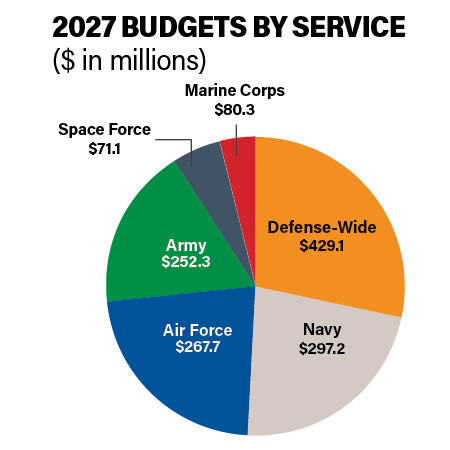
While the Air Force is emphasizing operations and maintenance, the Army and Navy are planning buying sprees with the 2027 budget plan. The Space Force budget, meanwhile, is getting closer and closer to that of the Marine Corps. And nonservice “Defense-Wide” funding more than doubled.
The Department of the Air Force’s topline is about $391 billion—nominally the largest of the military department budgets. But that covers the Air Force, the Space Force, and money that passes through the department directly to other agencies, more than $52 billion in this request.
The next largest department by funding is the Department of the Navy, which includes the Marine Corps, at more than $377 billion, followed by the Department of the Army, at slightly more than $252 billion.
Broken down by individual military services, the Navy is in line for the biggest budget share, with a topline of $297 billion, followed by the Air Force at about $267 billion (after accounting for pass-through), the Army at $252 billion, the Marine Corps at $80 billion, and the Space Force at a record $71 billion.
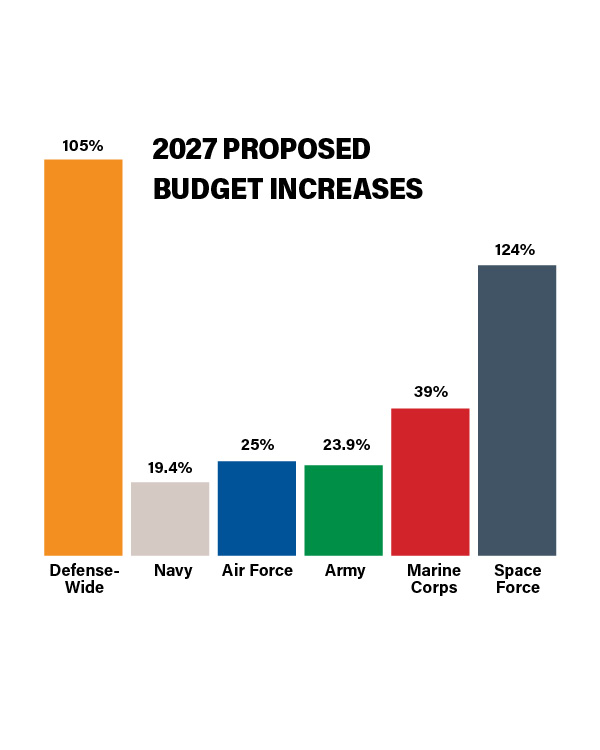
Among the five service branches, the Space Force would grow the fastest: If approved as requested, USSF spending would rise by 124 percent over fiscal 2026. The Marine Corps is next, at 39 percent, followed by the Air Force, Navy, and Army, which range from nearly 20 percent to 25 percent. Dwarfing all except the Space Force, however, are other Defense Department agencies, which together grow by an unprecedented 105 percent year over year. Each military service took its own approach to allocating its resources.
For the Air Force, spending on research, development, test, and evaluation would rise the most, increasing 30 percent, or more than $17 billion. That includes $5 billion for the new F-47 fighter, $4.5 billion for the Sentinel ICBM, and more than $2 billion each for the new B-21 bomber and E-4C Survivable Air Operations Center. The next largest increase, more than 20 percent, would fund operations and maintenance accounts, a follow-through on senior leaders’ pledge to fund improved readiness.
In contrast, the Army and Navy intend to invest heavily in new weapons. Army procurement would nearly double, from $31 billion to $61 billion, while Navy procurement would rise by 45 percent, to nearly $144 billion.
Notably, the Navy is asking to double its aircraft procurement from $17.75 billion to $34.4 billion, including both Navy and Marine Corps aircraft. If approved as submitted, the Navy’s 2027 aircraft purchases would eclipse those of the Air Force, which is seeking $30.6 billion for aircraft procurement. When it comes to combat jets, Air Force combat aircraft procurement would actually decline from 2026 to 2027, according to budget documents released so far.
The Navy intends to raise shipbuilding investment from $45 billion to $65.8 billion, and to double its purchases of missiles, from $10.1 billion to $22.6 billion.
Missiles lead the Army’s shopping list, as it seeks to more than quadruple its spending on missiles, from $8 billion in 2026 to $36.6 billion in 2027. That includes both projectiles for the Terminal High Altitude Area Defense (THAAD) and the Patriot air defense systems, as well as funds for a pricey Precision Strike Missile, estimated to cost as much as $3.5 million apiece.
Both the Army and Navy kept their RDT&E funding essentially flat—the Army figure rising 2 percent while the Navy would raise R&D funding by just 0.8 percent. Both services would invest in military readiness, with the Navy increasing its O&M spending by 11 percent and the Army increasing its investment by more than 20 percent.
Surprisingly, the greatest increases in procurement and R&D would be in Defense-wise programs, rather than those operated by the individual services. “Defense-Wide” spending, which includes the office of the Secretary of Defense, the combatant commands, the joint staff, and dozens of defense agencies, would more than double, rising from about $209 billion in fiscal 2026 to more than $429 billion in 2027—a 105 percent increase.
2027 Golden Dome Budget
($ in millions)
| Account | 2026 | 2027 |
|---|---|---|
| Operation and maintenance | $334.2 | $1,149.2 |
| Procurement | $1,296.2 | $2,147.1 |
| RDT&E | $19,312.7 | $14,221.7 |
| Advanced component development and prototypes | $22.0 | $0 |
| Operational system development | $132.0 | $0 |
| Total | $21,097.1 | $17,518.1 |
Much of that would go to the Missile Defense Agency (MDA), which is expected to have an outsized role in President Donald Trump’s signature “Golden Dome” missile defense initiative. But MDA is not the biggest winner. The largest chunk of those funds will be spent within the Office of the Secretary of Defense—around $180 billion more in 2027 just for procurement and research and development. Full details on how that money would be spent are not yet available, but the Defense Autonomous Warfare Group, a little-known organization that appears to have succeeded the prior administration’s Replicator drone initiative, looks to be a big winner with $53.6 billion in new funds.
The budget also includes $17.5 billion in a “Golden Dome for America” fund. Most of the money in that fund goes toward MDA and other defense agencies, but some is earmarked for Army, Air Force, and “Space” programs. Other funding in support of Golden Dome is contained within service budgets, such as money earmarked for the Space Force’s missile warning satellites.
Space Force Seeks to More Than Double Budget
By Courtney Albon
The Space Force is requesting $71 billion for fiscal 2027, a massive increase that puts the Space Force in line to outspend the Marine Corps. The money funds growth in nearly every sector, from missile warning programs and launch services to people.
The Space Force budget is about $36.1 billion in 2026 and leaders have been campaigning for more funding to meet mission demands. About $59 billion of the $71 billion total would come through the base request and another $12 billion would come through a separate reconciliation package, if the administration’s plan comes to fruition. Research and development would swell to over $40 billion—topping the entire service’s request from 2026—and its procurement account would increase to $19 billion, more than five times what it requested last year.
The proposal also includes $1.9 billion for Space Force personnel, up from the $1.6 billion it asked for in fiscal ’26, and $9.7 billion for operations and maintenance, a nearly $4 billion increase.
More Systems, Guardians
Chief of Space Operations Gen. B. Chance Saltzman said the Space Force’s budget request reflects its need to grow existing programs and add new ones. That’s largely reflected in the service’s research and development and procurement accounts, which would see the greatest gains from the White House’s proposal, with much of that funding going toward the service’s highest priorities.
That includes the Pentagon’s Golden Dome project, a signature Trump administration effort to bolster U.S. defenses against advanced missile threats. The defense budget requests $17.5 billion for Golden Dome, and while it’s not clear how much of that funding resides within the Space Force’s purview, major increases to the service’s existing space-based missile warning, tracking, and defense portfolio provide at least some indication.
The request includes nearly $5 billion for the Space Force’s Resilient Missile Warning and Tracking program, which is fielding satellites to low-Earth orbit and medium-Earth orbit—a $1.7 billion increase from its fiscal ’26 budget, according to high-level Pentagon budget documents. About $3.5 billion of that is for the LEO program, managed by the Space Development Agency, and $1.4 billion would be funneled toward the MEO layer, which Space Systems Command oversees.
The Space Force’s Long Range Kill Chains program would see an increase of nearly $1 billion for a total request of $1.3 billion, and another $1.5 billion would fund an effort called “Automate Sat C2,” which may support broader Space Force efforts to improve satellite command-and-control capabilities.
Efforts to build out a space-based moving target indication constellation would also see a boost. The Space Force’s R&D budget includes $1 billion for Space-Based MTI and, notably, its procurement request adds $7 billion for Air Moving Targeting satellites and $1 billion for its Ground Moving Target Indicator program.
Three other noteworthy increases in the Space Force’s R&D and procurement budgets: a $1.5 billion add for a new funding line, Proliferated LEO SATCOM; $4 billion for 22 National Security Space Launch missions; and $1.5 billion for the Space Data Network, the service’s larger data transport effort, which will include dedicated military spacecraft as well as commercial satellites and will support Golden Dome.
To manage the Space Force’s growing portfolio of missions and systems, Saltzman and Chief Master Sergeant of the Space Force John Bentivegna have said the service’s current cadre of 10,000 Guardians needs to double in size in the coming years.
With a $330 million increase in personnel funding, the fiscal ’27 budget puts the Space Force on a path toward increasing its end strength, but the doubling officials have called for won’t come for a few years. Funding projections from the White House’s Office of Management and Budget show the service’s personnel budget growing from $1.8 billion in 2027 to $3.2 billion in fiscal 2030.
The Space Force is requesting $1 billion in fiscal 2027 to build four space operations centers around the country, part of a broader push to build up the service to match growing demand for space capabilities.
The expansion is intended to support resilient operations for space control, space-based sensing and targeting, and data transport, Maj. Gen. Frank Verdugo, deputy assistant secretary of the Air Force for budget, said in an April 21 budget briefing.
Because the Space Force doesn’t have its own military construction budget, the funding is included in the Air Force’s request. The four operations centers would cost $250 million each and be built at:
- Kirtland Air Force Base, N.M
- Redstone Arsenal, Ala.
- Schriever Space Force Base, Colo.
- Grand Forks Air Force Base, N.D.
The new ops centers will bring “resiliency through distribution,” a Department of the Air Force spokesperson said, eliminating single points of failure.
Lt. Gen. Doug Schiess, nominated to become the next Chief of Space Operations, said the Space Force needs to spread out its critical assets.
“One of the things that we’re looking at is, from a resiliency perspective … we have some operation centers that have backups,” Schiess said. “We’ve talked about some at contractor facilities, but we just need to make sure that we have more resiliency in where we do operations from and where we go with new programs.”
Out With Old Jets, in With Fewer New Ones
2027 Aircraft
Divestments
| Type | Number |
|---|---|
| A-10 | 49 |
| U-2 | 23 |
| KC-135 | 20 |
| F-15E | 20 |
| C-130H | 16 |
| T-6 | 14 |
| F-16 | 6 |
| T-38 | 1 |
By Stephen Losey and Chris Gordon
The Air Force continues to divest aircraft faster than it is buying replacements. In fiscal 2027, its budget plans call for retiring 149 older aircraft and acquiring 108 new ones.
While it plans to acquire 62 new fighters, including 38 F-35As and 24 F-15EXs, the Air Force plans to give up half its A-10s, leaving just 54 of the iconic armored attack jets. The decision ensures the Warthogs remain until 2030.
The Air Force’s A-10 decision came late and details are not yet set, officials said. Three A-10 squadrons will remain, with one Active-duty squadron at Moody Air Force Base, Ga., scheduled for shutdown in 2029, and two others—a second Active-duty squadron at Moody and a Reserve squadron at Whiteman Air Force Base, Mo., holding out until 2030. Each squadron is expected to keep 18 Warthogs.
USAF leaders gave up after repeated attempts to divest older Block 20 F-22 Raptors failed to convince Congress. Not only do they now plan to keep those planes, holding the F-22 fleet steady at 184 jets, but they also will suspend retirements of F-15C/D fighters, retaining the remaining 42 aircraft after sending 74 to the boneyard in recent years.
The proposed 2027 Air Force budget request totals $338.8 billion, an all-time high that is 38 percent more than the approved 2026 funding of $246.3 billion.
“The Department of the Air Force’s fiscal year 2027 budget request moves beyond the trade-off between modernization and readiness,” Air Force Sec. Troy Meink said in an April 21 statement. “We are funding both as concurrent priorities to ensure the force is ready to fight tonight, tomorrow, next week, next year, and next decade.”
Overall, the Air Force’s plans to invest $30.7 billion in new aircraft, a modest 2 percent increase over its 2026 aircraft procurement budget of $30.1 billion. Included in that is $7.4 billion for 38 new F-35As, $1.1 billion to start production of an undeclared number of semi-autonomous Collaborative Combat Aircraft, and $3 billion for 24 F-15EXs. The 15 KC-46s would total $3.9 billion in cost.
The Air Force would also invest $3.2 billion for an unspecified number of B-21 Raider bombers, plus $2.9 billion for Raider research and development. If approved, that would be a total of $6.1 billion for the sixth-generation stealth bomber program.
If approved, the Air Force said the new plan would also retire:
- 20 KC-135 tankers, five more than the 15 new KC-46s being acquired
- 16 retiring C-130Hs, which are to be replaced eventually with an unspecified number of C-130J Super Hercules mobility aircraft.
- 15 training aircraft
- 20 older F-15Es
- 6 F-16s
- 14 T-6 Texans
- 1 T-38 Talon.
Future aircraft capabilities remain a focal point for Air Force planners, who want to spend $57.6 billion on research, development, test, and evaluation in 2027—up 27 percent over 2026 levels. If approved, their budget would include $5 billion to accelerate development of the sixth-generation F-47 fighter, a boost of $1.5 billion over 2026, and another $1.4 billion to continue to develop CCAs—roughly a $900 million increase.
Pass-Through Takes Smaller Share in ’27
By Greg Hadley
The U.S. defense budget is among the most transparent military spending plans in the world, but that doesn’t mean it’s not rife with hidden meaning and secret programs. Indeed, for more than six decades, the Department of the Air Force budget has hidden billions of dollars that get funneled into secret programs in the Intelligence Community.
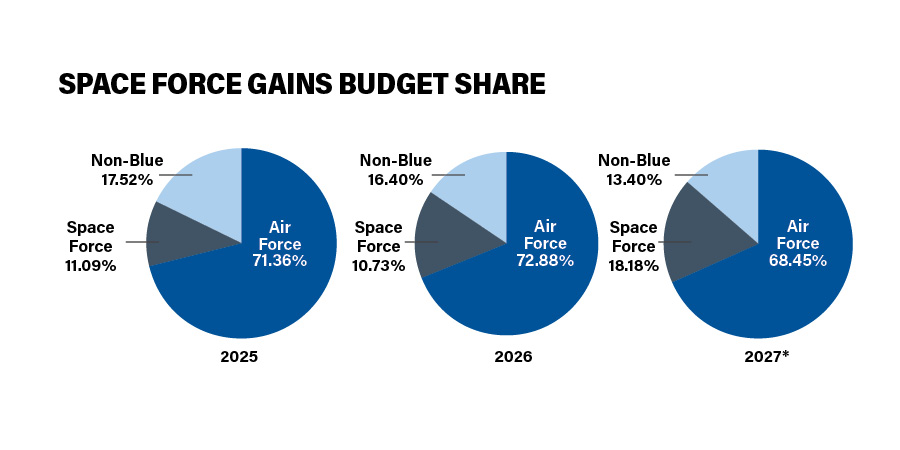
For 2027, so-called “pass through” accounts—money that funds other agencies and is never actually touched or used by the Air Force—will top $52.3 billion. That’s 13.4 percent of the total department spending plan. Proportionally, the pass-through makes up a smaller share than in past years, when it has often exceeded 20 percent.
The Space Force, meanwhile, is growing so rapidly that it is poised to gain a larger share of the Department of the Air Force’s pie—more than 18 percent in 2027, if the budget is approved as submitted.
Not counting pass-through funds, the Air Force and Space Force portions of the department’s budget total $338.8 billion, split $267.7 billion for the Air Force and $71.1 billion for the Space Force.
Meanwhile, Space Force investment is soaring. As submitted, the USSF budget accounts for more than 18 percent of the DAF’s topline, the highest level in its nearly seven-year history. Much of that is classified; the Space Force’s classified spend would reach $17.3 billion, or nearly a quarter of the service’s topline total. That’s nearly triple the $6.56 billion in classified spending in the 2026 budget.
The Air Force is likewise seeking a major injection of cash for its classified portfolio, with documents showing an increase from $48 billion in 2026 to nearly $57 billion for ’27.
Together, the Air Force’s and Space Force’s classified budgets would jump nearly $9 billion, more than twice as much as the proposed growth in secret pass-through spending, which would be $4.1 billion.
Critics of the pass-through contend that continuing this practice leaves the impression that the department’s budget is larger than it really is and has resulted over time in consistently short-changing Air Force investment accounts.
“With the Air Force’s responsibilities growing exponentially in the Pacific and Europe, the Air & Space Forces Association believes Congress and the public must be able to make an apples-to-apples comparison of the investment they are making in the Air Force and Space Force’s capabilities,” AFA leaders wrote in a 2024 letter to Congress.