
The Air Force will retire or divest 250 aging aircraft in 2023 if given a greenlight by Congress, and acquire 82 others.
Here’s what those cuts would entail:
Divestments
A-10

21 jets from the Air National Guard at Fort Wayne, Ind. The unit would gain 21 F-16s.
F-22

33 of 36 Block 20 F-22s. The cuts would decrease the F-22 fleet to 153 airplanes. Later model F-22s would be transitioned to the training role these aircraft now fulfill.
Air Force Secretary Frank Kendall said, “We see an efficiency, effectively, in removing those aircraft at this point.” However, USAF asked for $344 million to upgrade the sensors and other systems on the remaining Raptors in fiscal 2023.
E-3 AWACS

15 aircraft at Tinker Air Force Base, Okla. Only 16 AWACS will remain. A program to acquire a replacement will proceed within months..
E-8 Joint STARS

Eight JSTARS would be retired in 2023 and four more in 2024.“Basically, both the JSTARS fleet and the AWACS fleet are aging out and need to be replaced,” Kendall said.

12 C-130s from Maxwell Air Force Base, Ala., would be cut, while four new C-130-Js would be acquired, for a net reduction of eight aircraft. The C-130s would be backfilled with the new MH-139 helicopter.
T-1 Trainer

The Air Force is introducing new simulation and training techniques to obviate the need to re-engine or replace the T-1, relying on the T-6 for the newly determined actual flying hours. Aircraft will be redistributed among Undergraduate Pilot Training bases and will phase out as new simulation and training gear is brought online.
KC-135

13 KC-135s from March Air Reserve Base, Calif., and Joint Base McGuire-Dix-Lakehurst, N.J. They will eventually be replaced by new KC-46A Pegasus tankers. The service will take “a measured amount of risk” in the gap between the departure of the old aircraft and arrival of the new.
MQ-9

100 MQ-9s will move “to another government organization,” Kendall said, not specifying the agency. “It comes up as a divestment, but it’s not a change in capability.”
Procurement
The Air Force’s list of new aircraft buys is a bit shorter than the list of divestitures.
F-35

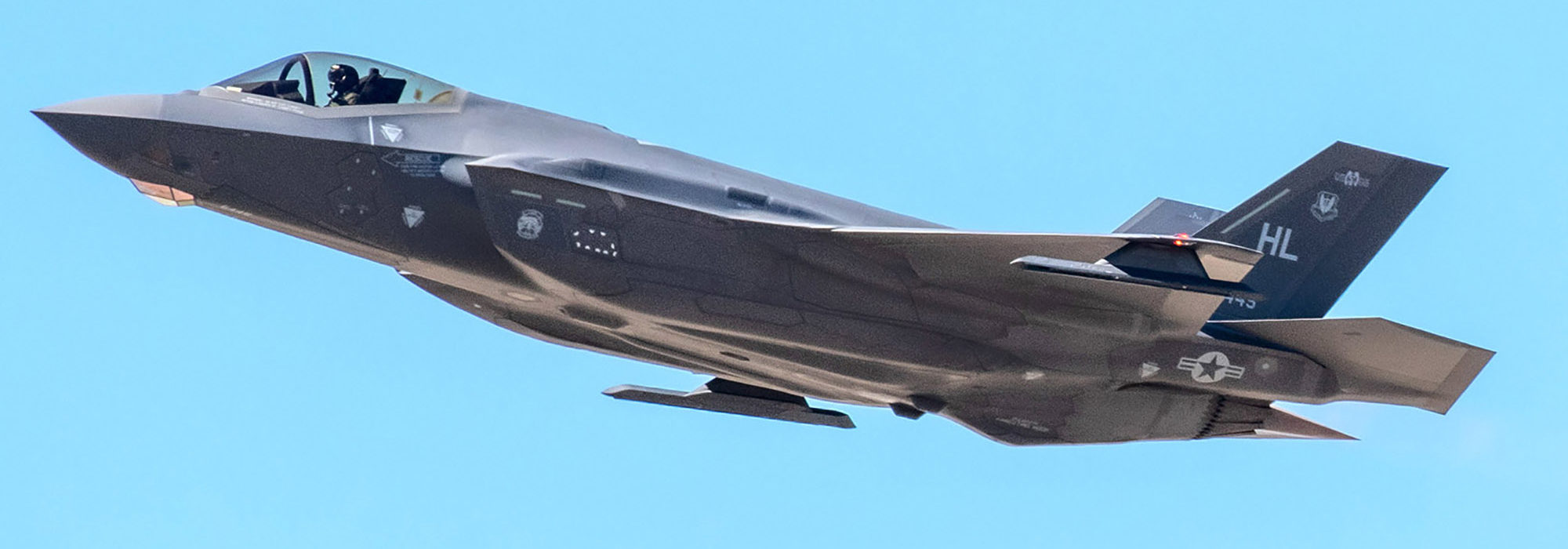
After several years of requesting 48 F-35s—and being given up to 12 more in 2019 and 2020—the Air Force is requesting only 33 F-35s in 2023.
There’s “a whole collection of reasons” for the reduction, Kendall said. First, the performance of the F-35’s Tech Refresh 3 update is “not what we wanted,” he said, and the TR3 is the basis for the Block 4 version of the jet, the version USAF has long said it wants to buy. The Air Force is investing additional money in the Advanced Engine Technology Program (AETP) that could power an upgraded F-35. Asked if the Air Force remains committed to the fighter, Kendall said, “Of course.” “We’re 15 years into production, and we’ll be building F-35s probably another 15 years. So, absolutely.” Kendall added the F-35 will continue to be, as Chief of Staff Gen. Charles Q. Brown Jr. has said, the “cornerstone” of the tactical fleet “for the foreseeable future. So there’s no question about that.”
Kendall noted that the AETP is a costly development program and that USAF is still courting “partners” among the other services to share the cost and the benefit of a new powerplant.
F-15EX

The Air Force doubles its 2022 request, from 12 Eagle IIs to 24 in 2023.
Kendall said Brown wants to “replace F-15Cs as quickly as possible,” and the availability of the F-15EX makes that possible. “It’s really a 4.5-generation kind of an airplane, but it provides more weapons carriage capabilities, writ large, than the F-35 does. So, for the homeland defense mission, and for some defensive counterair applications overseas, it has features that are desirable, operationally.”
USAF budget director James D. Peccia III said the F-15C/Ds will retire completely by fiscal 2026.
“One of the fundamental things motivating me on the operational imperatives in the TacAir area is the affordability of the future force,” Kendall noted. If we’re only buying NGAD, which is a very expensive platform; F-35s at $80 million a copy; and F-15EXs at $80 million a copy; we can’t afford the Air Force. So we’ve got to get a mix of lower-cost platforms, as well.”
B-21 Bomber

The FY23 budget grows by $1.7 billion to start low-rate initial production of the B-21 bomber, but Peccia said he could not reveal how many aircraft that will entail. At the time of the program’s unveiling, USAF officials said low-rate would probably entail five aircraft a year for several years.
KC-46A

The Air Force upped its 2022 buy from 14 to 15 in 2023, adding $220 million for the additional aircraft and getting the KC-46 rate up to where it was already planned to be. Kendall thinks the Air Force will likely stay with the KC-46 as it plans its next tranche of tanker buys.
“We had a KC-X, Y, and Z” scheme, Kendall said. “As we look at our requirements further out, [they] start to look more like a modified KC-46 than they do a completely new design.”
“I want to be very transparent about this,” he said. “I think there’s still a possibility of competition out there, but as we’ve looked at our requirements, the likelihood of a competition has come down.”
HH-60W

The Air Force’s plan was to buy 113 HH-60W helicopters for combat search and rescue, but USAF said it will “complete the buy” with 10 more aircraft in 2023, cutting the acquisition short at 75 helicopters.
Last August, Air Combat Command Chief Gen. Mark D. Kelly said Airmen who go down in contested areas of the Pacific may have to get themselves to a place where they can be picked up, given that the air defense threat will be so challenging to manage a rescue.
MH-139

The Air Force is buying five MH-139s in fiscal 2023. Peccia said they were in the 2022 budget but had several certifications yet to be completed. Those are now done, or will be in “the next couple of months,” and the program can proceed, he said. The goal remains to buy 80 of the Grey Wolf helos.