
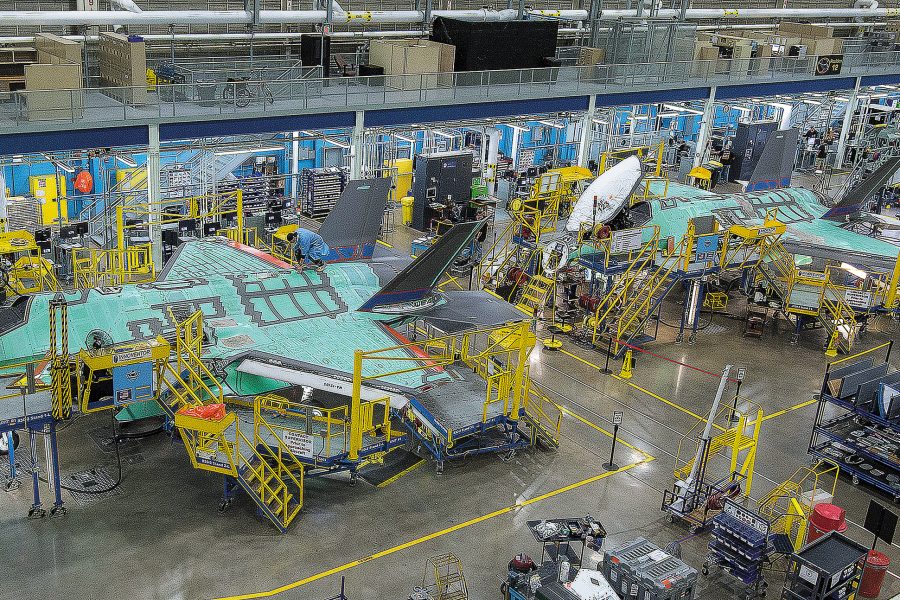
The Air Force is seeking to buy around 108 new aircraft in fiscal 2027—though really, officials wish they could get more.
The issue isn’t just more money, according to the service’s No. 2 officer; contractors just aren’t able to produce enough aircraft at the present moment, Gen. John Lamontagne said June 4 at AFA’s Mitchell Institute for Aerospace Studies.
“It’s [about] how quickly can industry respond to our demand signal? And right now, I’d say our demand signal is outstripping their ability to produce quality airplanes on schedule, on time,” Lamontagne said. “It takes them a while to facilitize, to be able to either stand up another line or to produce more airplanes over time.”
The 2027 budget request includes:
- 38 F-35As
- 24 F-15EX Eagle II fighters
- 23 T-7A Red Hawk trainer aircraft
- 15 KC-46 Pegasus refueling tankers
- An undisclosed number of B-21 Raider bombers
The number of fighters and F-35As in particular surprised some observers when the budget rolled out this spring. Despite the overall defense budget soaring to $1.5 trillion and the Air Force budget increasing some 25 percent, the service’s 62 new fighters fell short of its longstanding goal of 72 new fighters per year to hold down the fighter fleet’s age and keep capacity steady.
Lamontagne indicated that the Air Force would have allocated more of its budget increase to buying aircraft if it could.
“Candidly, we probably had some more opportunities to buy, but industry can’t quite respond that quickly to what we’d like to do,” Lamontagne said.
In the short term, the vice chief said, the service is trying to address the issue by retaining more of its older aircraft it previously planned to retire, such as the A-10 close air support aircraft and the KC-135 tanker. The increase in the Air Force topline makes it easier to do so, he noted.
Beyond that, the goal is to increase industry’s production rates. Pentagon and Air Force leaders are doing that, Lamontagne said, by giving vendors a stronger “demand signal” so they feel more confident investing in their production lines. Right now, he added, they are put off by what he called “sawtooth” funding that fluctuates every year.
“The more predictable and stable that funding is over time, it will enable that facilitization and the incentives to build more airplanes over time,” he said. “So, we’d love to buy more.”
One way to keep funding predictable is through multiyear contracts. Congress is currently considering legislation that would let the Air Force enter into multiyear procurement deals for the F-35 and F-15EX, and the Air Force is trying to whip up support for that, Lamontagne said.
“I think that serves our interest very, very well going forward,” he said.
NGAS
Lamontagne, a KC-135 and C-17 pilot by trade, came to the Vice Chief job after a stint at Air Mobility Command. In that role, he oversaw an analysis of alternatives for the Next-Generation Aerial Refueling System.
For years, the Air Force has envisioned a future tanker to replace the last of the Eisenhower-era KC-135s, capable of flying deeper into contested airspace to refuel stealthy fighters like the F-35 and the future F-47.
In the 2027 budget request, however, the service essentially shelved NGAS in favor of a new Advanced Tanker Systems program. Faced with a massive modernization portfolio projecting years out that includes new bombers, fighters, drones, trainers, intercontinental ballistic missiles, and more, Air Force officials decided to focus less on a new airplane and more on upgrading existing refuelers with systems that will help them survive in hostile airspace, Lamontagne said.
Yet the idea of a future NGAS tanker may not be so much dead as deferred as the service focuses on buying and accepting more KC-46s.
“We certainly need to procure another airplane,” Lamontagne said. “As we go towards 188 KC-46s, and then another 75, we’ll need to make a decision after that on how we want to continue to [recapitalize] the KC-135. There will still be probably north of 200 KC-135s that need to be recapped, and so we’ll need to make a decision on exactly how we’re going to do that going forward.”
