


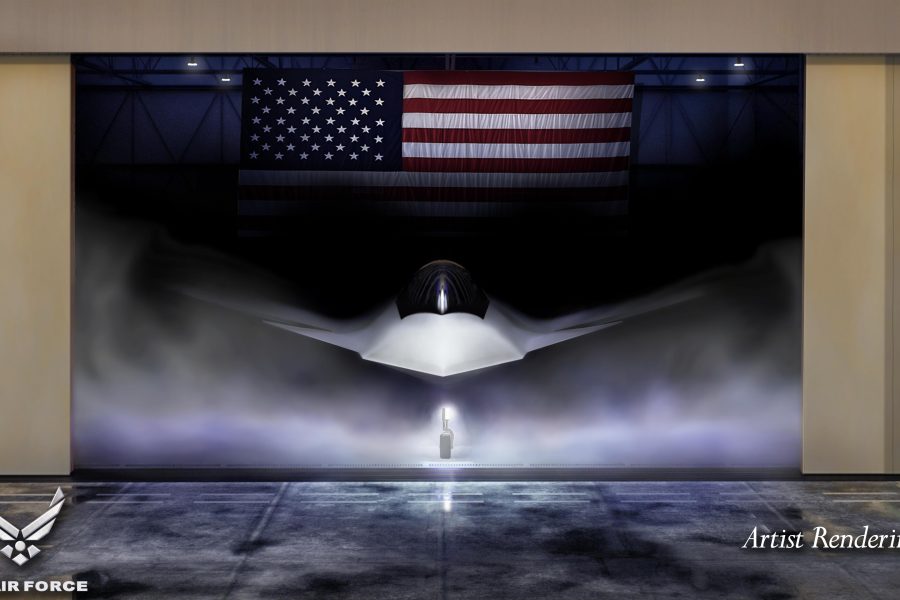
Chinese media outlets are attempting to dismiss the U.S. Air Force’s planned sixth-generation fighter jet, the F-47, by criticizing the cost, downplaying the technology, and reporting that the U.S. won’t be able to effectively produce the air dominance platform.
The China Aerospace Studies Institute at Air University, which regularly publishes research into Chinese military developments, released a report on early Chinese media coverage of the F-47 on April 13.
The report, authored by research analysts with the think tank BluePath Labs, identified three key points from Chinese media following a survey of various sources:
- Outlets have emphasized the program’s high cost and downplayed its capabilities.
- Chinese media are criticizing the F-47’s prime contractor Boeing.
- Some Chinese analysts predicted access to rare earth metals will be a chokepoint in F-47 production
The U.S. Air Force has trumpeted the F-47 as the first sixth-generation fighter jet in the world. Officials say the aircraft will have an even greater degree of stealth technology, a combat radius exceeding 1,000 nautical miles, and fly at speeds greater than Mach 2. If successful, that would nearly double the combat radius of the F-22 Raptor. Current plans call for acquiring more than 185 F-47s to match the F-22 fleet.
Retired Navy Cmdr. J. Michael Dahm, senior resident fellow for aerospace and China studies at AFA’s Mitchell Institute for Aerospace Studies, told Air & Space Forces Magazine that most major media outlets in China are state-run and stick to a larger strategic message.
“What we’re seeing from state media is what we would expect to see from state media,” Dahm said.
Much of the reporting from this state-run media is aimed at three audiences—the Chinese people, regional neighbors, and the U.S. government, he said.
For the Chinese audience, the goal is to reassure the population that China can effectively compete with the United States.
For regional neighbors, the aim is to show that the United States won’t be successful and get them to carefully consider who they pick as their allies.
And for the U.S. government, the effort is to get them questioning their own programs.
Military experts quoted in Chinese media, such as commentator Zhang Xuefeng, have said that the F-47 will be the most expensive aircraft in history, and a combination of those high costs and budget cuts could prevent the program from reaching its goals.
The advanced fighter is on track to fly by 2028, only three years since its start, USAF Gen. Dale White said at AFA’s Warfare Symposium in February.
By comparison, in 1991, the Air Force selected the F-22 as the winner of its Advanced Tactical Fighter contest. The first production model didn’t fly for another six years. The Lockheed Martin-built F-35 first flew five years after its contract was awarded.
White assured reporters at the symposium that Boeing was ahead of any anticipated problems in the F-47’s development.
“Boeing has done a really good job of ramping up the personnel piece,” White said. “In the early phases of these programs … you typically watch the personnel ramp against the timeline and activities you have to get done. They’ve done very well with that.”
Chinese media have been quick to note Boeing’s issues in recent years—cost overruns on the KC-46 tanker, delayed deliveries, and financial troubles—raising questions about the company’s ability to keep the F-47 moving forward.
But retired U.S. Air Force Col. John Venable, now a senior fellow at the Mitchell Institute, said most delays in recent years can be traced to supply chain issues that emerged with the COVID-19 pandemic. That has affected the entire industry in some form, but firms like Boeing are recovering from those problems.
“It would be a poor assumption to believe that’s going to continue for any amount of time for any longer,” Venable said. “I think you’re going to see a significant change in the delivery scheme for every one of the metal benders, and that includes Boeing.”
Chinese experts have also tried downplaying the F-47’s anticipated capabilities, per the report. One expert, Jin Yinan, said the effort to build the F-47 stemmed from the United States sensing it was losing its technological lead over China.
“With the rapid development of aviation industries in countries like China, the U.S. Air Force’s capabilities were not only failing to maintain a lead over competitors but were at risk of being overtaken—creating an aviation equivalent of America’s ‘Sputnik moment,’” Yinan is quoted as saying.
But Venable argued that the Air Force’s latest capabilities like the F-22 and F-35 are proving in current operations that the U.S. still outperforms Russian and Chinese systems.
He pointed to the F-35’s use against Chinese-made systems in Venezuela during the January mission to capture former President Nicholas Maduro, and its successes against the Russian-made S-400 aerial defense and other systems in Iran during Operation Epic Fury.
“The Chinese and the Russians don’t have an answer for the F-35,” Venable said. “The U.S. is not going to invest in something that doesn’t give them a generational advantage over the rest of the world.”
Venable said that F-35 technology, developed more than 20 years ago, is outgunning the competition and that the technology delivered from the F-47 would signal another “paradigm shift” in U.S. advantage.
Lastly, the CASI report noted that Chinese media outlets have claimed that the F-47 is too reliant on rare Earth minerals, most of which China produces, and that these materials will become a chokepoint in developing the F-47.
Venable acknowledged that China produces much of the planet’s rare Earth mineral supply, but he credited the Trump administration with bringing in the minerals from other countries and beginning to build rare Earth mineral capacity in Canada and the United States. The amounts required for the F-47 are small enough to be readily obtained through those means, he said.