
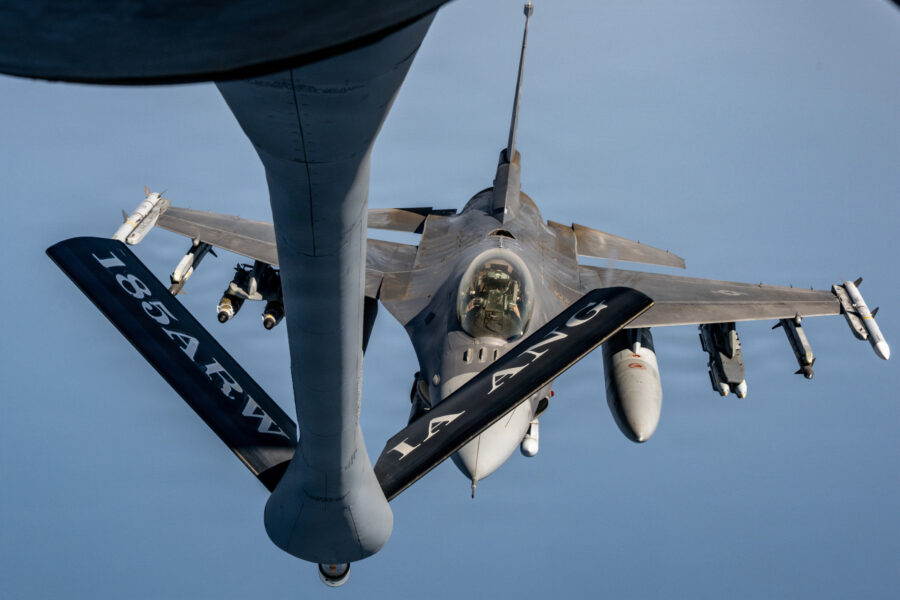
The U.S. is rotating fresh fighter squadrons to the Middle East to support the Trump administration’s open-ended pressure campaign against Iran.
The move will free up units that have been based in the region far beyond the Air Force’s usual six-month deployments. More fighter unit rotations are expected in the coming weeks.
Units on their way home include the 158th Fighter Wing of the Vermont Air National Guard, which flies F-35 Lightning II aircraft, and F-16 Fighting Falcons from the 555th Fighter Squadron based at Aviano Air Base, Italy, are also returning, according to people familiar with the matter and data collected by the open-source research group the Military Air Tracking Alliance.
The departing units have been deployed overseas since last year. The Vermont F-35s first deployed to Puerto Rico in December 2025 and supported the capture of Venezuelan President Nicolas Maduro in January, before deploying to the Middle East ahead of the U.S. air war against Iran. The Vermont ANG’s F-35s were spotted transiting through RAF Lakenheath, U.K., on their way back home. The F-16s from the 555th Fighter Squadron had been deployed to the Middle East since November.
Arriving in CENTCOM are F-16s from the Ohio Air National Guard’s 180th Fighter Wing. Twelve F-16s from the Ohio ANG departed Lajes in the Azores on Sept. 4, according to local aircraft spotters. The planes, which arrived on the Portuguese island on Aug. 29, are due to head to the Middle East.
Other units likely to deploy in the coming weeks include the 115th Fighter Wing of Wisconsin Air National Guard, which flies F-35s, sources said.
A spokesman for U.S. Central Command did not respond to a request for comment.
Treasury Secretary Scott Bessent said last month that the U.S. is stepping up its economic sanctions campaign to try to stop Iran from interfering with oil tanker traffic in the Strait of Hormuz while pressing Tehran to make concessions on its nuclear program. That is in addition to the ongoing American maritime blockade.
“If we are doing the maximum economic pressure, then that means that likely there will not be a large-scale kinetic restart,” Bessent told CNBC last month.
But U.S. officials also say that the increased economic pressure might lead Iran to retaliate militarily. Fighting in the region flared up late last month when the U.S. struck Iranian launchers that were preparing to launch rockets with mines into the strait, and Iran retaliated by firing ballistic missiles at American forces in Jordan.
The new U.S. pressure campaign is likely to reduce the need for defensive and offensive munitions in the near term. But it still requires an ongoing military presence in the region and efforts to manage operational demands on the force.
The USS Abraham Lincoln docked in Thailand earlier this week after spending nine months at sea. The Lincoln took part in Operation Epic Fury—which officially lasted from Feb. 28 to early April—and then helped enforce a U.S. military blockade of Iranian ports and partook in tit-for-tat clashes against the Iranians for months.
Dozens of Air Force and Navy fighter jets remain deployed to the Middle East.