


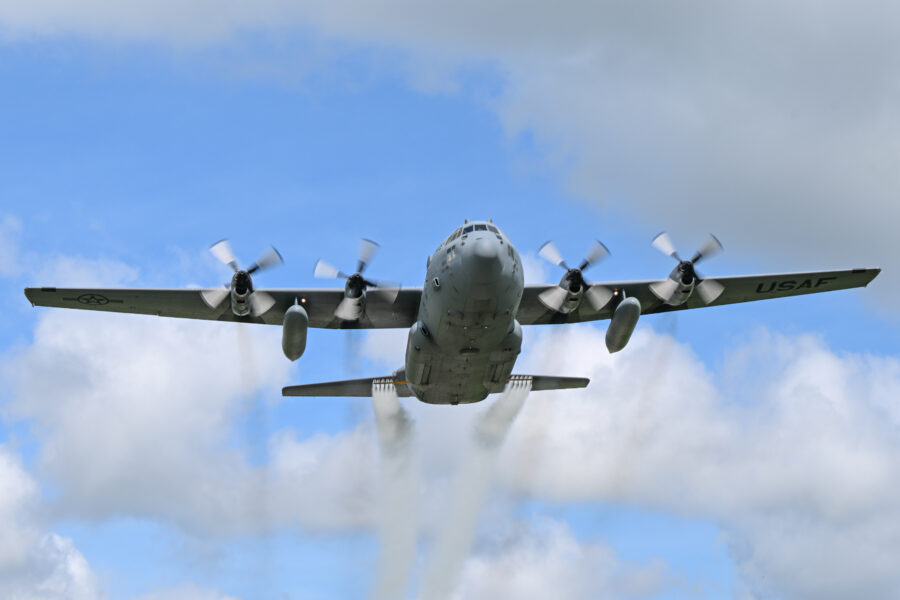
Over the past few months and peaking in August, crews with the 910th Airlift Wing out of Youngstown Air Reserve Station, Ohio, have been running nighttime, low-flying missions to kill a ubiquitous and deadly adversary that’s plagued Americans for centuries—mosquitoes.
In a given year, crews with the wing conduct 25 recurring missions annually, blanketing thousands of acres with spray to kill mosquitoes carrying West Nile virus; a blue-hued herbicide for invasive plants such as halogeton, which grows on the Utah Test and Training Range; and an oil dispersant for spills such as the 2010 Deepwater Horizon incident.
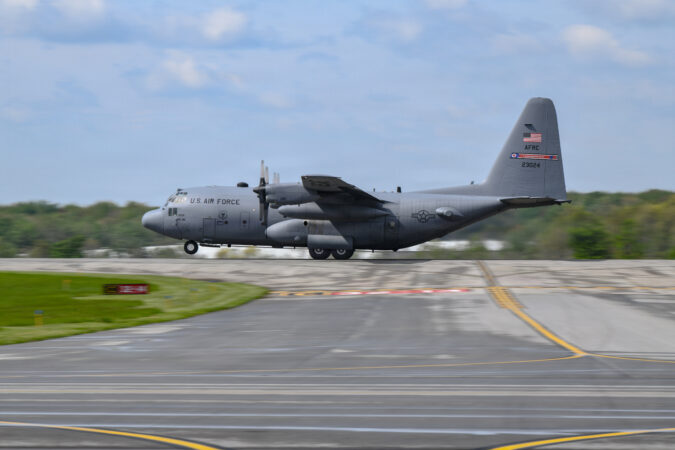
For decades, the 910th’s C-130H Hercules and analog sprayers have conducted this mission, but the aging aircraft and its equipment have far exceeded their expected use.
The Air Force Reserve has been working since the early 2010s to replace these aging aircraft with C-130Js and their sprayers with more efficient technology.
But like the pesky mosquito, delays in integrating the new Electronic Modular Aerial Spray System and delivering the Lockheed Martin-built C-130Js have stymied the modernization effort.
In April, during his final testimony to Congress before retiring, then-Chief of the Air Force Reserve Lt. Gen. John P. Healy praised the unique work of the 910th, whose main mission is to provide tactical airlift—delivering cargo and personnel via airdrop and air-land techniques—and told lawmakers he fears that their spray mission could stall if political leaders and the Department of the Air Force didn’t take action.
Delays in J model deliveries, EMASS compatibility, requirements to divest H models, and aircraft availability concerns means the department could be forced to rely on one plane to service a dozen military sites across nine states. That’s not to mention the possible need for spraying in the event of a major hurricane, overseas disaster, or combat mission that needs to exterminate deadly bugs.
“I predict next year in ‘27, where we’re going to be stuck with only one potential spray system to service the country, and I think that’s an uncomfortable risk with regard to the mission set that they provide,” Healy testified.
Life extensions on the H model aircraft and the integration and delivery of the new EMASS equipment could mitigate the issue, and the wing is hoping to receive four new C-130Js in the coming months, Reserve spokesman Sean Houlihan told Air & Space Forces Magazine. The last of the H models will stick around through 2027, Houlihan added.
But even with the Js now arriving, the long timeline for crew training and certifying the EMASS spray system means that the new Js won’t be able to spray for months.
The Mission
The spray mission predates the Air Force itself; in 1943, the Army Air Forces worked with the Bureau of Entomology and Plant Quarantine to develop technology for a wide-area, aerial-dispersal spray to kill mosquitoes in World War II’s Pacific theater using dichlorodiphenyltrichloroethane, or DDT.
The Reserve took over the spray mission from Active-Duty units in 1973 at the tail end of the Vietnam War. In the 53 years since, the Reserve has conducted 10 non-military emergency deployments, spraying more than 7 million acres for pests and insects. Those missions included a 1973 Panama deployment to combat mosquitoes carrying Equine encephalitis, a 1987 mission to reduce Dengue fever-carrying mosquitoes in Puerto Rico, a 1999 deployment to North Carolina and Virginia in the wake of Hurricane Floyd, and a 2005 trip to the Gulf Coast in the aftermath of Hurricanes Katrina and Rita.
The 910th has been the sole unit for this mission since 1992, and as recently as 2009, it had 16 aircraft. Between 2009 and 2014, the wing lost eight planes as the Department of the Air Force decided to retire more of its H models.
Delayed Aircraft
Planning to recapitalize that fleet goes back to at least the fiscal 2020 budget, which saw Congress allocate $730 million for eight C-130J aircraft, four each for the Guard and Reserve. At the time, Air & Space Forces Magazine reported that the Reserve was considering the 910th and the 302nd Airlift Wing in Colorado as potential units for the new aircraft, with deliveries expected in 2023.
More funding for Reserve C-130Js followed in the 2021 and 2022 budgets, and in late 2022, the Department of the Air Force tapped Youngstown as its preferred location for eight C-130Js, setting up the 910th to recapitalize its entire C-130H fleet.
The J model requires two fewer crew members, easing the aircraft’s manning load on all missions. The C-130 crew no longer needs a navigator or flight engineer because its advanced systems perform that work.
The unit received its first C-130J in July 2024 and its second in December 2024. But then things slowed in 2025, as manufacturer Lockheed Martin began integrating a new communications suite because of obsolete components. Deliveries ground to a halt.
Christopher Karns, a Lockheed spokesman, told Air & Space Forces Magazine the firm has finalized certification of the new implementation design and resumed deliveries earlier in 2026. The 910th received its third J model in May.
The company does not determine which Air Force units get planes and when. That’s determined by the service. The 910th had expected its fourth C-130J over the summer, but that has been delayed again until September.
Lockheed expects to return to “historic averages between 16-24 aircraft” in 2026, Karns said. As of late August, there were 40 C-130Js in various phases of production, Karns said.
The delivery delays have had a ripple effect. The 910th has been divesting H models as it takes on new J models, leaving the wing with three C-130Js and four C-130Hs built between 1989 and 1992.

Spraying System
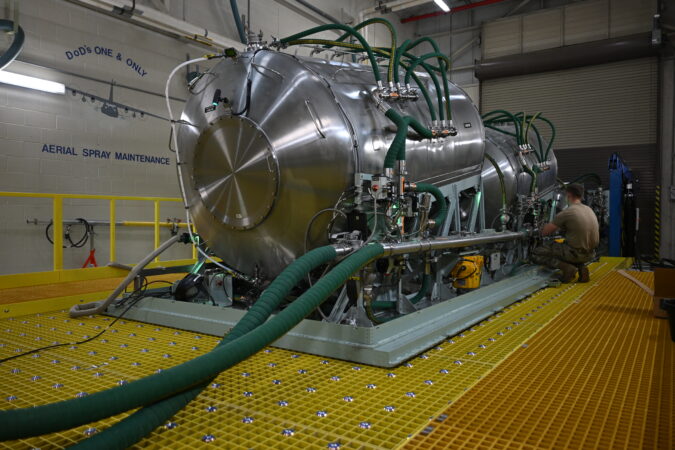
New aircraft are only part of the equation for the spray mission. The Air Force is also trying to field a new spraying system, the EMASS. In 2025, the service awarded a $98.4 million contract to the Battelle Memorial Institute in Ohio to build five EMASS for the Js.
The legacy Modular Aerial Spray System is now 30 years old. It runs four 500-gallon tanks with a 250-gallon flush tank. By contrast, the EMASS can carry up to 3,500 gallons for spraying.
The full, palletized, roll-on/roll-off EMASS kits interface directly with the J model and use the Next Generation Agricultural-Global Positioning System to manage precision, location-based spraying at low altitudes, maximizing pesticide and herbicide use while minimizing collateral or off-target spraying.
Training and Certification
The combination of a new aircraft model and new spray system has required extra layers of training, testing, certification, and calibration for the 910th.
Training to transition from the C-130H to the J model can take six months to a year at Little Rock Air Force Base, Ark.
Beyond that transition, there’s another layer of specialized training for the spray mission. Pilots typically need at least 500 flight hours before starting spray training, which has aircraft fly as low as 150-300 feet off the ground.
“We do not have a simulator for spray training, so we outfit a vehicle with a lightbar to put on the dashboard,” said Lt. Col. Steve Stroney, 757th Airlift Squadron director of operations and the unit’s most seasoned aerial spray operator. “This is what we use to identify the centerline of a spray swath in the airplane.”
By training with a lightbar on the ground, pilots can get a “low-threat introduction” to visual cues before flying, Stroney said.
After ground training, pilots start local training using the equipment but not yet spraying, working down to 300 feet at night and 100 feet during the day.
Effects
The spray mission’s impact is vast—the 910th services ranges and air installations across the country. It even helps kill many of the legendary sand fleas that munch on recruits at Marine Corps Depot-Parris Island, S.C.
At Minot Air Force Base in North Dakota, Lester Nicholas, 55, has worked the pest control mission both in uniform and as a civilian. Right now, the retired master sergeant works with two Airmen to track and handle every pest across the base’s 8,500 square miles and 150 ICBM launch facilities.
Nicholas spent much of his career at Minot and Grand Forks Air Force Base, N.D. The job chose him.
“I came into the Air Force, and that’s the job they assigned me,” Nicholas told Air & Space Forces Magazine. “That was a long time ago.”
The three-person crew drives trucks with pesticide foggers through some areas of the base, but the harder-to-reach spots where mosquitoes love to live can be tougher. That’s where the 910th comes in.
“We’re kind of limited to the areas, especially the areas that get swampy,” Nicholas said. “Whereas the plane flies above, and the chemical will drift down and get pretty much 100 percent coverage.”
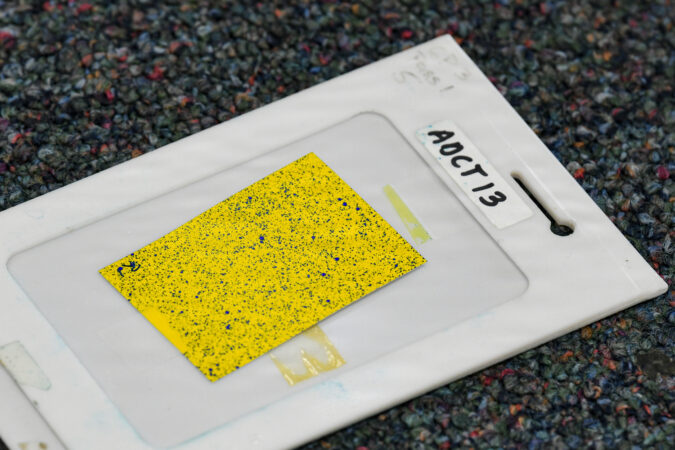
The unit’s data shows that sprays can reduce insect bite counts from up to 200 bites per minute down to less than one, a 91 percent reduction.
Bryan Banfill, a 21-year Air Force veteran who retired in 2024, saw the spraying while stationed at Minot from 2004 to 2013 and now depends on it in his job as the city of Minot’s public works operations director.
The former electronic warfare technician, Joint Air-to-Surface Standoff Missile program manager, and ROTC instructor didn’t plan on targeting mosquitoes for his day job.
“You know, when I first took this job, I thought for sure I’d learn a lot of neat and interesting facts,” Banfill told Air & Space Forces Magazine. “Mosquitoes, that was definitely not on that list. I had no clue.”
Banfill and his office start tracking mosquito numbers in June. The wetness of the winter and late spring/early summer seasons indicates the likely population, but it always varies.
“We check larval counts, so we actually look at standing bodies of water and what type of increases we’re seeing for larvae,” Banfill said. “Essentially, the pre-hatch for the mosquitoes themselves.”
The city of Minot and the 910th then try to time the spray to kill the adults and reduce the mosquito count later in the summer, when it typically peaks in August.
“We start seeing increases right around the time they’re able to assist us with the spray, the aerial spray itself,” he said.
In July, his team saw about 120 mosquitoes per week, then a spike of more than 2,000 at various locations throughout the city.
“The aerial spray is mainly used, or actually only used, for adulticide,” Banfill said. “So, it is to go ahead and attack the mosquitoes themselves that are already post-hatch.”