
New Hypersonic Attack Cruise Missiles
By Greg Hadley
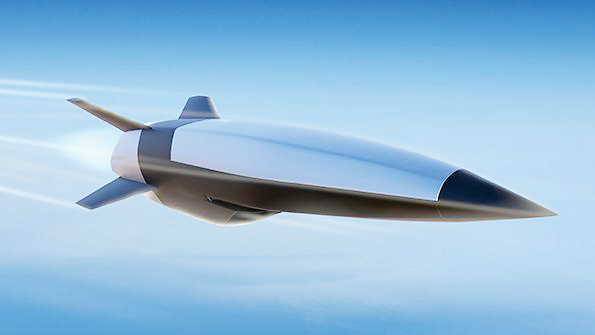
The Pentagon’s top research lab is interested in developing a hypersonic cruise missile prototype that provides “a revolutionary leap in operational performance,” as the first wave of U.S. hypersonic weapons enters production and service.
The Defense Advanced Research Projects Agency (DARPA) released a notice Aug. 7 informing industry of a potential new program called the Next-Generation Hypersonic Cruise Missile and seeking information and ideas on the topic.
“The goal is to design, build, and flight-test a fully integrated hypersonic cruise missile system demonstrator,” the notice states. “This demonstrator must establish the foundation for a next-generation capability that delivers a revolutionary leap in operational performance—specifically in range, cruise speed, and/or altitude. This capability must maintain technological superiority, enabling the U.S. to promptly strike advanced threats in highly contested environments.”
The notice also states that previous demonstrator programs have proven the technology behind air-breathing hypersonic weapons. But these concepts have provided only “predictable, incremental gains in isolated performance metrics” and are often expensive and complex, making them hard to transition to mass production.
Now, DARPA is hoping for a “quantum leap in overall system performance,” fueled by “high-risk, high-reward technologies,” though the notice doesn’t say what those technologies might be.
In addition to range and speed, the agency is interested in improved performance in areas like midcourse maneuverability and overall signature so that the new hypersonic missile can better evade adversaries’ integrated air and missile defenses.
DARPA previously explored hypersonic cruise missiles through its Hypersonic Air-breathing Weapon Concept in the early 2020s, developed with the Air Force and Lockheed Martin and resulting in several successful flight tests. Then the Air Force started developing the Hypersonic Attack Cruise Missile with Raytheon—the service is planning to start production on the HACM in 2027, according to budget documents.
These weapons use a “scramjet” air-breathing engine to reach hypersonic speeds, defined as above Mach 5. They’re different from other “boost-glide” weapons that use solid rocket boosters to power the vehicle to hypersonic speeds and then have the vehicle coast or “glide” to its target while being able to maneuver along the way. Air-breathing weapons are considered more efficient and can be smaller, allowing them to be carried on a greater variety of platforms.
Indeed, DARPA’s latest notice states that the agency is interested in different “classes” of next-gen hypersonic missiles, ranging all the way from weapons that can be carried internally and externally on fighters to ones that can be launched from pallets to ones that can only be launched from bombers or on the ground.
In addition to developing a new generation of weapons, DARPA wants to develop new test and evaluation technologies for hypersonic weapons—testing has been a persistent chokepoint in hypersonics development.
Current Hypersonic Weapons
The Air Force is pouring most of its resources for hypersonics into the HACM program; the service’s 2027 budget request includes around $1.01 billion for HACM, split $404 million for production and $806 million for research, development, test, and evaluation. Exactly how expensive each of these missiles is—and thus how many the Air Force is buying—remains secret.
The first aircraft HACM will be fielded on is the F-15E Strike Eagle, according to budget documents, and it could be carried by fighters and bombers alike.
But the service is also still pursuing the Air-Launched Rapid Response Weapon. ARRW is a boost-glide weapon that can only be carried by bombers. Despite a series of test failures several years ago, the Air Force recently revived the program and is requesting $797 million for it in 2027: $452 million in procurement, $345 million in R&D mostly for a second “increment” of the weapon.
The Army and Navy, meanwhile, are working to field variants of the same boost-glide system called the Long-Range Hypersonic Weapon or Dark Eagle.
The Air Force’s New Standoff Strike Option
By Todd South
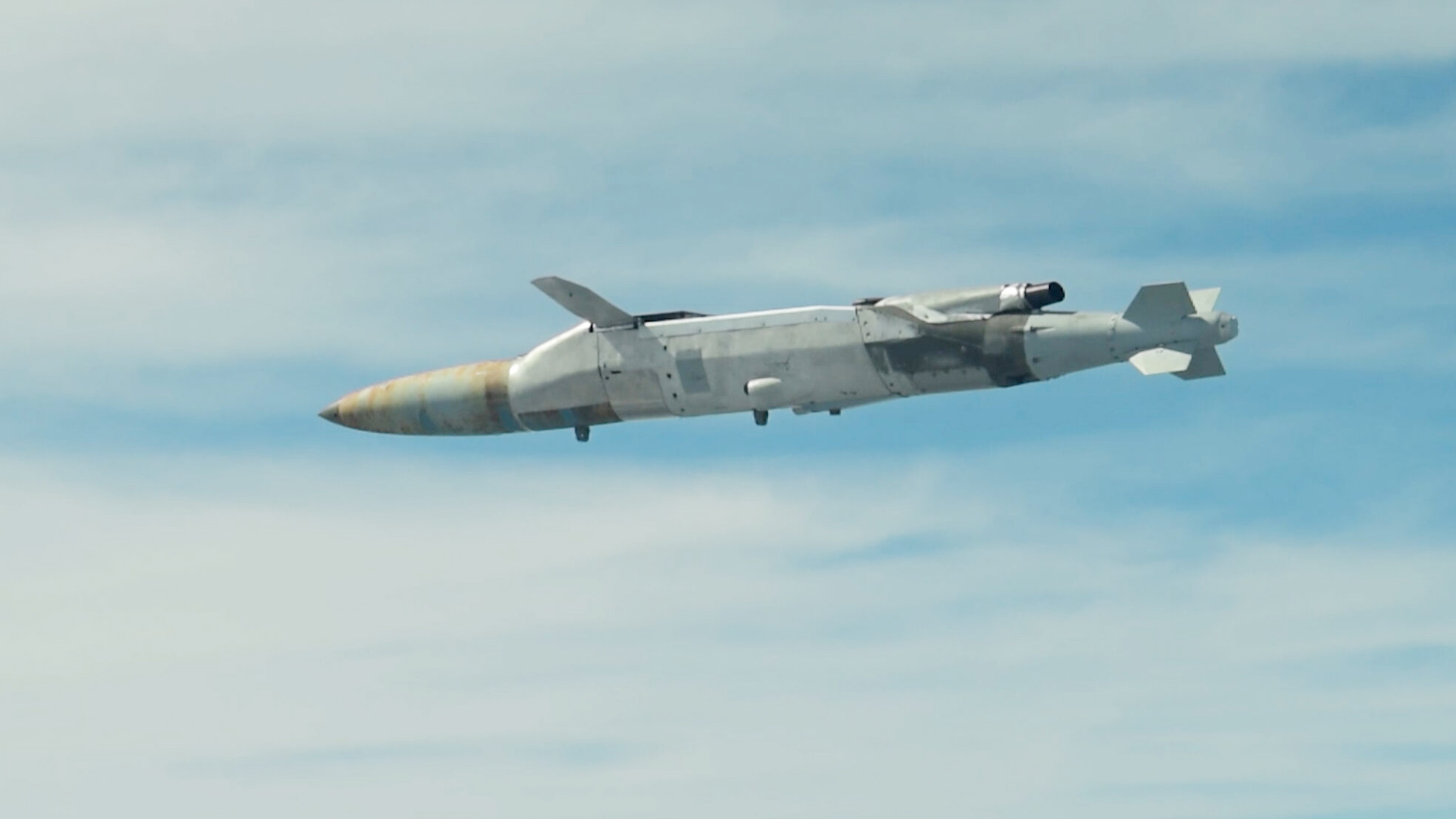
The Air Force awarded Boeing a $75 million production contract to begin supplying long-range Joint Direct Attack Munitions (JDAMs) as the service seeks to expand its arsenal and extend the range of its key munitions.
The BSU-111 Payload Delivery Unit (PDU) creates a new JDAM variant, the GBU-75 JDAM-LR, with a standoff range of more than 300 nautical miles for a 500-pound payload, Boeing said in a release.
That’s a significant increase from the standard GBU-38 JDAM, at 15 nm, and the extended-range JDAM-ER, at 45 nm.
The long-range variant adds a Kratos TDI-J85 turbojet providing 200 pounds of thrust to enable jets to attack from a much safer distance. Improvements in adversaries’ air defenses have made penetrating strikes by nonstealthy aircraft increasingly risky.
“This is a good decision, though long overdue,” said retired Air Force Col. Mark Gunzinger, Director of Future Concepts and Capability Assessments at the Mitchell Institute for Aerospace Studies. “This will give the Air Force new options to conduct strikes from medium-range standoff distances.”
The 2027 National Defense Authorization Act includes about $277 million for 1,150 upgraded JDAM guidance tail kits with M-Code GPS for the legacy munitions.
Gunzinger said the new version will cost “far less than more exquisite standoff munitions, so they should be considered as an affordable mass capability.”
The JDAM-LR was developed through the Navy, and only completed flight testing in April, marking rapid development by typical standards—recognition that fourth-generation aircraft need this capability soon, and that the Air Force and Navy need less costly alternatives to missiles for standoff attack.
Separately, the Air Force is developing its Family of Affordable Mass Missiles, to produce lower-cost missiles under a series of multiyear framework agreements signed in July with three defense newcomers—Anduril, CoAspire, and Zone 5 Technologies. The three companies are slated to produce a total of 8,000 missiles a year once production ramps up.
Munitions stocks were depleted during Operation Epic Fury, with U.S. forces expending an estimated 10,000 JDAMs, according to a June report from the Center for Strategic and International Studies.
The new munitions “will help the Air Force accelerate rebuilding its munitions inventories,” Gunzinger said.
While the Navy-led JDAM-LR program focused on delivery by fighters, Gunzinger said the weapon also has utility for bombers. “The Air Force should buy JDAM-LR at scale and integrate them on its bombers as well as fighters,” he said.
The Boeing contract letter authorizes initial production of the PDU with the Navy, according to the Aug. 5 Boeing release. JDAMs are a joint Air Force/Navy program.
“This first production contract is a major milestone for the JDAM LR program, demonstrating our ability to deliver long-range precision-strike capability at a significantly lower cost,” Bob Ciesla, vice president of Boeing Precision Engagement Systems, said in the release. “Scaling production of the GBU-75 will provide the fleet with an affordable, sustainable solution designed to eliminate long-range land and sea-based threats to U.S. and international forces and enable them to safely and effectively operate in a contested battlespace.”
The JDAM-LR system completed its first test flight off the coast of California on April 1 and a second test flight on April 3. During those flights, it sustained powered flight on a predefined test profile using M-code GPS, according to the release.
Both demos flew an estimated 200 nautical miles, according to a Navy release at the time.
“As Naval Air Forces in theater continue to rely heavily on JDAM systems, the program recognizes a critical need to provide the fleet with greater standoff range,” said Capt. Sarah Abbott, Precision Strike Weapons (PMA-201) program manager, in an April Navy release. “This new capability allows pilots to engage targets from significantly safer distances, maintaining a tactical advantage in contested environments.”
Navy teams are also doing testing for shipboard integration of the JDAM-LR.
USAF Preps Next-Gen Engine Testing
By Todd South
DAYTON, Ohio—
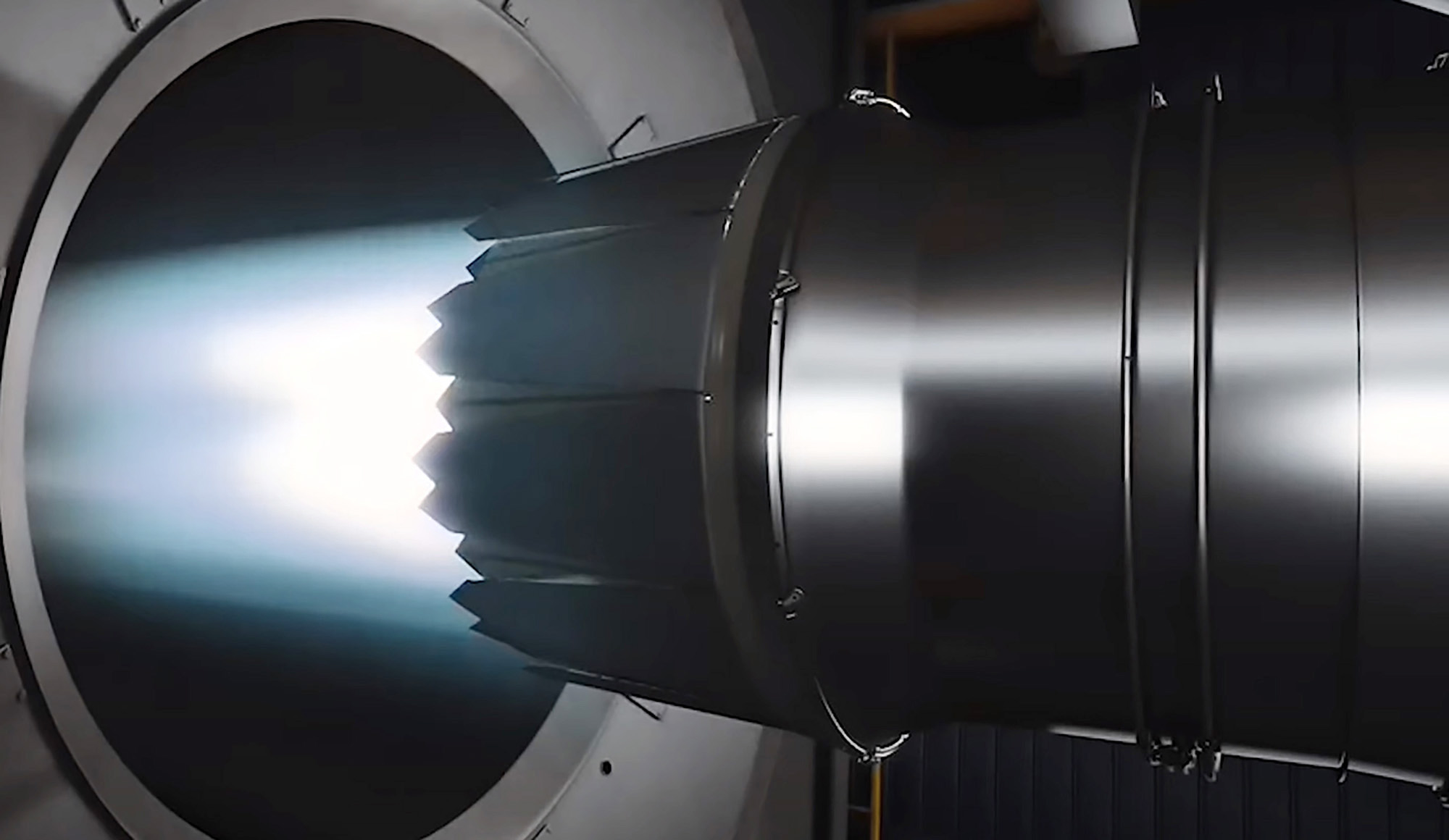
The Air Force is preparing to move toward prototyping and testing a next-generation advanced engine and wants to be ready to integrate it onto an aircraft around 2030.
But while the Next-Generation Adaptive Propulsion (NGAP) engine has been closely associated with the Next-Generation Air Dominance fighter, now called the F-47, service officials have yet to determine which aircraft the NGAP powerplant will first go on.
John Sneden, the Air Force’s portfolio acquisition executive for propulsion, told reporters at the Life Cycle Industry Days conference July 27 that the NGAP program has recently finished a readiness review and is ready to start moving toward prototyping, building, and testing adaptive engines.
That preparation is reflected in the Air Force’s future budget projections, Sneden said, which show spending on NGAP growing sharply from $326 million in 2026 to nearly $906 million in 2028. That’s followed by another big year of $865 million in 2029, before falling back down to $303 million in 2030.
That budget spike “is really about building engines, testing engines, and then we’ll be rolling through that competitively over the next few years, and be ready for potential integration activities in the 2030 timeframe,” he said.
GE Aerospace and RTX’s Pratt & Whitney are working on so-called adaptive engines under the multibillion-dollar NGAP program. Adaptive engines are designed to shift to the most efficient thrust configuration for whatever situation a jet is in.
The Pentagon gave serious consideration to modifying the F-35 with adaptive engines under the Adaptive Engine Transition Program, but ultimately decided to instead upgrade the F-35’s already-existing engines, an effort that Sneden said is also progressing toward a 2030 milestone.
Still, the work that was done on AETP has informed the NGAP program.
Sneden said both GE Aerospace and Pratt & Whitney have met the NGAP program’s requirements and showed their systems are ready.
“That means initial hardware is procured, their design meets our standards, everything is clean from that end, and both vendors have been able to do that,” Sneden said.
NGAP engines are also the first that have ever been designed digitally, Sneden said, which allowed the program to verify their design attributes digitally as well.
Sneden said the Air Force is still figuring out which platform it wants to integrate NGAP engines into. That could be the sixth-generation F-47 Boeing is working on, he said, or another platform.
Sneden said NGAP will be flexible enough to give the Air Force multiple paths forward for aircraft propulsion.
“We built NGAP as essentially an agnostic system,” Sneden said. “It was, build the system first, open up options for the future, and then when those options come to the forefront, we’ll be able to take advantage of it. You have to lean into propulsion technology first.”
Col. Timothy Helfrich, the PAE for fighters and advanced aircraft, emphasized that the F-47 is “still on track to fly this administration,” underscoring former Air Force Chief of Staff Gen. David Allvin’s promise that its first flight will take place in 2028.
Helfrich would not comment on propulsion plans for the F-47 in his own July 28 media roundtable, citing its high levels of classification.
However, since NGAP integration is not expected until 2030, it appears that the first F-47 flights will take place using a different engine.
Sneden acknowledged NGAP’s schedule has slipped and said it was because the program wanted to keep working with two viable vendors who could provide advanced propulsion technology. With a fixed budget, he said that meant splitting resources between two vendors instead of one.
But that investment will pay off down the line, he said.
“The competition is the gateway that enhances producibility, drives innovation, keeps costs down,” Sneden said. “So it’s actually quite critical, and it’s also critical to be able to maintain our advanced propulsion industrial base as we go into the future.”
NGAP is a “host of technologies,” and not a single unified system, Sneden said. That means the technologies could be broken out and integrated piecemeal on other platforms—even older aircraft.
“Not everything has to have an adaptive fan,” Sneden said. “So we can actually take that backward as well and incorporate it in some of our legacy platforms. So there is a great utilization for this type of tech.”
Sneden called NGAP a critical technology, that will help the United States maintain its air superiority in years to come.
“If you want to stay ahead of our competitors, then you have to lean into this technology now,” Sneden said.
