
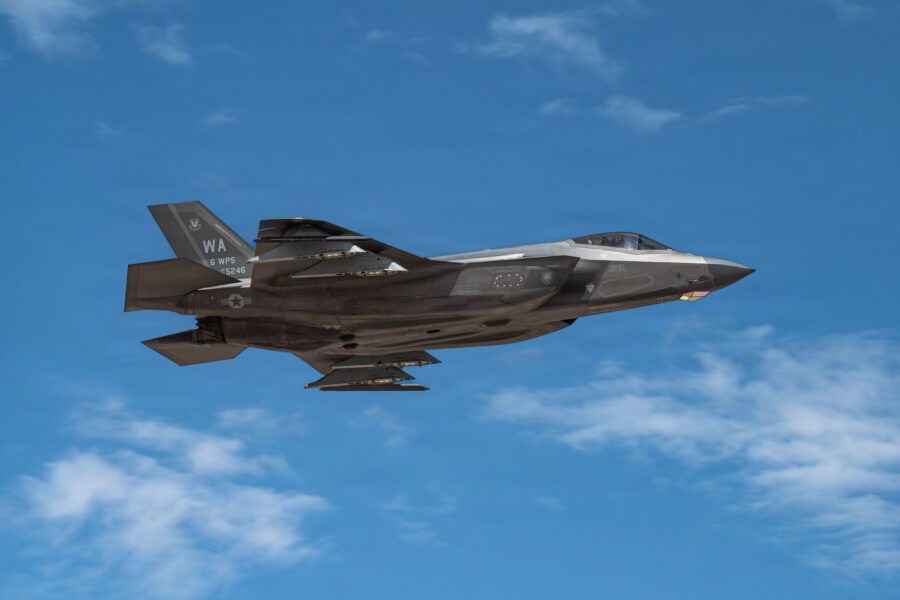
National Guard adjutants general from nearly two dozen states have signed a letter to Congress seeking multiyear funding for the Air Force to purchase between 72 and 100 new fighter jets per year to modernize the total force.
The letter, sent to Congress last week, stresses the need for the Air Force’s Active, Guard, and Reserve components to recapitalize their decades-old fighter aircraft with newer jets such as the F-35A Lightning II, F-22 Raptor, F-15EX Eagle II, and F-47.
“The United States Air Force is the oldest, the smallest, and the least ready in its 78-year history,” the letter states. “We must build a fighting force that will win.”
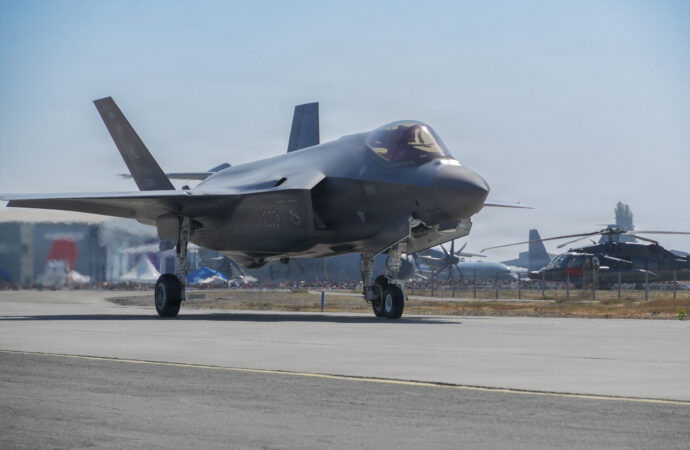
The generals are pushing the Air Force to request higher procurement numbers specifically for the F-35 and F-15EX, seeking a minimum of 72 new aircraft annually—48 F-35s and 24 F-15EXs. But their desired goal is more than 100 new fighters annually to “effectively build a force that will prevail if deterrence fails.”
The letter signers recommend a “desired goal” of procuring 72 new F-35s and 36 F-15EXs annually.
Brig. Gen. Shannon Smith, head of the Idaho Air National Guard and the state’s assistant adjutant general, told Air & Space Forces Magazine that it was the first time the group collected the signatures of all 22 adjutants general who serve in states with Guard fighter units.
“This is a pretty big deal,” Smith said. “What we’re trying to do with this is send a strong message from the two-star generals that command the National Guards in these states.”
Smith emphasized that the procurement numbers recommended by the letter are for the total force: Active, Guard, and Reserve.
The letter is being followed by communications from the group to congressional delegations this week to seek further support, Smith said.
The combination of a potential $1.5 trillion defense budget and the demands on the total force in Iran during Operation Epic Fury shine a light on the decadeslong modernization gap between the Guard/Reserve and Active Duty, Smith said.
“We all see the headlines of the amazing things our service men and women do,” Smith said. “We are burning these jets and the Airmen over time to support the joint force to accomplish the president’s goals with Epic Fury in this conflict with Iran.”
The backlog of legacy aircraft across the force means that even if Congress agreed to fund 100 new fighters a year and industry could produce that many, it might still take 10 to 15 years to fully modernize the entire fighter fleet, Smith said.
The Air Force requested funds to procure 48 F-35s in fiscal 2024; 42 in 2025, 24 in 2026, and 38 in the new 2027 budget. Over the past decade, the highest number of F-35s the service has sought in a single year is 62 in 2020, according to Air Force data.
Meanwhile, the service sought to acquire 24 F-15EXs in fiscal 2024, 18 in 2025, 21 in 2026, and 24 in 2027, according to budget documents.
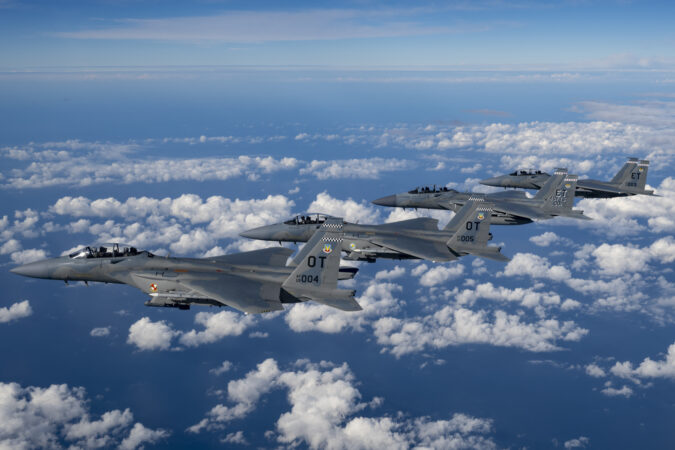
The last time the Air Force acquired more than 72 new fighters in a single year was 1998. So meeting even that threshold would require a sizable step up in production. But such an increase is what’s needed, Smith said.
“If we keep dabbling under 72, that isn’t winning, that is raising the water line,” Smith said. “If we don’t procure at a higher rate, all of these fighter squadrons will remain with ’70s-era fighters. Most of the money will go to keep them flying. In a few years, they’ll be struggling to be flyable, let alone be relevant.”
The F-35s and F-15EXs are meant to replace decades-old A-10s, F-15Cs, and, in future waves, the F-16.
“Aircraft availability directly correlates to age,” Smith said. “You get a new fighter, aircraft availability, parts availability, all that stuff gets better.”
But Smith pointed out that replacing those legacy aircraft with new fighters still puts the inventory behind where it should be. Older F-35s are already due for replacement.
Those varying numbers point to another emphasis by the adjutants’ letter—multiyear procurement contracts.
Multiyear contracts help stabilize production rates by allowing for industrial base planning, investment in parts, and growth in expertise, among other factors.
A 2025 Congressional Research Service report on multiyear contracts for the F-35 program noted that such contracts could have cost savings of 5 to 15 percent.
The generals also want the Air Force to provide specific details on how it will modernize the Guard and Reserve in parallel with Active-Duty forces. They emphasized that the Guard comprises 13 of the Air Force’s 33 total F-16 squadrons, or 39 percent. It’s even higher when only counting combat-coded squadrons: 10 of 22, or 45 percent.
Eleven of the Guard’s total 24 fighter squadrons either have or are scheduled to receive modernized aircraft. But the 13 F-16 squadrons do not yet have specific plans for recapitalization once those legacy F-16s are divested.
“The Air Force must equally prioritize the remaining 13 ANG fighter squadrons for recapitalization into advanced fighters,” the letter states. “Cascading legacy fighters from the Active component to the Reserve component is NOT recapitalization.”
The adjutants general signing the letter hail from:
- Alabama
- Arizona
- California
- Colorado
- Florida
- Hawaii
- Idaho
- Indiana
- Louisiana
- Massachusetts
- Missouri
- New Jersey
- Ohio
- Oklahoma
- Oregon
- South Carolina
- South Dakota
- Texas
- Vermont
- Wisconsin