
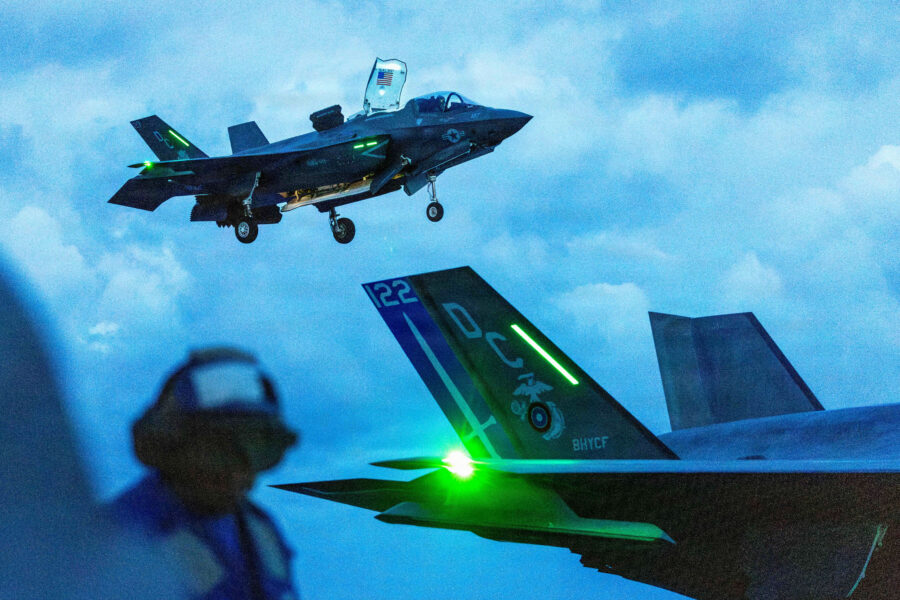
The Marine Corps has accepted six F-35B jets with ballast rather than radars in their nose cones—and the Air Force and Navy will have to do likewise later this year.
Design changes made to accommodate a new and improved, but currently delayed, radar are the problem. Because the radars are purchased separately by the government, the delay lies with radar-maker Northrop Grumman, not prime contractor Lockheed Martin. The mounts for the new AN/APG-85 radar don’t match those of AN/APG-81 it replaces.
The Air Force has not taken delivery of a jet without the radar yet, but Air & Space Forces Magazine has learned that both the Air Force and Navy will have to accept jets without radars later this year.
F-35 Joint Program Office director Marine Corps Lt. Gen. Gregory Masiello told members of the Senated Armed Services Committee on June 23 that the only F-35s delivered without radars so far are six short takeoff and vertical landing F-35Bs for the Marines. The jets were produced earlier this year and began acceptance testing in February. Asked later to clarify, a spokesperson confirmed that no Air Force or Navy jets have been delivered without radars so far.
Beginning with Lot 17 of F-35 production aircraft, the aircraft are manufactured with a unique bulkhead designed for the new APG-85 radar. With that product delayed, however, and responsibility for that equipment falling on the government, rather than Lockheed, there is no alternative but to deliver aircraft now and install the radars when they are available.
Aircraft lacking radars can be used for basic flight training, but not for combat training or missions.
According to the JPO spokesperson, the Pentagon knowingly and “deliberately undertook a highly concurrent development and production program for advanced capabilities. The June 25 email answer to questions noted that “this decision was made with full understanding of the risk of having production aircraft ready ahead of the capabilities.”
Similar things have happened before: the Air Force took delivery of F-15 Eagles in the 1970s at a time when engine shortages required engines be pulled immediately upon delivery so they could be sent back and put into other new aircraft for the same purpose. Eventually, engine deliveries caught up and the planes could fly again.
In this case, however, parts shortages and other problems contributing to F-35 readiness shortfalls mean that the entire program is under scrutiny. Accepting radar-less planes only adds to those negative impressions.
A Government Accountability Office report in June found only about one in four F-35s were fully mission capable in 2025—that is, able to carry out its entire mission portfolio. The rate for being able to carry out any of its missions was better, at 44.1 percent, but still far short of historic targets
In testimony, Masiello said he would not “dispute their numbers or how they do it,” but argued that GAO’s findings lack context because of the way F-35 readiness is calculated by the JPO. Using its calculus, he said the mission capable rate was much better, at 56 percent. He did acknowledge that F-35s without radars are not fully mission capable.
Cooling the New Radar
The new APG-85 radar is among a number of delayed upgrades included in the still-pending Block 4 configuration. Other changes include improved power and thermal management systems to help cool the radar, which will shed more heat than the existing radar.
Eventually, F-35s will need enough cooling to manage systems devouring 62 to 80 kilowatts of power, Masiello said—more than double the maximum 32 kilowatts consumed by existing hardware.
The existing cooling system maxes out at 32 kilowatts. “Cooling really is what we’re looking at,” Masiello said. “There’s no margin, which as you know, is not a smart way to go. So we have an incremental approach to increase that. And we have an ongoing program to look at a more systemic and affordable upgrade to the power thermal management across the program.”
The JPO funded development of a next-generation engine that could provide more cooling power, but that effort proved too costly and was not funded. Masiello said upgrades to the cooling system will not be ready until after 2031, when Pratt & Whitney’s upgraded engine core design is expected to be in production and fielded. That engine will offer a “marginal increase” in cooling, but additional upgrades to the power and thermal management system won’t come for another few years after that, he said. Those should be in time for post-Block Four upgrades.
Masiello deferred answers to further questions aboutthe APG-85’s capabilities and cooling requirements into the hearing’s classified session.