


Editor’s Note: This article has been updated to identify the source of information regarding Red Flag-Alaska 26-3 as exercise Assistant Director of Operations Pete Bussa.
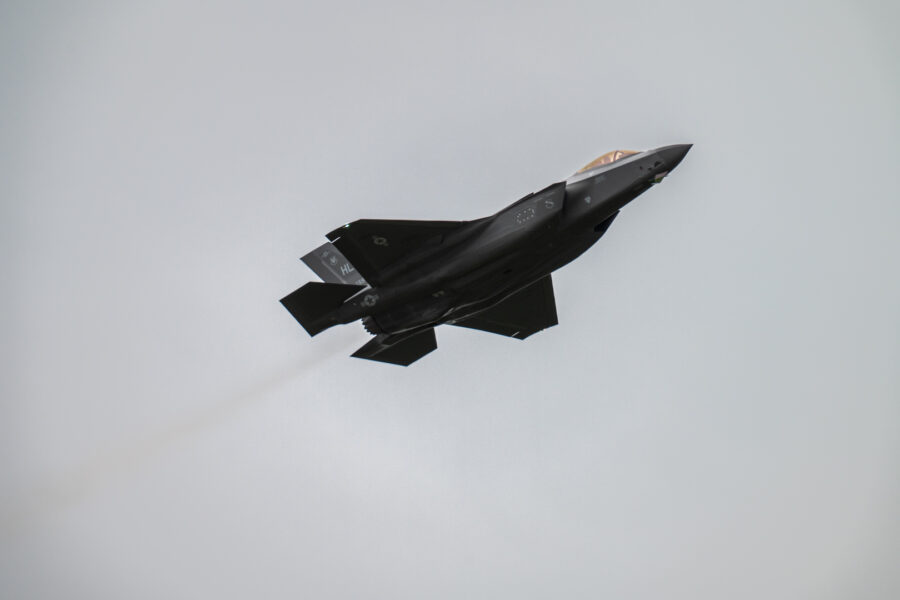
The 13th Fighter Squadron from Misawa Air Base, Japan, deployed its new F-35A fighters to a major exercise for the first time, sending them to Pacific Air Forces’ premier air combat training event: Red Flag-Alaska.
It’s a key milestone in Misawa’s transition to the F-35 from its longtime fleet of F-16 CJs, used for the “Wild Weasel” suppression of enemy air defense mission. Eventually the 35th Fighter Wing at Misawa will get 48 F-35s.
These are the first F-35s the Air Force has stationed overseas in the Indo-Pacific region, and they are based strategically close to China, North Korea, and Russia. They will play a key role there integrating with other services and allies—both of whom also participated in Red Flag-Alaska, a regular two-week exercise that takes place multiple times a year
At this edition, the 13th Fighter Squadron focused on its SEAD mission. Alongside it, the 90th Fighter Squadron out of Joint Base Elmendorf-Richardson, Alaska, flew its F-22s. Marine Fighter Attack Squadron 225 out of Marine Corps Air Station Yuma, Ariz., used their F-35Bs for counter-air and strike missions in the exercise, and Marine Fighter Attack Squadron 251 from MCAS Cherry Point, N.C., flew F-35Cs for joint force integration and homeland defense measures.
The 65th Aggressor Squadron out of Nellis Air Force Base, Nev. flew its F-35As as “red air” operating against U.S. and allied paricipants, as did the 18th Aggressor Squadron of Eielson Air Force Base, Alaska, using their F-16s.
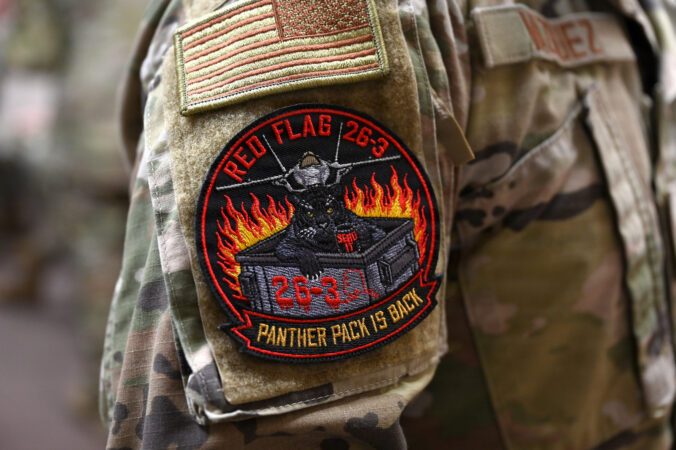
This is the third and final iteration of Red Flag-Alaska this year. The exercise mainly takes place in the Joint Pacific Alaska Range Complex with 77,000 square miles of airspace, compared to the main Red Flag exercise at Nellis Air Force Base, Nev., which uses the Nevada Test and Training Range and its 12,000 square miles of airspace.
“The tactical execution performed at Red Flag-Alaska complements that at Nellis by allowing forces to project power across massive distances, much like the Pacific theater,” Pete Bussa, assistant director of operations for the exercise, told Air & Space Forces Magazine in an email. “These maneuvers help refine rapid power projection over intercontinental distances, ensuring our forces remain resilient and prepared to respond to dynamic regional security challenges.”
The JPARC also challenges exercise participants with “movable electronic threat emitters to mimic the complex digital signatures and tactical mobility of adversarial Integrated Air Defense Systems,” Bussa wrote. These emitters give participants realistic electromagnetic training, a key challenge when conducting missions against peer-level adversaries in real-world combat.
Red Flag exercises started in 1975, growing out of the Vietnam War exercise that ran from 1969-1973 known as Exercise Coronet Organ, which sought to solve the problem of the first 10 combat flights being the most dangerous for fighter pilots by putting them into demanding, realistic, simulated combat scenarios.
The F-35 participated in its first Red Flag exercise at Nellis in 2017 and in Alaska in 2020.
Nellis, which typically hosts three editions of the main Red Flag exercise every year, has only hosted one in 2026, in February.