
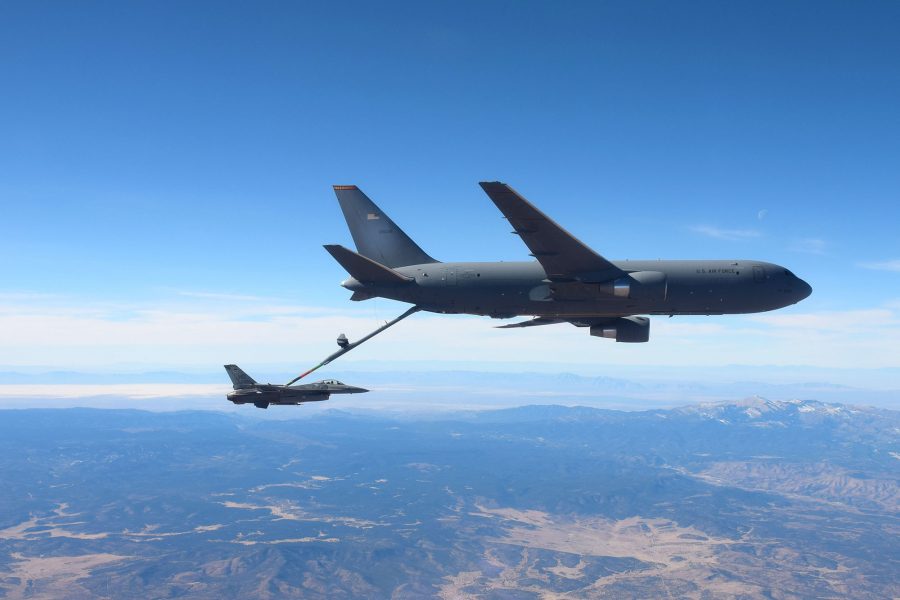
The KC-46A is a heavily modified Boeing 767-200ER multirole passenger/cargo-tanker equipped with flying boom and probe/drogue refueling capability using the Wing Air Refueling Pod (WARP) system. It is also equipped for aeromedical evacuation. KC-46 incorporates the 787’s state-of-the-art cockpit, a fly-by-wire boom, remote boom-operator’s station, advanced self-defensive suite including Large Aircraft IR Countermeasures (LAIRCM), RWR, tactical situational awareness, comms relay hosting, and nuclear/chem/bio hardening.
Boeing was contracted for 179 KC-46A tankers under the first increment (KC-X) to replace approximately half of USAF’s KC-135R fleet in 2011. Pegasus incorporates more fuel capacity, improved efficiency, enhanced cargo and AE capability and independently operating hose/drogue system.
The 767-2C prototype (minus refueling boom) flew on Dec. 28, 2014, and received FAA certification in 2017 prior to the first production delivery in 2019. USAF awarded the first contract in 2016 and most recently awarded Lot 12 in November 2025, raising the quantity on contract to 183 airframes. Boeing is working to correct long-running deficiencies with the boom, remote vision system (RVS), and fuel drain lines.
USAF began flight-testing the revised 3D-RVS system which incorporates six color/IR cameras as well as boom modifications though plans to retrofit the fleet have slipped four years to 2027. KC-46s suffered four refueling boom-related mishaps, most recently involving an F-22 in July 2025, and the 50 percent mission capable rate falls significantly short of the target 90 percent rate. The KC-46 is cleared to refuel receivers in combat (except for the A-10) while awaiting resolution of the final three critical deficiencies.
The KC-46 completed developmental testing and entered operational testing in 2019, which USAF now plans to complete in FY26. The KC-46 is additionally testing a C2 pod, which is the first element of the Advanced Battle Management System (ABMS) to network fifth-generation aircraft in high-threat environments. FY26 aims to launch LOS/BLOS secure comms C2 and situational awareness.
USAF announced it will buy the maximum number of KC-46s under the current contract, upping procurement from 183 to 188. The service also announced it will pursue the KC-46 for its 75-aircraft “bridge” fleet to the next-generation, possibly stealthy, tanker. The service will not contract the additional aircraft until existing deficiencies are resolved. KC-46s debuted in combat supporting B-2 strikes on Iranian nuclear facilities during Operation Midnight Hammer on June 22, 2025.
KC-46 Pegasus Technical Data
Contractor: Boeing.
First Flight: Sept. 25, 2015 (KC-46A).
Delivered: Jan. 10, 2019-present.
IOC: FY24 (planned).
Production: 183 (planned).
Inventory: 89 (KC-46A).
Operator: AETC, AFMC, AFRC, AMC, ANG.
Aircraft Location: Altus AFB, Okla.; Edwards AFB, Calif.; JB McGuire-Dix- Lakehurst, N.J.; McConnell AFB, Kan.; Pease ANGB, N.H.; Seymour-Johnson AFB, N.C.; Travis AFB, Calif. Planned: MacDill AFB, Fla.; March ARB, Calif.; McGhee Tyson ANGB, Tenn.; Selfridge ANGB, Mich.; others TBD.
Active Variant: •KC-46A. Modified Boeing 767 designed as a multirole cargo tanker.
Dimensions: Span 156 ft, length 165.5 ft, height 52.8 ft.
Weight: Max T-O 415,000 lb.
Power Plant: Two Pratt & Whitney PW4062, each 62,000 lb thrust.
Performance: Speed 650 mph, range 7,350 miles (farther with air refueling).
Ceiling: 43,000 ft.
Fuel Capacity: 212,299 lb., max transfer load 207,672 lb at 1,200 gpm (boom), 400 gpm (drogue).
Accommodation: Two pilots, boom operator, and up to 12 additional crew; 15 crew seats, incl AE crew.
Passenger Load: 58 or up to 114 for contingency operations. AE load: 58 patients (24 litters and 34 ambulatory).
Cargo Load: 18 pallet positions, max 65,000 lb.