
The U.S. military’s naval blockade of Iran is relying on a significant amount of airpower to surveil the seas and protect maritime assets, U.S. officials and experts outside government said April 14.
Some 10,000 U.S. military personnel from the Navy, Marines, and Air Force are participating in the blockade. It applies to vessels that were in an Iranian port before 10 a.m. Eastern Time on April 13, according to U.S. Central Command, which oversees forces in the region.
“U.S. forces have completely halted economic trade going into and out of Iran by sea,” CENTCOM commander Adm. Brad Cooper said in a April 14 statement.
The U.S. goal is to pressure Iran into making concessions on its nuclear program and agreeing to reopen the Strait of Hormuz.
The two sides held an initial round of talks in Pakistan after they agreed to a temporary ceasefire. It ended without a breakthrough, but President Donald Trump has said the negotiations may resume in the coming days.
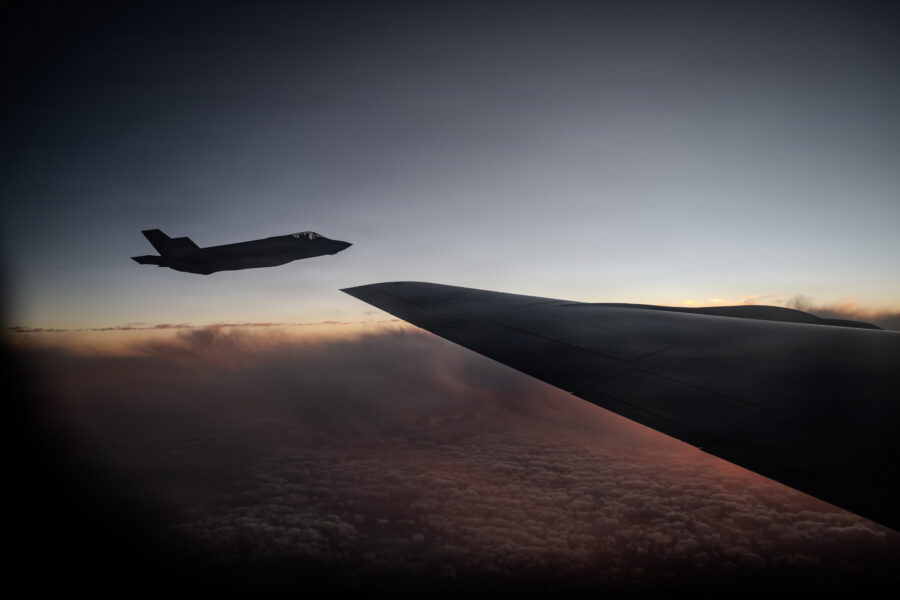
The U.S. blockade is being carried out by more than a dozen warships. But CENTCOM is also using more than 100 fighters, drones, intelligence, surveillance and reconnaissance aircraft, and tankers. The aircraft are flying from air bases in the region and on an aircraft carrier and an amphibious assault ship. U.S. satellites are also playing an important role in monitoring the region, people familiar with the matter said.
Air Force assets being used to enforce the blockade include A-10 Thunderbolt II attack aircraft, which provide close air support and can attack fast-moving gunboats, such as those used by Iran’s Islamic Revolutionary Guard Corps, people familiar with matter said. A-10s have already been tasked with patrolling the Persian Gulf and Strait of Hormuz.
Also participating in the blockade are USAF F-16 Fighting Falcon and F-15E Strike Eagle fighters, joined by Navy and Marine Corps fighters from the USS Abraham Lincoln aircraft carrier, which carries F-35C and F/A-18 Super Hornets, and the USS Tripoli amphibious assault ship, embarked with USMC F-35B vertical takeoff and landing stealth fighters.
Other U.S. military aircraft, including U.S. Air Force KC-46 Pegasus tankers and U.S. Navy P-8 Poseidon and MQ-4 Triton surveillance aircraft, have been spotted using flight tracking data flying over the Persian Gulf, the Strait of Hormuz, and the Gulf of Oman during the blockade, though their precise missions were unclear.
“This is a joint effort,” said retired Marine Corps Gen. Kenneth F. McKenzie Jr., the commander of CENTCOM from 2019-2022. “The secret to a blockade is broad-area ocean surveillance, and you gain that through a variety of airborne platforms—some launched from the sea, some launched from the land, all completely integrated into a single command and control architecture.”
The blockade applies to all vessels that sail to and from Iran and the entire Iranian coast. CENTCOM said six vessels that left ports in Iran complied with directions from the U.S. military to “turn around to re-enter an Iranian port on the Gulf of Oman.”
Seizing a ship is a last resort, a U.S. official said.
That avoids “impounding vessels that might belong to another nation and have oil on board for yet another nation,” said Bryan Clark, an expert in naval operations and senior fellow at the Hudson Institute.
But the U.S. has the capability to interdict ships if necessary.
In recent weeks, U.S. forces in the region have been bolstered by the arrival of the 31st Marine Expeditionary Unit, which carries Marines trained in boarding vessels, as well as additional helicopters and F-35s embarked on the USS Tripoli amphibious assault ship and associated vessels. Sailors on other vessels in the region are also trained in so-called Visit, Board, Search, and Seizure (VBSS) procedures.
“The amphibious ships end up being useful players in a blockade, because they have a lot of helicopters,” said Clark. “Amphibious ships’ additional capacity gives them the ability to board, or at least interdict, more ships simultaneously.”
The U.S. is also relying on unmanned aerial vehicles, according to CENTCOM. The U.S. military has not said which drones are supporting blockade operations.
On April 9, a U.S. Navy MQ-4 drone was lost over the Persian Gulf. MQ-9 Reapers have played a key role in the conflict, often used for dynamic targeting, according to people familiar with the matter. If called upon, Reapers can spot vessels that may be subject to the blockade, experts said.
“It’s got a synthetic aperture radar that can scan hundreds of square miles at a time,” said retired Brig. Gen. Houston Cantwell, a former F-16 and MQ-9 pilot and former commander of the 732nd Operations Group, a key MQ-9 unit. “It’s a very useful platform for situational awareness of where surface vessels are.”
The MQ-9’s radar, sensors, and cameras can also help it detect and identify threats, he added.
“The Reaper can play a critical role in defending our naval assets, because the Reaper carries Hellfire missiles” in addition to its ISR equipment, said Cantwell, now a senior resident fellow at AFA’s Mitchell Institute for Aerospace Studies. “We’re not worried about the Iranian Navy sailing a cruiser out to come take on our destroyers. We’re worried about these small, fast attack boats, and that’s exactly the type of threat that the MQ-9 can be on the lookout for.”
Similar to aircraft, ships typically carry transponders and broadcast data known as the automatic identification system, or AIS. But ships may try to transit the narrow, risk-filled waterways without broadcasting data. A significant number of ships that transport Iranian oil are part of the so-called “shadow fleet” of vessels that fly under false flags or transmit false AIS data.
But the presence of U.S. military forces is likely to act as a deterrent for the shadow fleet crew, who have been put on notice that trying to run the blockade would risk the impoundment of their ship.
“These shadow fleet captains, they’re criminals, but they’re not idiots,” said retired Rear Adm. Mark Montgomery, who commanded a carrier strike group and is now a senior fellow at the Foundation for Defense of Democracies. “If they try to break the blockade and get boarded and detained, we’re going to find a lot of things wrong with that ship.”