
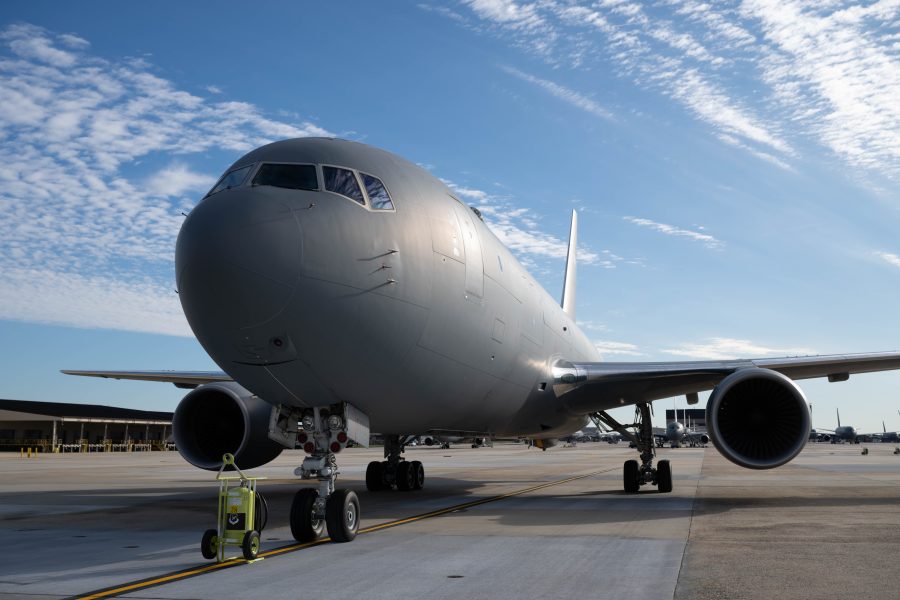
Boeing has completed initial flight testing on its redesigned Remote Vision System for the KC-46 tanker, the defense giant announced June 4.
The new system, dubbed RVS 2.0, is meant to replace the original camera and video system boom operators use to refuel other aircraft, which has faced issues for years now.
RVS 2.0 first flew in November 2025 on a modified test aircraft, kicking off months of validation tests.
Boeing and the Air Force confirmed these tests were “non-contact,” meaning they didn’t involve using the system to actually connect with another aircraft. Instead, this initial phase “demonstrated the system’s maturity and validated the … optical performance of the ruggedized cameras, as well as control and processing hardware,” per Boeing’s announcement.
The completion of this first phase keeps RVS 2.0 moving toward certification and fielding.
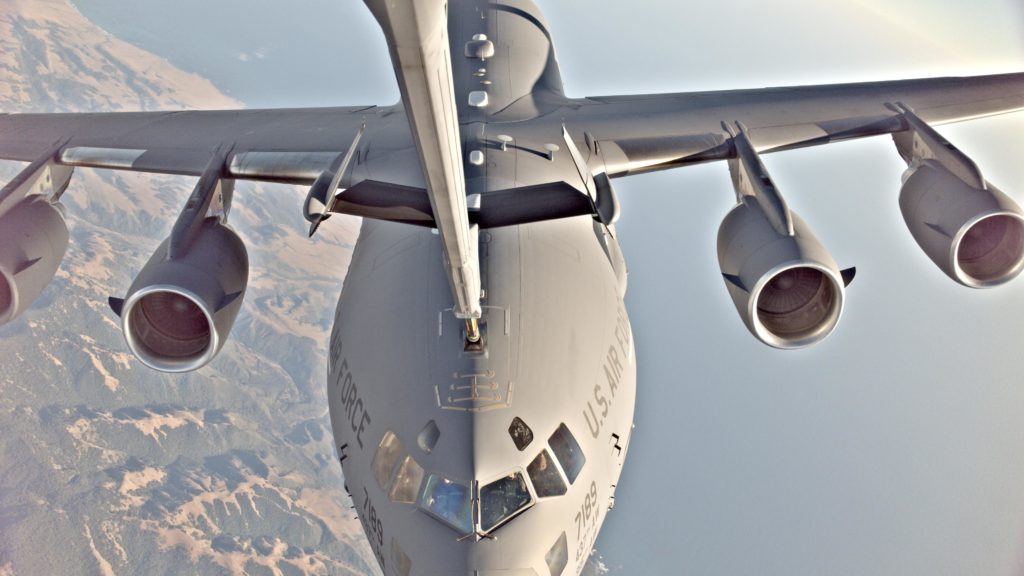
The roots of RVS 2.0 date back to 2016, when the Air Force identified major deficiencies with the current system. Boom operators reported eye-strain and headaches while using it, and in certain lighting conditions struggled to see the refueling receptacle clearly. That can lead to damage to the receiving plane if the boom scrapes against that aircraft.
The new system is meant to fix these issues with upgraded cameras and an advanced 3-D display system to enhance depth perception. It has been delayed several times, however, most recently slipping from a projected target of summer 2027 into 2028.
This latest testing milestone comes three weeks after the Air Force and Boeing unveiled an agreement to resolve critical deficiencies with the Pegasus that currently stand in the way of the service signing a pending contract for 75 additional KC-46s.
A major part of the Air Force-Boeing agreement is to “accelerate” the fielding of the new RVS 2.0 by installing the new system on existing KC-46s as they come in for depot-level maintenance. While the initial fielding date slipped, the agreement cut the timeline to complete retrofits on existing KC-46s with the RVS 2.0 from 13 years to seven years. Boeing will provide engineering, hardware kits, and training, but Air Force personnel at the Oklahoma City Air Logistics Complex will be responsible for the installation of the RVS 2.0, an Air Force spokesperson said.
Details about the next steps in RVS 2.0 testing and certification are not completely clear, but a Boeing spokesperson said the “remaining work will include additional lab and flight test and other formal certification activities, performed in collaboration with the Air Force.”
Other Issues
RVS 2.0 is just one of several KC-46 fixes that Boeing and the Air Force are working on.
The original boom telescoping actuator had to be redesigned after it was found to cause the boom to become “stiff” and prevent it from refueling certain aircraft, such as the A-10 Thunderbolt II, that cannot produce enough thrust to keep the boom in place during refueling.
The Air Force-Boeing plan also includes a five-year “performance-based logistics agreement” to better support the aerial-refueling subsystem and other key components.
A third aspect of the plan involves the Air Force “repurposing five early-build aircraft”—two for testing and three of which will cannibalized for their engines, landing gear, and other high-value spare parts and injected into the operational fleet.
These early-build aircraft are initial production units of the current KC-46 contract, an Air Force spokesperson said. They were originally intended to be refurbished and delivered to the fleet in early 2031, so repurposing them for spare parts now will free up “otherwise trapped materiel,” according to the May 13 announcement.
The KC-46 plan is needed to improve the fleet’s readiness—despite being relatively new, the Pegasus has struggled in that area. It had a 62 percent mission capable rate in 2024, the last year the Air Force publicly released aircraft readiness rates. The Pegasus “still faces fleet readiness challenges,” William Bailey, acting assistant secretary of the Air Force for acquisition, technology, and logistics, acknowledged during the May 13 congressional hearing.
The new readiness improvement initiative between the Air Force and Boeing “is expected to provide a near-term availability boost of approximately 6 percent and provide a long-term aircraft availability increase of over 20 percent by 2030,” Bailey said.
Senior Air Force leaders remain adamant that the RVS 2.0 and other upgrades must be ready before the Air Force will sign a new contract to buy an extra 75 additional tankers in fiscal 2028.
Officials announced in July 2025 that the service would purchase the additional KC-46s on top of the current program of record for 188. The additional KC-46s are intended to serve as a short-term measure to keep production on a modern tanker going while the Air Force considers a long-term plan to replace its aging fleet of KC-135 Stratotankers.
