


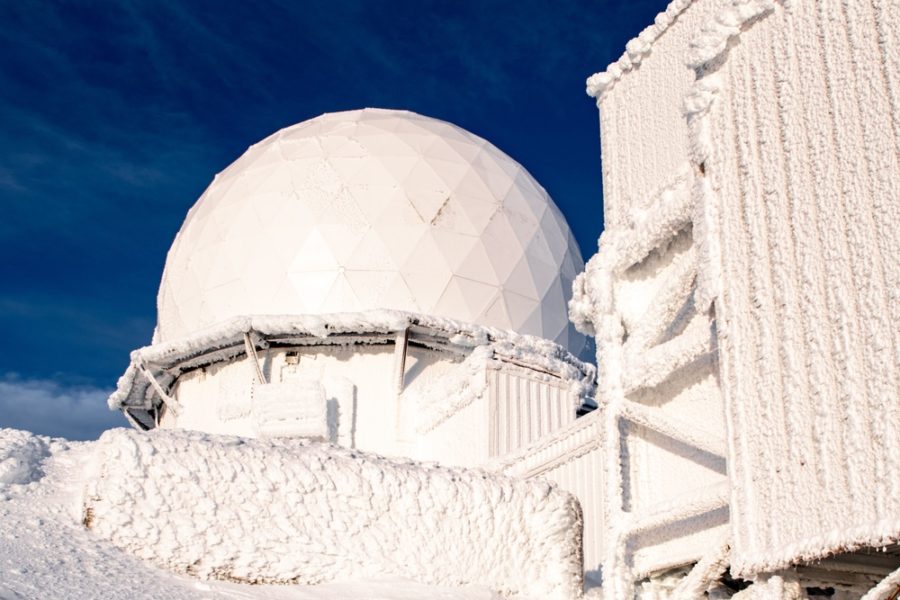
A small civilian plane carrying eight people and contracted by the U.S. Army Corps of Engineers crashed Aug. 20 near a remote Alaskan radar site managed by the Air Force in support of NORAD, killing all aboard.
A spokesperson for the Federal Aviation Administration told Air & Space Forces Magazine the Cessna 441 crashed west of Cape Newenham Long Range Radar Site at 12:15 p.m. local time, after taking off from Ted Stevens Anchorage International Airport, some 450 miles away. A spokesperson for NORAD’s Alaskan Region and the 11th Air Force confirmed in a statement there were no survivors.
A NORAD spokesperson confirmed to Air & Space Forces Magazine no personnel from the command were on the flight. The U.S. Army Corps of Engineers said in a statement that two of its employees were on board. In statements on social media, Sen. Lisa Murkowski and Rep. Nick Begich both indicated the plane belonged to Security Aviation, an air charter company that flies passengers to remote locations across Alaska.
The identities of the passengers and crew will be released 24 hours after their next of kin are notified. The FAA spokesperson said the National Transportation Safety Board and the FAA will investigate the crash.
HH-60W helicopters, an HC-130 personnel recovery plane, and Guardian Angel Airmen from the Alaska Air National Guard all responded to the crash, according to the 11th Air Force statement.
Cape Newenham Air Force Station dates to the 1950s, according to the Air Defense Radar Veterans Association. The base opened in 1954 as one of more than a dozen long-range radar sites that monitored for Russian military activity in the Arctic region. More than 100 personnel were assigned to the 794th Aircraft Control and Warning Squadron there.
By 1983, however, the AN/FPS-117 radar was upgraded to transmit data via satellite and the Air Force deactivated the 794th, leaving only contractors to maintain the site.
Now, Cape Newenham is considered part of the Alaska Radar System, comprised of 15 remote long-range radar sites and three remote radio sites. It is managed by the Pacific Air Forces Regional Support Center, which tracks aircraft operating in Alaskan airspace.
According to documents from a 2024 solicitation for operation and maintenance of the sites, the Newenham site spans 2,359 acres, with the main buildings split between an upper and lower camp. It has a 3,950-foot gravel runway, a dozen or so buildings, and an AN/FMQ-22 automatic meteorological station. Its estimated to support up to 22 people. The strip serves up to 170 flights annually, a third of which might carry passengers.
Radar sites like Newenham are famed for their isolation and harsh weather, with an average annual temperature of 33 degrees. They play a key role in helping NORAD monitor the Arctic airspace near Russia.
“This is a devastating loss for our military family and the communities we serve,” said USAF Lt. Gen. Robert Davis, commander of Alaskan Command, the Alaskan NORAD Command Region, and 11th Air Force. “These individuals were dedicated professionals carrying out a vital mission in a demanding environment. Our absolute priority right now is providing unwavering support to their families, friends, and teammates during this devastating time. We are profoundly grateful for the swift and tireless response of our search and recovery professionals.”