
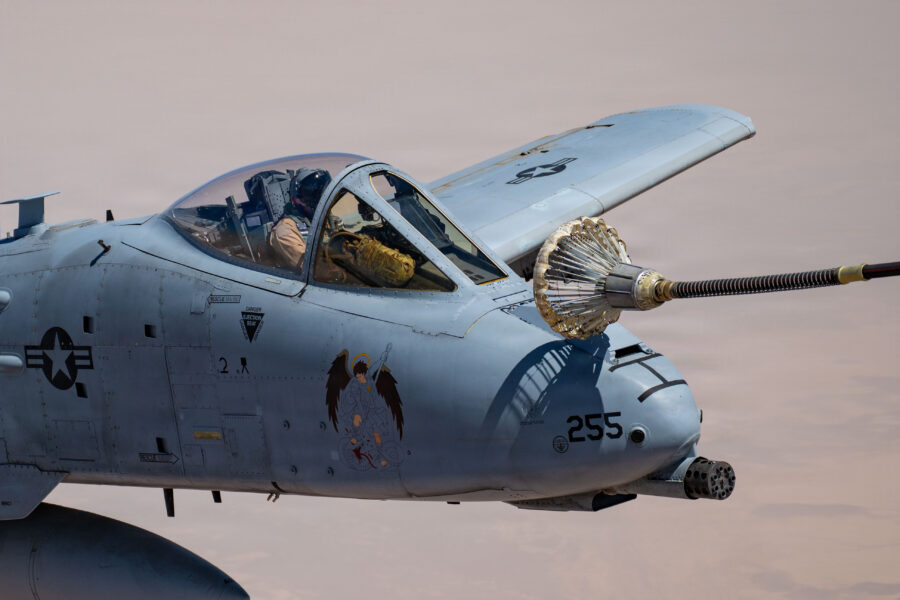
A-10 Thunderbolt II attack planes in the Middle East are flying with fresh modifications as the Air Force looks to make the plane more versatile amid America’s ongoing blockade of Iranian ports and a tenuous ceasefire in the U.S. air war against Iran.
Warthogs in the region have been spotted in official photos from earlier this month flying and refueling with a new probe-and-drogue aerial-tanking system. That comes a month after that system was announced as a rapid development for the A-10. The aircraft were also carrying a novel electronic warfare pod.
Without the new probe, the A-10’s limited thrust currently allows the aircraft to refuel only from KC-135 Stratotankers, using receptacles for “flying boom” tanking systems.
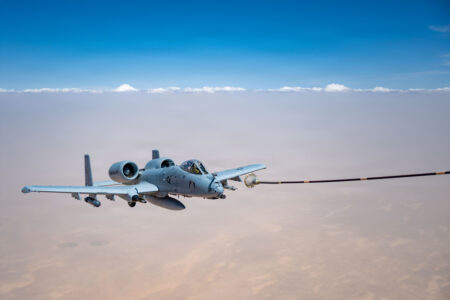
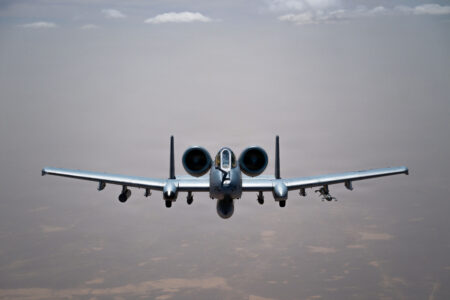
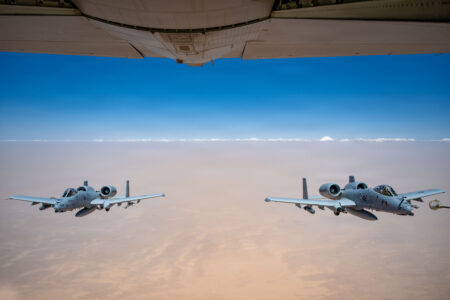
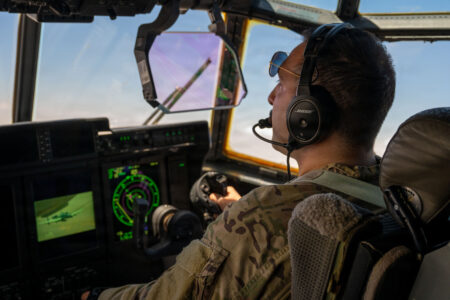
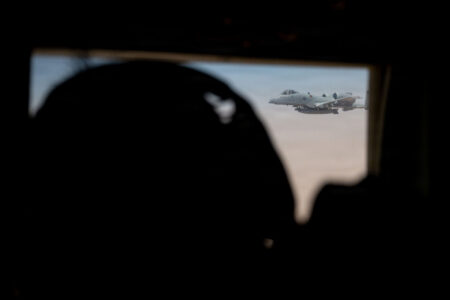
The new modification, called the Probe Refueling Adapter, was spearheaded by the Air National Guard Air Force Reserve Command Test Center, known as AATC, in response to what the organization has called an “urgent combatant command requirement.”
Over two dozen A-10s are known to be based in the Middle East, where they have attacked Iranian-backed Iraqi militias in Iraq and struck Iranian small boats in the Strait of Hormuz. They also participated in a multiday combat search and rescue operation to save the two aviators of a downed F-15E Strike Eagle, during which one A-10 was shot down, though its pilot ejected over friendly territory. A-10s are currently helping enforce the U.S. blockade of Iranian ports.
A probe-and-drogue refueling system uses a flexible hose with a funnel-shaped drogue at its end, and the hose plugs into the probe on the receiving airplane. The “flying boom” uses a firm, telescoping tube.
The probe modification allows the slow-moving A-10 to refuel from a variety of aircraft, including specialized C-130 variants, such as the HC-130J Combat King II used for combat search and rescue and the MC-130 Commando II special operations plane, as well as other services’ aircraft, such as Marine Corps KC-130s. It would also allow the A-10 to refuel from KC-46 Pegasus tankers, which, along with KC-135s, make up much of the armada of refueling aircraft force arrayed in the Middle East. The KC-46 is equipped with a probe-and-drogue system, which, for modified A-10s, could help overcome a “stiff boom” issue that currently prevents the type from refueling A-10s using the traditional Air Force method.
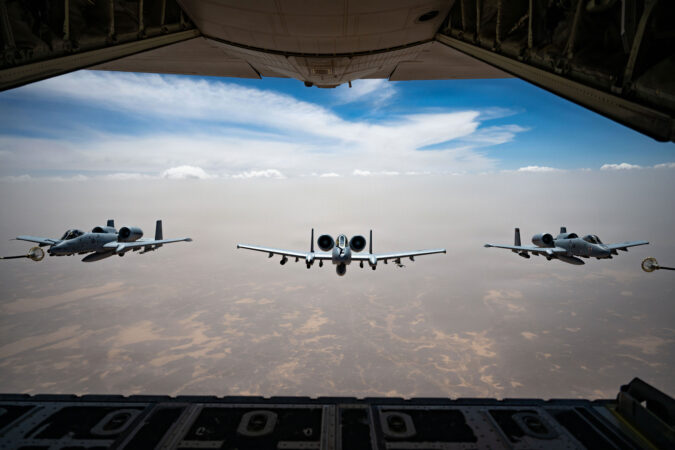
The A-10s spotted with the refueling probes are from the 107th Fighter Wing at Selfridge Air National Guard Base, Mich., which deployed to the Middle East last month.
A-10 flights with the Probe Refueling Adapter in the Middle East are part of operational testing for the modification, which is still undergoing some research and development work, a U.S. official told Air & Space Forces Magazine. The probe is not yet standard equipment for A-10s in the region.
Test flights of the probe in the U.S. and the Middle East have used HC-130s, the type of aircraft that already refuels HH-60 helicopters for the “Sandy” CSAR mission, which the A-10, nicknamed the Warthog, supports.
There have been A-10s continuously deployed on a rotational basis to CENTCOM since 2023, when the command requested the planes to bolster its airpower in the region. Back then, the aircraft were quickly modified to carry a heavy load of Small Diameter Bombs, improving their firepower.
The newly released photos also show A-10s carrying “Angry Kitten” electronic warfare pods, another program from ATTC.
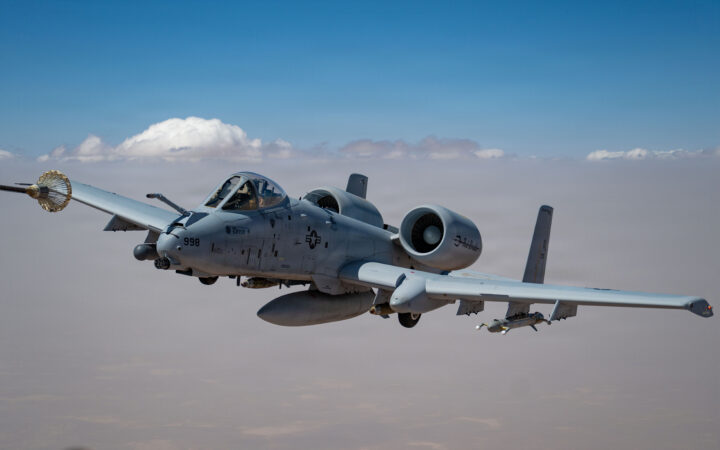
The system has been fitted to the A-10 during testing in the U.S., but it has not yet been known to have been previously used on Warthogs in a combat zone. The Angry Kitten system was originally developed as a quickly reprogrammable training tool to simulate enemy threats. In the past few years, the Air Force has been exploring—and now employing—its attack capabilities.
The Angry Kitten pod made its combat debut in Operation Epic Fury against Iran, appearing on F-16 Fighting Falcons in images released by the U.S. military.
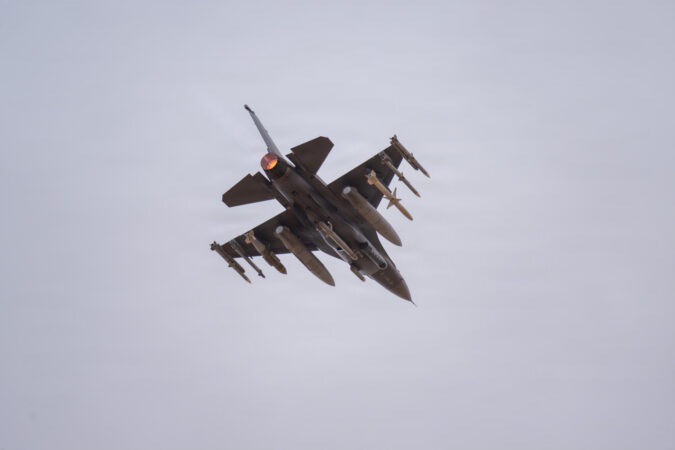
Angry Kitten is designed to be more easily reprogrammable compared to previous electronic warfare systems, which traditionally have to be updated against new enemy threats away from the front lines by specialists. The pods are used in hostile airspace and regularly refreshed.
Dedicated electronic warfare aircraft have flown missions against Iran, including Navy EA-18 Growlers, which can help escort other aircraft into harm’s way, and Air Force EC-130 and EA-37 Compass Call jamming aircraft, which operate further from targets.
The Air Force has delayed the retirement of the A-10 until at least 2030.