
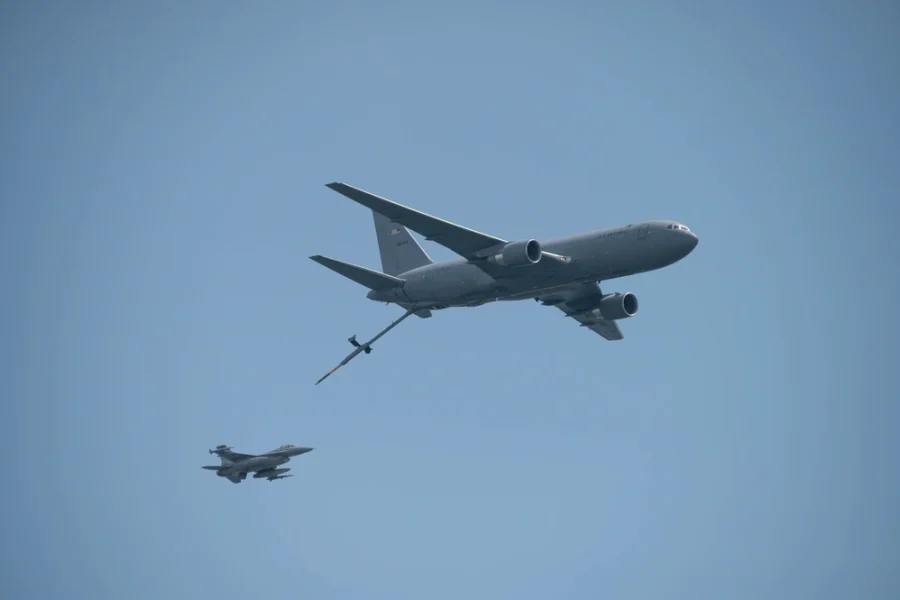
The Air Force wants to spend more than a half billion dollars through 2031 on a new protection system designed for cargo and refueling aircraft that features onboard sensors and weapons to track and take down enemy missiles and drones.
The service’s fiscal 2027 budget show a request for $68 million in research, development, test, and evaluation funding for the Large Aircraft Survivability Systems, or LASS—a program intended to provide a new level of protection to aerial refuelers such as the KC-135 Stratotanker and KC-46 Pegasus as well as airlifters like the C-5 Galaxy and C-17 Globemaster III.
LASS will develop a set of modular, on-board systems consisting of sensors, processors, and defensive weapons, or effectors, for transport and tanker aircraft that will likely be extremely vulnerable to enemy attack in a conflict with a peer adversary, according to Air Force budget documents.
“Large aircraft must have the ability to detect, decide, and defeat the enemy threats organically from onboard the aircraft,” the budget document states. “Multiple sensors will detect threats, processors will decide what threat is inbound and which aircraft is being targeted, and determine which effector is the best option to defeat the threat.”
Aviation Week first reported on the new program.
The Air Force is requesting $50 million in 2027 to develop onboard sensors that will “look downward and upward to identify threats and provide aircrews a common operating picture.” The service also plans to invest $18 million to design a effector system, consisting of a processor and kinetic and nonkinetic effectors, “to defeat any long-range threat” without external assistance, according to the budget documents.
The requirements for sensor package, processor and effector effort were validated March 18 in the Platform Agnostic Kinetic Self-Defense (PAKS-D) System Attributes Requirements Document.
The Air Force plans to invest $508 million in the effort over its next five budgets. In addition to the $68 million request in fiscal 2027, the service is projecting $264 million for the effector system in fiscal 2028 and 2029, as well as $176.2 million for the sensors spread out between fiscal 2028-2031, according to budget documents.
Initially, the service plans to award Other Transaction Agreements, or OTAs, to qualifying companies to promote rapid design and prototyping, budget documents state, but it’s unclear when that will occur.
“The Air Force seeks to compete these efforts using a rapid and flexible strategy,” the budget document states. “This model is needed to accelerate innovation, reduce technical risk, and provide key insights to inform future acquisition decisions for an advanced modular scalable architecture sensor system.”
The budget request also includes some funding for a program called Large Aircraft Infrared Countermeasures, a defensive system against man-portable air-defense systems and other IR threats, but documents known that LAIRCM has largely finished development and started fielding, and “the Air Force’s focus is to expand protection of large aircraft beyond the threats LAIRCM counters.”
The LASS effort comes as the service is racing to upgrade and modernize both its airlift and tanker fleets. The Air Force is also requesting $105 million in 2027 for connectivity upgrades designed to improve survivability on tankers, Air Force Chief of Staff Kenneth S. Wilsbach told lawmakers at a recent hearing.
Air Mobility Command leaders, working with U.S. Transportation Command, are studying options for the Next Generation Air-refueler System, or NGAS. Options on the table include acquiring more KC-46 Pegasus tankers and fielding systems for protecting the tankers or developing a stealthy refueling platform that is more survivable in contested airspace. A third way would combine both strategies. The Air Force is already planning to procure an additional 75 KC-46s to replace some of the service’s 60-year-old KC-135s.
Meanwhile, planning for a future Next-Generation Airlifter is still in its early stages, but mobility leaders say that work must continue to stay ahead of the threat.
In 2022, then-TRANSCOM boss Gen. Jacqueline D. Van Ovost said the Pentagon will have to start investing in defensive systems for large support aircraft, especially tankers.
“Gone are the days where you can just go out there and go to an anchor orbit and just wait for someone to come,” Van Ovast said, adding that tankers will need some form of active defense.
Combat operations in recent years have reinforced that warning—since 2024, dozens of KC-135 crew members have received awards, including the Distinguished Flying Cross, for supporting missions to down Iranian missiles and drones and take out Iranian-backed militias in Yemen.