
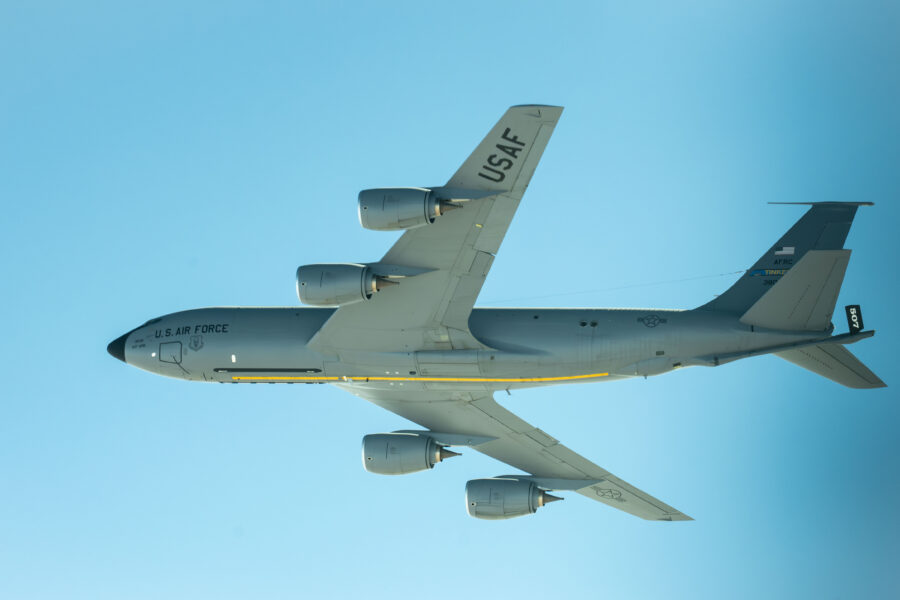
Lawmakers drafting the 2027 defense policy bill worry the Air Force is not moving fast enough to arm its tanker fleet with new protection systems capable of defeating incoming missile threats.
The service is working on the issue, with plans to spend more than half a billion dollars through 2031 on the Large Aircraft Survivability Systems, or LASS, program. That would start with a $68 million request for research, development, test, and evaluation funding in 2027, budget documents show.
LASS would develop a set of modular, on-board systems consisting of sensors, processors, and defensive weapons, or effectors, for aerial refuelers such as the KC-135 Stratotanker and KC-46 Pegasus as well as other large mobility aircraft.
But in its first draft of the fiscal 2027 National Defense Authorization bill, the House Armed Services Committee said it wants the the Air Force to submit a report by Dec. 1 explaining the service’s plan for moving the program out of RDT&E and having it ready for initial fielding by late 2031.
Explaining their concern, lawmakers stressed that the Air Force’s ability to carry out successful long-range strategic strike missions such as Operation Midnight Hammer may be challenged in the future if tankers can’t defend themselves against enemy missile and drone attacks.
“The committee is aware of nascent efforts by the Air Force to address this vulnerability with both active and passive self-protect capabilities but is concerned that development and fielding timelines are not keeping pace with the risk to the fleet,” the lawmakers wrote.
That risk is considerable given how critical refueling is to airpower.
“Successfully targeting a single tanker effectively defeats four or more tactical aircraft that depend on refueling and can quickly unwind mission planning assumptions, as well as follow-on operations,” the draft bill notes.
The report the committee is asking for should include an assessment of “technology readiness levels and relative effectiveness” of current active and passive self-protect systems and subsystems,” and funding required, by year, to achieve “initial operational capability of a passive system and an active system by December 31, 2031.”
Overall, the Air Force plans to invest $508 million in the LASS effort through fiscal 2031. In addition to the $68 million request in fiscal 2027, the service is projecting $264 million for the effector system in fiscal 2028 and 2029, as well as $176.2 million for the sensors spread out between fiscal 2028-2031, according to budget documents.
The budget request also includes some funding for a program called Large Aircraft Infrared Countermeasures, a defensive system against man-portable air-defense systems and other IR threats, but documents show that LAIRCM has largely finished development and started fielding.
These efforts are taking place as the Air Force works to upgrade its tanker fleets and explores options for the Next Generation Air-refueler System, or NGAS. Air Force Chief of Staff Kenneth S. Wilsbach told lawmakers at a recent hearing that the service is requesting $105 million in 2027 for connectivity upgrades designed to improve survivability on tankers.
The HASC’s draft bill also calls on the Air Force, working with U.S. Transportation Command, to submit a report to House and Senate defense committees by Jan. 1 with a detailed strategic plan for the “development, acquisition, modernization, and integration of mobility capabilities” through fiscal 2047.
The report would include requirements for mobility aircraft to operate in “highly contested environments including austere locations, battle-damaged airfields, degraded runways, ramps, taxiways, and other runway agnostic operating environments,” according to the document. It would also include the Air Force’s plans for aircraft designed with open architecture to enable “rapid integration” of capabilities for complimentary missions such electronic warfare, battle management, and intelligence, surveillance, and reconnaissance capabilities.
