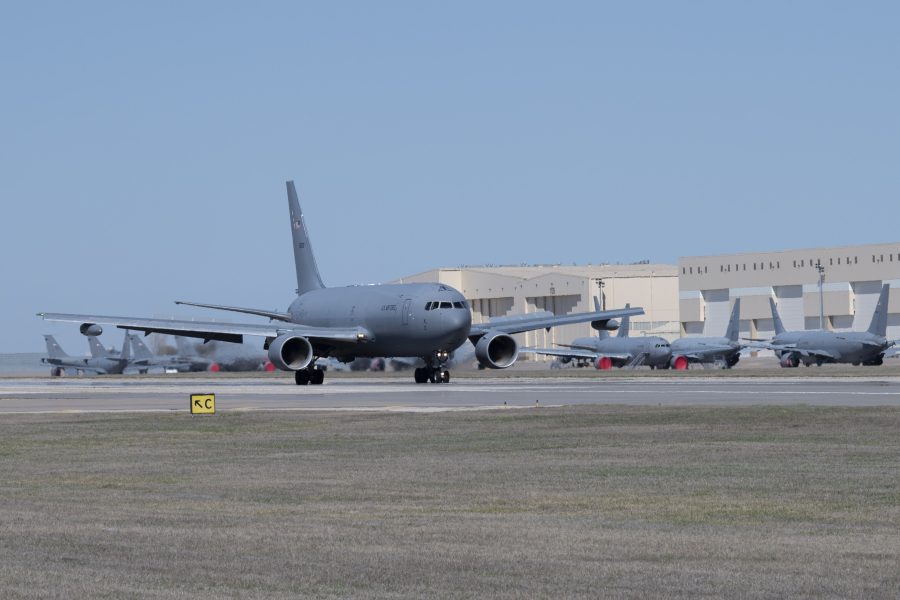
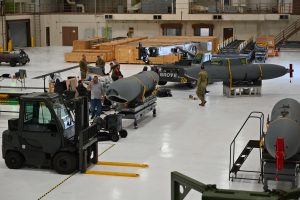
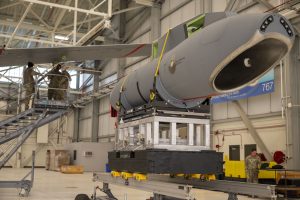
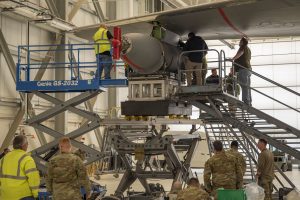
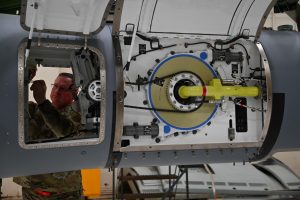
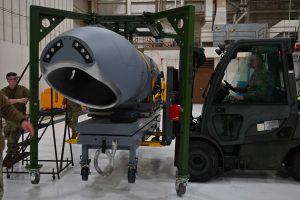
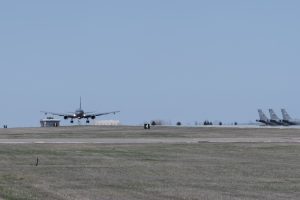
A KC-46A Pegasus, with Wing Aerial Refueling Pods (WARPs) attached, lands on the runway at McConnell Air Force Base, Kansas March 19, 2024. The KC-46 recently finished WARPs refueling with U.S, Navy F/-18 Hornets, which allows the Pegasus to simultaneously refuel two aircraft via drogue chutes. (U.S. Air Force photo by Airman 1st Class Gavin Hameed)
Audio of this article is brought to you by the Air & Space Forces Association, honoring and supporting our Airmen, Guardians, and their families. Find out more at afa.org
Airmen started testing new Aerial Refueling Pods last month which enable the KC-46 Pegasus to refuel two naval aircraft at once, using their probe and drogue system.
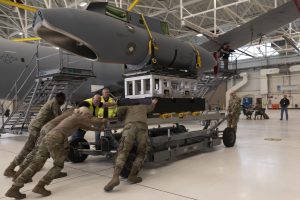
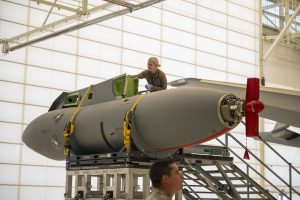
McConnell is the first operational base to get the pods, which have been in development since 2019 and delayed during a lengthy FAA certification process. A team drawn from the Air Force Operational Test and Evaluation Center, 22nd Air Refueling Wing, and 931st Air Refueling Wing installed the pods March 5, according to a 22nd Air Refueling Wing statement, and the tanker has flown at least two successful missions so far, refueling two Navy F/A-18 Hornets from Naval Air Station Joint Reserve Base Fort Worth, Texas, on March 9, and two Marine AV-8B Harriers from Marine Corps Air Station Cherry Point, N.C., on March 20.
The 20-foot-long pods connect to the fuel tanks in the KC-46’s wings, and pump fuel through some 80 feet of hose at a rate up to 400 gallons per minute, depending on the receiving aircraft.
“The WARPs are an optional capability that was included in the original design of the KC-46, so there is very little difference in handling characteristics of the aircraft,” said Capt. Taylor Johnson, a KC-46 pilot. “The big challenge is making sure aircrews are properly trained and understand the additional considerations with WARPs installed on the aircraft, so they can properly execute missions.”
These tests have been a long time coming. The Air Force first successfully tested the system in 2019, and Boeing officials expressed confidence in January 2021 that FAA certification would soon follow. But the Pentagon’s director of operational test and evaluation wrote in a 2023 annual report that the pods missed a scheduled test in April 2023 because it still lacked FAA certification due to questions about wiring corrosion risk and safety tolerance in case of bird strikes. Those tests didn’t get underway until March of this year.
“We’ve been waiting for a while to get started on using WARPs,” said Airman 1st Class Cord Nakaahiki, a boom operator for the 22nd Air Refueling Wing, in a statement. But the first flight offered no surprises. “Using the new system felt just like our usual practice on simulators, which made using the real thing pretty straightforward. To be out there flying them has been exciting and rewarding.”
An Air Force Life Cycle Management Center spokesman previously told Air & Space Forces Magazine that the FAA certification will not delay initial operational testing, “as IOT&E will be conducted using one of the production article pods.”
In a statement, 22nd Maintenance Group commander Col. Robert Meadows said initial operational testing would last another two months, to “provide training for our aircrews and maintenance teams on servicing and inspecting the pods on the wings.”
Audio of this article is brought to you by the Air & Space Forces Association, honoring and supporting our Airmen, Guardians, and their families. Find out more at afa.org
At least two KC-135 Stratotankers that were seriously damaged during Operation Epic Fury are still undergoing extensive maintenance depot repairs, the head of Air Force Materiel Command said Oct. 21.
As the Air Force wrestles to solve the logistics of dispersed operations in the vast Indo-Pacific, it’s investing $3.5 million to help develop a new kind of aircraft: a blended-wing body freighter that’s smaller than a C-130 but larger than a Cessna for “sub-tactical” lift.
Roughly two of every five fighters in the Air Force fleet could be F-35As by 2035, according to a new fighter force structure report the service submitted to Congress on Oct. 16. Lt. Gen. David Tabor, deputy chief of staff for plans and programs, revealed the new estimate during an…
The Air Force Life Cycle Management Center is moving forward with a program to upgrade a quarter-century-old computing system for some F-16 fighter jets.
The U.S. Navy on Oct. 15 accepted a C-130J-30 Super Hercules plane that it will modify to become the first of its new nuclear command, control, and communications aircraft—a route the Air Force is considering for a similar NC3 mission under congressional direction.
More than 40 years after the original YF-117 operational prototype flew test runs from a Lockheed Martin Skunk Works facility, an F-117 returned for a $1 million refurbishment to look its best when it assumes its place in history alongside other iconic aircraft on permanent exhibit at the National Air…
A U.S. Air Force F-22 pilot controlled a YFQ-44A Fury Collaborative Combat Aircraft this month while both aircraft were in flight, according to an Oct. 16 release, another milestone in the service’s ambitious CCA efforts.
The Marine Corps recently conducted its first-ever “ripple” release of eight Small Diameter Bomb IIs from an F-35B, a key early step in proving out the capability for all F-35 variants.
The Air Force will field operational prototypes for an autonomous drone to replace its MQ-9 Reaper in 2028, Secretary of the Air Force Troy Meink said Oct. 14.
✓
Thank You!
Check your inbox to verify your email address and finish setting up your AFA account.
★
Welcome Back!
An account with this email already exists. Please log in to continue.
Subscribe to the Air & Space Forces Daily Report
The latest news from Air & Space Forces Magazine, as well as news from other leading publications, delivered right to your inbox every morning!
We’re sorry, there has been an error. Please review your input or try again later.