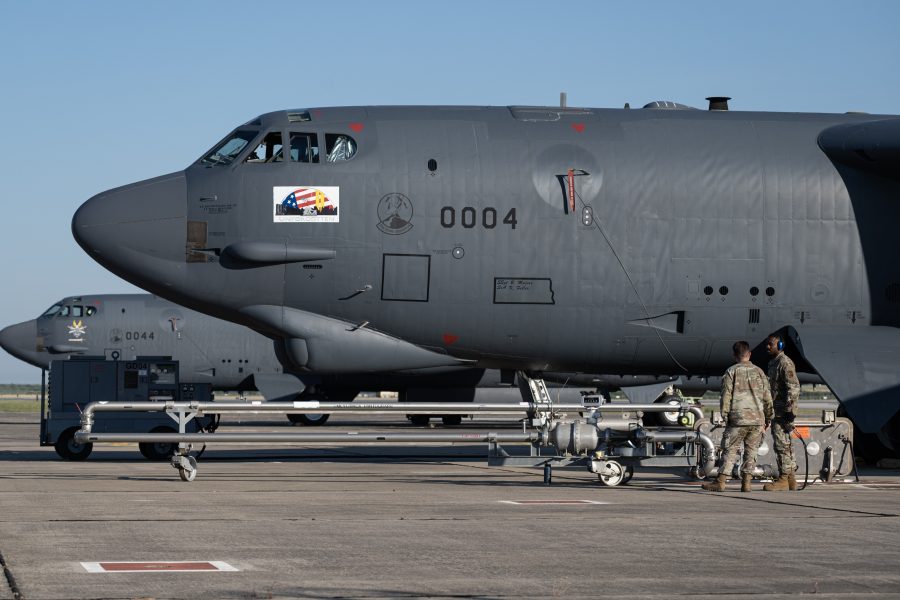
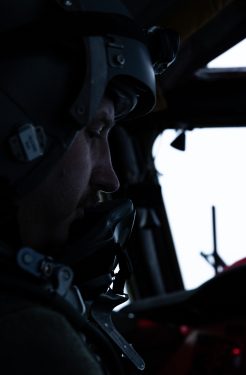
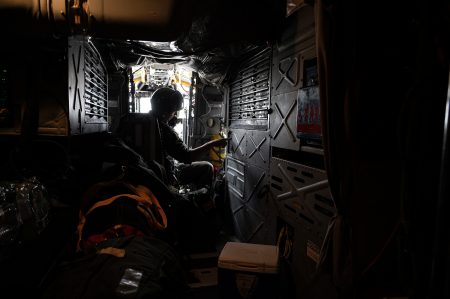
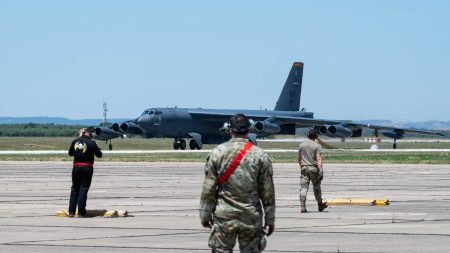
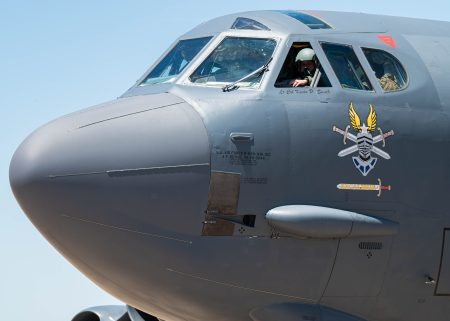
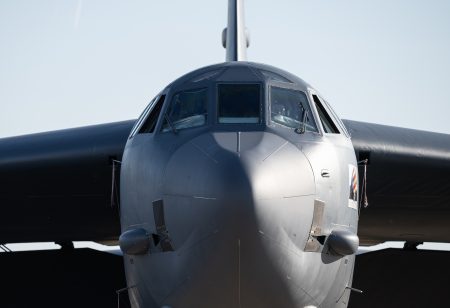
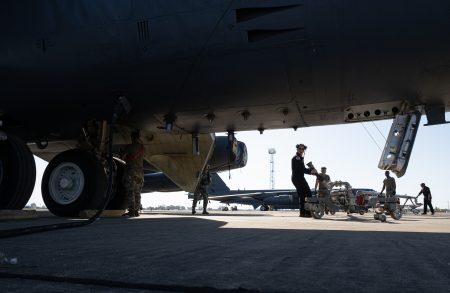
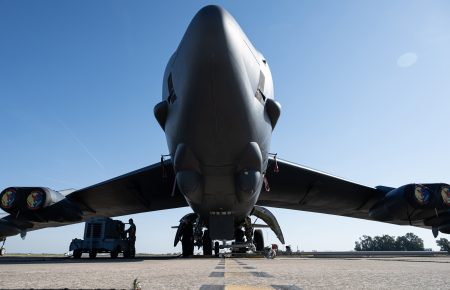
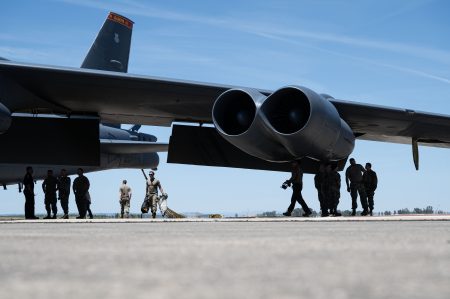
U.S. Air Force maintenance personnel assigned to the 23rd Bomber Generation Squadron stand watch over a fuel line connected to a B-52 Stratofortress aircraft during Bomber Task Force Europe at Morón Air Base, Spain, May 22, 2025. U.S. Air Force photo by Staff Sgt. Bryan Guthrie
Audio of this article is brought to you by the Air & Space Forces Association, honoring and supporting our Airmen, Guardians, and their families. Find out more at afa.org
B-52H Stratofortress bombers have arrived in Spain to kick off a new European deployment as the Air Force looks to make its nuclear-armed fleets more flexible.
The Air Force said in a news release that the bombers would operate from “smaller, more flexible locations across Europe and Africa,” a concept the service has also rehearsed with fighter, cargo, and refueling aircraft.
Recent bomber task force missions to Europe have operated mainly out of RAF Fairford, U.K., with long-range flights and air refueling extending their missions.
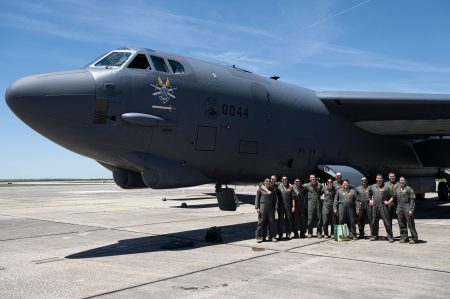
Two B-52s arrived at Morón Air Base May 20, a defense official told Air & Space Forces Magazine. The bombers are from Minot Air Force Base, N.D., and deployed as the 23rd Expeditionary Bomb Squadron with tail numbers 60-0044 and 60-0004.
“Bomber Task Force Europe is a clear signal of peace through the strength of airpower,” Lt. Gen. Jason T. Hinds, deputy commander of U.S. Air Forces in Europe-Air Forces Africa, said in a statement. “This BTF deployment will ensure our forces remain resilient, dynamic, and capable of responding to evolving security challenges with speed and precision.”
U.S. defense officials did not preview the missions the bombers planned to conduct during the deployment. The Pentagon typically declines to comment on upcoming bomber operations.
The U.S. is not the only global power flexing its long-range strike capability. On May 20, the same day the B-52s arrived in Europe, two Russian TU-95 strategic bombers flew over the Barents Sea, according to Russia’s Ministry of Defense. The bombers appear to have been carrying air-launched cruise missiles, which are visible in a video released by the Russian government.
The B-52s appear not to have conducted any missions out of Morón since arriving in Spain, according to flight tracking data, though they hooked up with KC-46A Pegasus refuelers from McConnell Air Base, Kan., on their way across the Atlantic.
It is Minot’s second bomber task force deployment of the year to Europe, following another that ended in March. One of the bombers in the current rotation, 60-0044, also participated in the earlier visit, which was based at RAF Fairford and carried out missions across Europe and the Middle East.
Morón Air Base has been a strategic location for the Air Force since the 1950s, when it first served as a key Cold War bomber base and has routinely housed U.S. bombers since then. The U.S. no longer maintains a continuous bomber presence overseas but sends them abroad multiple times a year for training exercises with foreign allies and partners.
U.S. conflicts in the Middle East have also led to rare bomber combat deployments. Four B-52s are currently stationed on the island of Diego Garcia in the Indian Ocean, home to a joint U.S.-U.K. base. Those bombers arrived after six B-2 Spirit stealth bombers participated in the U.S. campaign against the Houthis in Yemen from late March to early May, when the U.S. agreed to a ceasefire with the group.
In November, six B-52s from Minot headed to Al Udeid Air Base, Qatar, for a 45-day combat deployment, during which they bombed Islamic State group targets in Syria.
Audio of this article is brought to you by the Air & Space Forces Association, honoring and supporting our Airmen, Guardians, and their families. Find out more at afa.org
Roughly two of every five fighters in the Air Force fleet could be F-35As by 2035, according to a new fighter force structure report the service submitted to Congress on Oct. 16. Lt. Gen. David Tabor, deputy chief of staff for plans and programs, revealed the new estimate during an…
The Air Force Life Cycle Management Center is moving forward with a program to upgrade a quarter-century-old computing system for some F-16 fighter jets.
The U.S. Navy on Oct. 15 accepted a C-130J-30 Super Hercules plane that it will modify to become the first of its new nuclear command, control, and communications aircraft—a route the Air Force is considering for a similar NC3 mission under congressional direction.
More than 40 years after the original YF-117 operational prototype flew test runs from a Lockheed Martin Skunk Works facility, an F-117 returned for a $1 million refurbishment to look its best when it assumes its place in history alongside other iconic aircraft on permanent exhibit at the National Air…
A U.S. Air Force F-22 pilot controlled a YFQ-44A Fury Collaborative Combat Aircraft this month while both aircraft were in flight, according to an Oct. 16 release, another milestone in the service’s ambitious CCA efforts.
The Marine Corps recently conducted its first-ever “ripple” release of eight Small Diameter Bomb IIs from an F-35B, a key early step in proving out the capability for all F-35 variants.
The Air Force will field operational prototypes for an autonomous drone to replace its MQ-9 Reaper in 2028, Secretary of the Air Force Troy Meink said Oct. 14.
One of the Air Force’s critical B-2 Spirit stealth bombers has returned to Whiteman Air Force Base, Mo., after an extensive course of maintenance to restore its stealth coating and preserve its structural integrity.
BAE Systems has received a contract from Lockheed Martin to install an upgraded Block 4 electronic warfare system into new F-35 Joint Strike Fighters, as well as to retrofit some older jets.
✓
Thank You!
Check your inbox to verify your email address and finish setting up your AFA account.
★
Welcome Back!
An account with this email already exists. Please log in to continue.
Subscribe to the Air & Space Forces Daily Report
The latest news from Air & Space Forces Magazine, as well as news from other leading publications, delivered right to your inbox every morning!
We’re sorry, there has been an error. Please review your input or try again later.