
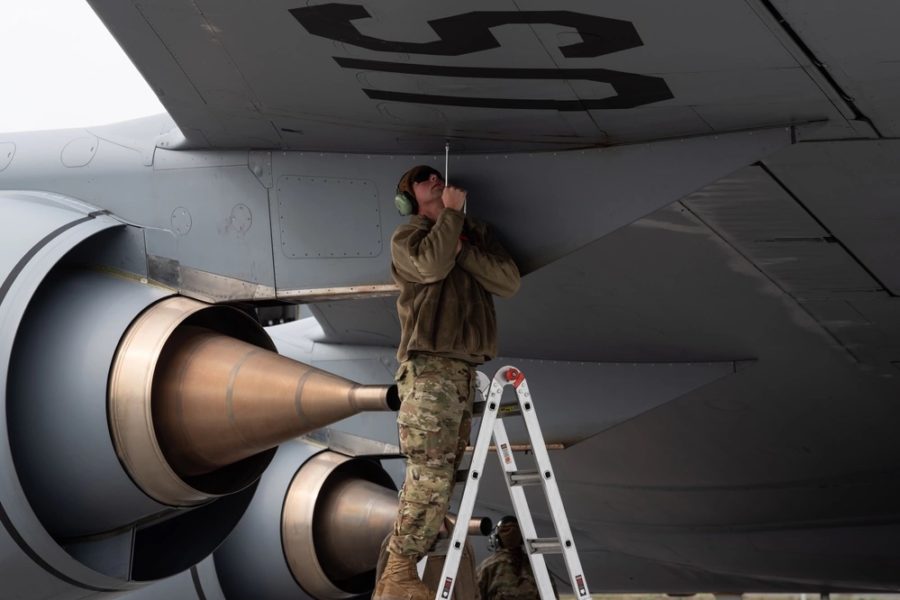
The Air Force tanker fleet “did not meet” its availability and mission capable rate goals from fiscal 2019 to 2025, in large part because of parts shortages and delays fielding the KC-46 refueler, according to a Government Accountability Office report released June 10.
The government watchdog also noted that a shortage of skilled maintainers in the Air Force contributed to lower readiness rates in the tanker fleet.
The report comes in the wake of moves by the Air Force to resolve the KC-46’s deficiencies and availability issues before it agrees to sign a new contract with Boeing for 75 additional Pegasus aircraft in 2028 in an effort to replace more of the aging KC-135 Stratotanker fleet.
“The percentage of aerial refueling tankers that are available and mission capable has remained persistently below the standards that the Air Force established for the fleet,” the GAO report states. The Eisenhower-era KC-135 had a mission capable rate of just under 68 percent in fiscal 2024, the last year the Air Force released those rates. That same year, the KC-46 had a 62 percent MC rate. The GAO omitted detailed readiness rates from its report for operational security reasons.
The report noted multiple KC-46 program delays due to critical deficiencies with the redesigned Remote Vision System 2.0—the camera and video system boom operators use to refuel other aircraft—and the new aerial-refueling subsystem. In certain conditions, the boom operator using the current RVS is unable to see the receptacle clearly, risking damage to the receiving plane if the boom scrapes against that aircraft. And the original boom telescoping actuator had to be redesigned after it was found to cause the boom to become “stiff” and prevent it from refueling certain aircraft.
As a result of these issues with the KC-46A, the Air Force is continuing to rely on a fleet composed largely of KC-135 aircraft, the report states: “The continued reliance on the KC-135 has led to an increase in the missions assigned to the aircraft, thereby increasing the necessary sustainment and maintenance work to ensure the KC-135 fleet is available and mission capable.”
The Air Force recently announced a multipronged agreement with Boeing to improve KC-46 readiness and availability by 2030.
A major element of the plan is to “accelerate” the fielding of the new RVS 2.0 by installing the new system on existing KC-46s as they come in for depot-level maintenance. The projected fielding for RVS 2.0 is now early 2028, a slight slip from the previous target of summer 2027. Air Force officials maintain that the strategy shortens the overall retrofit timeline from 13 years to seven years, according to the announcement.
Spare parts shortages also affected tanker fleet availability, the report states.
“The Air Force faces critical shortages of key maintenance parts for both KC-135 and KC-46A aircraft,” officials told the GAO. “Maintainers from multiple units cited parts failure to be the key contributing factor to low availability and mission capable rates.”
The Air Force and the Defense Logistics Agency told the GAO that the KC-46A had higher failure rates than expected, the report states. While the KC-46 is based on Boeing’s 767 commercial aircraft, “the requirements for a military version of the same aircraft differ substantially and result in higher usage and subsequently shorter lifespan of critical parts.”
The Air Force also did not plan for the correct number of parts to ensure timely replacements, the report states. The service and the DLA told the GAO that the defense industrial base faces challenges to provide replacements parts, the report states, adding that some parts are no longer in production, especially for the older KC-135.
Air Force officials also told the GAO that the service “has since resolved the critical shortages” through improved coordination with the contractor to ensure timely parts delivery and internal measures such as reverse engineering of key components, the report states.
Still more efforts are underway to ease the parts shortage. Air Force Chief of Staff Gen. Kenneth S. Wilsbach told lawmakers on April 30 that the service has prioritized readiness by budging $24.7 billion for weapons systems sustainment in its proposed fiscal 2027 budget. Wilsbach added that the 2027 request also includes more than $4 billion for the Working Capital Fund, so the service can buy the critical spare parts.
The new Air Force-Boeing KC-46 agreement also includes a five-year “performance-based logistics agreement” to better support the aerial-refueling subsystem and other key components.
A third aspect of the plan involves the Air Force “repurposing five early-build aircraft”—two for testing and three of which will cannibalized for their engines, landing gear, and other high-value spare parts and injected into the operational fleet. These early-build aircraft are initial production units of the current KC-46 contract, an Air Force spokesperson said. They were originally intended to be refurbished and delivered to the fleet in early 2031, so repurposing them for spare parts now will free up “otherwise trapped materiel,” according to the May 13 announcement.
The KC-46 readiness improvement effort “is expected to provide a near-term availability boost of approximately 6 percent and provide a long-term aircraft availability increase of over 20 percent by 2030,” William Bailey, acting assistant secretary of the Air Force for acquisition, technology, and logistics, said during the May 13 congressional hearing.
Air Force unit officials also told GAO that “there are shortages of skilled maintainers to conduct scheduled maintenance work at the depots, as well as unexpected repairs at the unit level,” the report states.
The service’s transition from military to civilian maintainers at the depots in recent years has resulted in an influx of new and less experienced personnel, the GAO also found. Some bases that operate both the KC-135 and KC-46 maintain a 100 percent staffing level for aircraft maintainers, “but about 75 percent of the maintainers lack the necessary experience.”
“Officials from the KC-46A program office said the Air Force did not sufficiently plan for skilled personnel that would be needed to service the new aircraft once it became available,” the report states.