
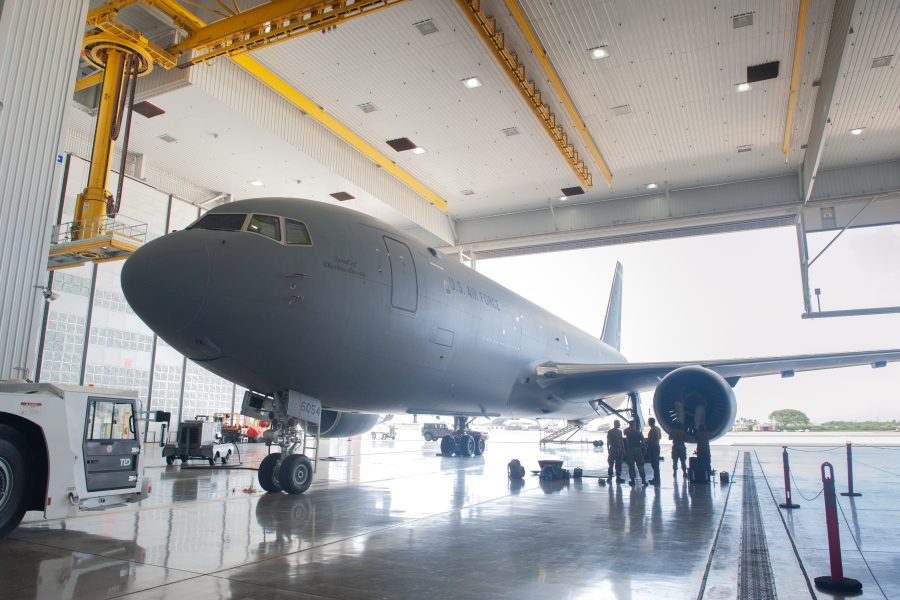
The Air Force says it has formed a plan with Boeing to get key upgrades deployed across the KC-46 tanker fleet faster—but the service acknowledged it won’t start fielding the refueler’s upgraded vision system until 2028, a slight schedule slip.
USAF announced the “multi-pronged” agreement with Boeing in a May 13 release. It’s the latest effort to rectify critical issues with the KC-46 that senior leaders have said must be resolved before the Air Force will sign a new contract to buy an extra 75 additional tankers.
The plan, which also involves upgraded contractor logistical support, will significantly increase KC-46 availability by 2030, officials claim.
A major element of the plan is to “accelerate” the fielding of the new Remote Vision System 2.0—the camera and video system boom operators use to refuel other aircraft—by installing the new system on existing KC-46s as they come in for depot-level maintenance. The strategy shortens the retrofit timeline from 13 years to seven years, the announcement maintains, but it’s unclear whether Boeing or Air Force maintainers will install the retrofits.
The announcement also states that RVS 2.0 will “begin fielding in early 2028.” Last fall, the Air Force projected that the RVS 2.0 would be ready for fielding by summer 2027.
RVS has been an issue for the KC-46 for years now. In certain lighting conditions, the boom operator using the current RVS is unable to see the receptacle clearly, risking damage to the receiving plane if the boom scrapes against that aircraft. Originally, officials said the upgraded RVS 2.0—which includes better cameras, color video, and increased depth perception—would be ready by 2023. That timeline has slipped several times now.
Air Force Lt. Gen. David Tabor, deputy chief of staff for plans and programs, told Rep. Donald Norcross (D-N.J.) in at a May 13 congressional hearing that RVS 2.0 retrofits would be delivered in early summer 2027, but the system won’t be installed on new production KC-46s until the “second quarter of fiscal 2028.”
An Air Force spokesperson clarified the new fielding schedule in a statement describing the RVS 2.0 schedule as “largely stable relative to last year’s briefed baseline with a minor adjustment to the RVS 2.0 certification timeline from [fourth quarter fiscal 2027] to [first quarter fiscal 2028], which naturally sequences fielding into early 2028.”
The Air Force did not respond to other questions about the new plan by press time.
Parts and Logistics
The new Air Force-Boeing plan also includes a five-year “performance-based logistics agreement” to better support the aerial-refueling subsystem and other key components, the announcement states. The original boom telescoping actuator had to be redesigned after it was found to cause the boom to become “stiff” and prevent it from refueling certain aircraft, such as the A-10 Thunderbolt II, that cannot produce enough thrust to keep the boom in place during refueling.
“Reliability and parts availability of the aerial-refueling subsystem collectively represent the largest detractors of KC-46 availability,” the announcement states.
A third aspect of the plan remains somewhat murky and involves the Air Force “repurposing five early-build aircraft”—two for testing and three of which will cannibalized for their engines, landing gear and other high-value spare parts and injected into the operational fleet, the announcement states.
Details are still unclear, but the Air Force maintains that these aircraft will were not scheduled to reach the fleet until early 2031, so the repurposing will free up “otherwise trapped materiel,” according to the announcement.
Increased Availability
The KC-46 plan is needed to improve the fleet’s readiness—despite being relatively new, the Pegasus has struggled in that area. It had a 62 percent mission capable rate in 2024, the last year the Air Force publicly released aircraft readiness rates.
“Though it is performing admirably, the [KC-46] fleet still faces readiness challenges, requiring daily heroics from the crews on the ground to address those challenges,” William Bailey, acting assistant secretary of the Air Force for acquisition, technology, and logistics, acknowledged during the May 13 congressional hearing.
The new readiness improvement initiative between the Air Force and Boeing “is expected to provide a near-term availability boost of approximately 6 percent and provide a long-term aircraft availability increase of over 20 percent by 2030,” Bailey said.
Officials announced in July 2025 that the service would purchase another 75 KC-46 Pegasus refuelers on top of the current program of record for 188 while the Air Force explores plans for a Next-Generation Air Refueling System. The additional KC-46s are intended to serve as a short-term measure to keep production on a modern tanker going while the Air Force considers a long-term plan to replace its aging fleet of KC-135 Stratotankers.
The service plans to take delivery of 20 KC-46s next year, but the same number of KC-135s are headed to retirement in fiscal 2027, budget documents show.
The Air Force is seeking $3.9 billion to buy 15 KC-46s next year and the service plans to increase KC-46 procurement to 18 aircraft per year from fiscal 2028 to fiscal 2031, according to budget documents.
