


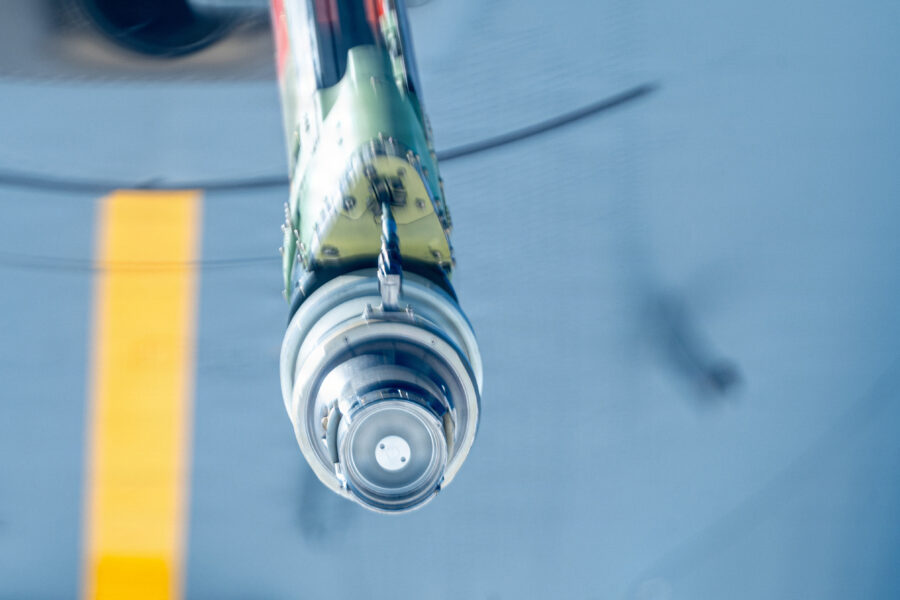
Mistakes made by a KC-46 boom operator and an F-22 pilot combined to break off the refueling boom, leaving $10 million in damage as the boom plunged into the Atlantic Ocean, an Air Force investigation found.
An Accident Investigation Board report, published June 12, said the KC-46’s “stiff boom,” a known aircraft deficiency, was also a factor in the accident. But human factors were the primary focus of investigators.
Incorrect control inputs by the boom operator put the boom “out of trim,” while the F-22 pilot failed to fully account for the “stiff boom” deficiency, the report states. The boom became stuck, or “bound,” in Air Force lingo, so when the boom disconnected, it suddenly jerked upward, smashing into the tanker’s tail assembly before breaking in half.
Air & Space Forces Magazine had previously reported the July 8, 2025, mishap.
The AIB states that the KC-46, from the 22nd Air Refueling Wing at McConnell Air Force Base, Kan., was on a training mission and scheduled to refuel seven F-22s from the 1st Fighter Wing at Joint Base Langley-Eustis, Va., when the accident occurred.
The boom operator was a qualified instructor with more than 1,000 flight hours in the KC-135 and KC-46 at the time of the accident. The F-22 pilot was a student with just 13 hours in the F-22 at the time of the mishap.
The refueling started badly. The F-22 approached the KC-46 three times trying to make contact, and twice the boom operator called for emergency separations because the F-22 pilot couldn’t hold the proper position. Once the two aircraft did connect, the boom operator had to repeatedly make “many verbal corrections”—four in less than 15 seconds, according to the report.
As the operation continued, the F-22 kept pushing forward relative to the KC-46, approaching the “inner telescope disconnect limit,” when the KC-46’s refueling system automatically disconnects to prevent the boom from being driven too far inward. Meanwhile, the boom operator’s inputs also increased the “load” on his boom, triggering a warning. When the boomer initiated a disconnect to retract the boom’s telescope, he couldn’t, finding the boom bound.
Next, the boom operator told the F-22 to break away from the KC-46, but failed to pull back on the boom. The boom eventually wrenched free as the F-22 pulled away, the force of the movement causing it to swing up and strike the KC-46’s empennage, damaging the tail cone, auxiliary power unit exhaust, and the boom.
The KC-46 flight commander “described the impact as ‘a loud noise, violent action’ causing [the aircraft] to ‘kind of bow wave several times’ before the boom began to oscillate and ultimately separate,” the report states.
The Air Force investigation determined that the boom operator’s control inputs were the primary cause of the mishap. Those inputs created high radial force on the nozzle; they reasoned that had the boom operator simply waited the nozzle probably would have become unbound and the boom telescope could have retracted properly.
The investigation noted that technical documents explicitly advise that when boom operators suspect the nozzle is stuck, they should first “neutralize” their flight controls to “avoid abrupt boom flight control inputs.”
But the AIB also cited the F-22 pilot’s actions as a “substantially contributing factor.” To manage the KC-46’s stiff boom, the pilot needs to apply power to drive the boom into place—but once that’s done, power should be reduced or the receiver aircraft will drift forward, triggering the KC-46’s telescope disconnect limit. But the F-22 pilot failed to reduce power, “contributing to the nozzle binding and the resulting mishap,” the report states.