


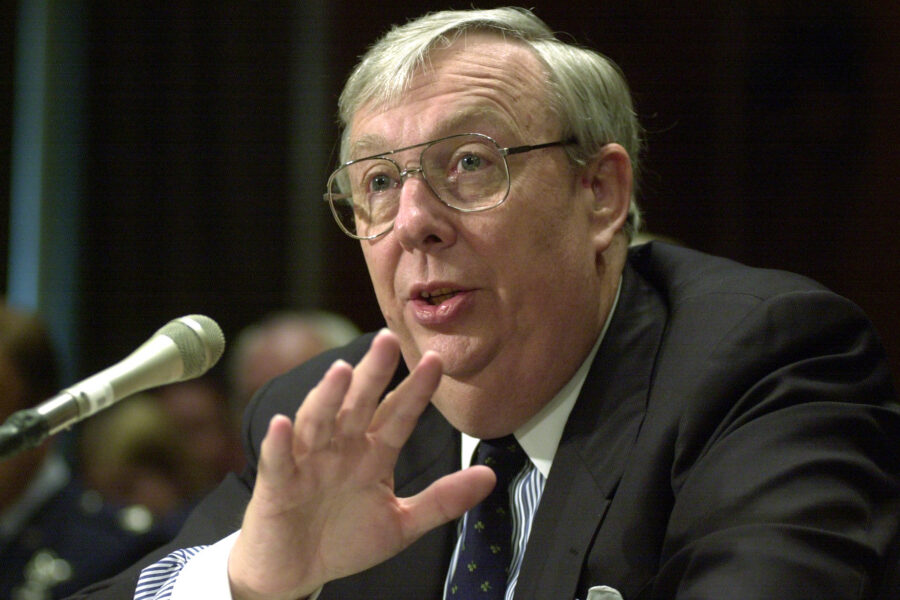
James G. Roche, the 20th Secretary of the Air Force who led the department from 2001-2005, died Aug. 4. He was 86.
As Secretary, Roche led the Air Force through the Sept. 11, 2001 terrorist attacks and subsequent preparations and campaigns in Afghanistan in 2001 and Iraq in 2003. During his tenure, he pushed for tighter synergy between the Air Force’s air and space activities, improved readiness, a shift from platform-based acquisition to capabilities- and networks-based systems, and setting the Air Force on a course to adopt combat drones partnered with piloted aircraft; a concept now coming to fruition in the form of Collaborative Combat Aircraft.
Though nominated by President George W. Bush to be Army Secretary in 2005, Roche withdrew his name from consideration when it became apparent that congressional opponents would block his confirmation indefinitely. At issue was Roche’s promotion of a plan to replace the Air Force’s oldest aerial tankers with aircraft leased from Boeing. One of Roche’s acquisition officials acted improperly in pursuit of the idea: that official went to jail and another resigned, but Roche himself was not found to have acted criminally.
Born in Brooklyn, N.Y., in 1939, Roche earned a bachelor’s degree in humanities from Chicago’s Illinois Institute of Technology in 1960 and took up a Navy commission through the ROTC. In 1966 he completed a master’s in operations research from the Navy postgraduate school in Monterey, Calif. , and earned a doctorate in business administration from Harvard in 1972.
Roche served 23 years as a Navy officer, during which he commanded the guided missile destroyer USS Buchanan. While in uniform, he worked on the Senate intelligence committee and served as deputy to Andrew Marshall, the Pentagon’s Director of Net Assessment. Retiring as a captain in 1983, he then headed the Democratic staff of the Senate Armed Services Committee for a year, moving to Northrop in 1984. He headed the company’s analysis center in Washington for five years, then became a vice president and assistant to Northrop CEO Tom Jones. A series of executive positions with Northrop followed: first as VP and then chief of advanced development and planning, then as president of Northrop’s Electronic Sensors and Systems sector until his appointment by Bush to be Air Force Secretary in 2001.
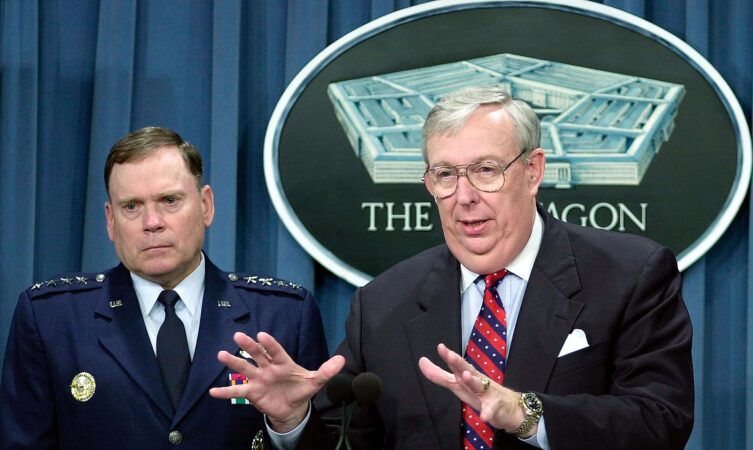
In the months leading up to the Sept. 11, 2001, attacks, Roche moved to enhance the appeal and quality of life for enlisted Airmen by improving their educational opportunities and living conditions. He insisted the Air Force’s air and space capabilities needed to be more closely aligned: he set in motion plans to integrate air- and space-based sensor and communications networks, and expanded the integration of space capabilities with field units. He also moved to improve readiness through more exercises and more funding for spare parts.
Roche also took a cue from Chief of Staff Gen. John Jumper to pursue unmanned combat aircraft. In 2000, Jumper, as head of Air Combat Command, had directed the arming of MQ-9 Predator reconnaissance drones, tests of which began in early 2001. Roche saw armed, self-directed drones as certain to be an important part of the Air Force’s future. He began to promote the idea—pushing for further development of experiments like the X-45 Unmanned Combat Aircraft Vehicle, already underway—and in several speeches and internal messages told Air Force leaders to anticipate and begin preparing for the day when unmanned combat aerial vehicles, or UCAVs, would fly alongside piloted aircraft or pursue combat missions independently.
While successful, the UCAV experiment did not become a top Air Force acquisition priority until Air Force Secretary Frank Kendall formally started the CCA program in 2022. It is likely the Air Force’s UCAV program transitioned to classified efforts in the intervening years. Roche frequently touted combat UAVs as assets that did not tire and could undertake long missions without degraded “acuity.” He also noted that if a drone is lost in combat, “you don’t have to write a letter to the mother of a computer chip.”
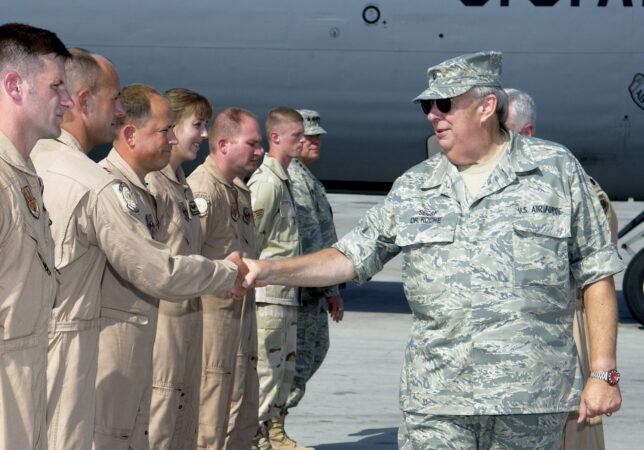
In the immediate aftermath of the 9/11 terrorist attacks, Roche put greater emphasis on the Air Expeditionary Forces concept, already then taking shape, pumping more people, aircraft, and logistical backing into the construct, and shifting emphasis from stateside garrison activities to forward deployments. He pushed the deployment of unmanned aircraft like the RQ-4 Global Hawk and MQ-1 Predator into the Southwest Asia theater, even though both were still considered experimental. Along with the Army, he fostered greater field cooperation between the services, putting airmen in Army ground units to facilitate air attacks and close air support.
Roche also increased the use of the Air National Guard and Air Force Reserve in the Afghanistan campaign, integrating those units more closely with the Active-Duty force; leading to a day-to-day operational dependency on reserves that the Air Force still maintains.
In addition, Roche advocated creation of more Air Operations Centers as a way to develop Air Force and joint networks and integrated capabilities, and moved to add more Air Force special operations capabilities to aid the other services.
Soon after 9/11, Roche was favorably inclined toward a plan suggested Sen. Ted Stevens (R-Alaska) to rapidly obtain additional aerial refueling capability by leasing such aircraft from Boeing, which had built the KC-135 and KC-10 tankers. The idea was that leasing the aircraft would allow them to be acquired through operations and maintenance accounts rather than through an outright acquisition program at a time when the Air Force was strapped for modernization dollars. It was also thought that a lease would bring the jets online faster than a straight buy. For his part, Stevens saw the idea as a way to help prop up Boeing and the U.S. airline industry, which had taken a body blow in canceled orders due to the terrorist attacks, which had caused a precipitous drop in air travel.
Roche favored quickly awarding a contract to Boeing both as a boost to the U.S. industrial base and because Boeing alone had a recent design for a boom-type refueling system. However, European airliner maker Airbus/EADS persuaded members of Congress that it could quickly certify its own boom and create a production line in the U.S. and should be allowed to compete for the work. Those members and others succeeded in getting the Air Force to agree to a “best value” competition, since EADS could not compete on unit price alone, given that its A330 aircraft was much larger than Boeing’s 767-based tanker.
In emails that came to light through subsequent investigations, it was clear that Roche favored a sole-source Boeing approach. He also had a personal animosity toward Ralph Crosby—a former Northrop rival—who was then head of EADS North America. Roche disparaged EADS’s offering of the Airbus A330 tanker as a mostly European product with only a “Made in America” sticker on it.
Roche also reportedly had an ongoing feud with Sen. John McCain (R-Ariz.) dating back to their Navy days, and McCain, a powerful voice on the Senate Armed Services Committee, made the tanker lease a personal crusade, publicly criticizing it as a “sweetheart deal” for Boeing that would cost the government far more than a straight purchase. He demanded numerous investigations of the plan.
Darleen Druyun, who had been the Air Force’s Principal Deputy Assistant Secretary for Acquisition and Management for 10 years, was zealous in promoting the Boeing lease. Several investigations determined that Druyun passed information to Boeing about EADS’ proposal and had demanded from Boeing an executive job for herself and jobs for other family members in exchange for giving Boeing favorable terms on the lease and overall favorable treatment on the competition. She also collaborated with Boeing to give the company favorable terms on launch vehicle contracts and steered the initial Small Diameter Bomb contract to the company. Druyun was arrested and eventually served nine months in prison, but it was determined Roche had not directed her to commit the contracting crimes and was unaware of her activities. One Boeing executive also went to jail and longtime Boeing CEO Phil Condit resigned. Boeing had to pay a $615 million fine. Druyun’s immediate boss, Marvin Sambur, resigned his post, but was not found to have participated in Druyun’s scheme.
McCain and other Senators held up promotions of several senior Air Force officers while demanding information and awaiting investigation results on the tanker lease, which the Air Force finally abandoned in fall 2004. Instead, it decided to buy 100 tankers, but that plan went through extensive modifications and reruns of a competition until Boeing was finally awarded a contract in 2011 for 179 KC-46 tankers.
Soon after the lease plan imploded, Bush nominated Roche to take on the post of Secretary of the Army, but he withdrew his name from nomination when it became clear his confirmation would be blocked indefinitely by tanker foes in Congress. He said it was unfair to make the senior officers awaiting promotion to wait while his issues were resolved. He announced his resignation from the Air Force in November 2004, and departed the job at the beginning of the second Bush term, in January 2005. Roche said he had always planned on serving only one term and allowed some overlap of his successor with the term of Gen. John Jumper.
Roche himself was found to have committed an ethics violation by sending an email recommending a person for a job with Northrop. While the recommendation itself wasn’t an ethical violation, Roche’s use of his official email, which bore his government title and potentially implied government endorsement, constituted the infraction. Defense Secretary Donald Rumsfeld considered the mistake inadvertent and did not pursue any sanctions.
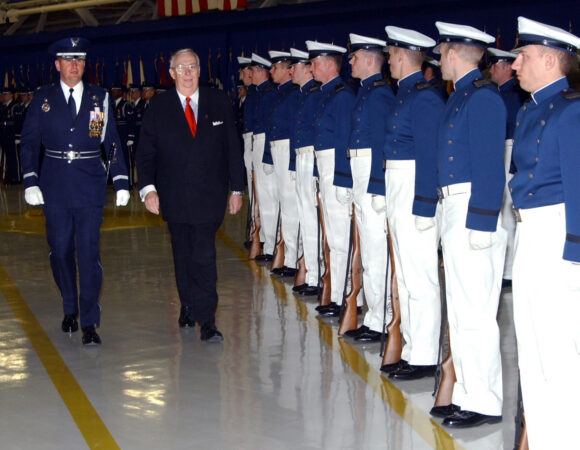
In retirement, Roche served on the board of Orbital Sciences Corp./Orbital ATK until it became part of Northrop Grumman. He was also a member of the Council on Foreign Relations and the Washington Institute for Near East Policy.
Ret. Lt. Gen. David Deptula, head of AFA’s Mitchell Institute for Aerospace Studies, worked for Roche during the Air Force’s 2001 Quadrennial Defense Review.
“Secretary Roche’s impact on our national security cannot be overstated,” Deptula said. “Whether in uniform, in industry, or as Secretary of the Air Force, he was a most innovative, dedicated, and driven individual. He didn’t simply receive briefings—he understood the issues at a fundamental level, challenged assumptions, and pressed those of us on his staff to advance our thinking about air and space power. His command of strategy and policy, coupled with his deep interest in science and technology, was second to none. He made the Air Force and the nation stronger, and had a significant impact as a result.”
Air Force Chief of Staff Gen. Kenneth S. Wilsbach wrote on social media that Roche “led our Department … through one of its most consequential moments following September 11th, cementing air and space power as the linchpin of the Joint Force.”
The current Secretary of the Air Force, Troy Meink, wrote that Roche’s “leadership and commitment helped strengthen the Joint Force, leaving a true impression on our nation.”