
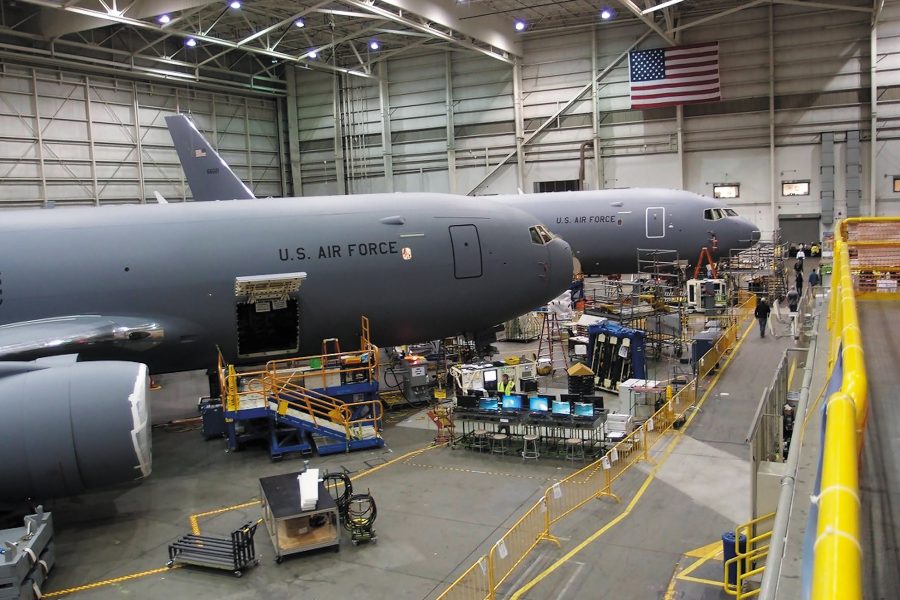
The Air Force is planning to retire more tankers than it buys in its fiscal 2027 budget, but an increase in deliveries of new KC-46s next year will cover the gap to ensure the service satisfies a congressional mandate to build up the overall refueling fleet, an Air Force spokesperson said.
Air Force Vice Chief of Staff Gen. John D. Lamontagne told House Armed Service Committee members on April 15 that the service intends to “fully comply” with a requirement in the fiscal 2026 National Defense Authorization Act raising the minimum inventory for the tanker fleet from 466 to 502 by Oct. 1, 2028, with intermediate milestones along the way.
A service spokesperson confirmed the current fleet meets the 466-aircraft requirement. Budget documents released earlier this month indicate USAF has roughly 370 KC-135 Stratotankers and 105 KC-46 Pegasus refuelers, though those figures do not address aircraft lost during Operation Epic Fury, Air Force officials said. The Air Force lost at least one tanker when a KC-135 crashed on March 12 in Western Iraq, killing its six crew members.
Under the congressional mandate, the Air Force must have 478 tankers in fiscal 2027 and 490 in fiscal 2028, leading up to the 502 figure by the start of fiscal 2029.
Lamontagne told lawmakers that the Air Force was “previously retiring a KC-135 every time a KC-46 came off the line. We’re no longer doing that so that we can grow our tanker capacity from 466 to 502.”
But during the fiscal 2027 budget rollout this month, USAF officials said the service plans to retire 20 KC-135s, and a service spokesperson said the service is receiving 20 KC-46s in the upcoming year as well.
That would represent a new high for the program. Boeing officials said during a January earnings call that they delivered 14 aircraft in 2025 and plan to deliver 19 in 2026.
The number of aircraft delivered in 2027 would exceed the number purchased—the Air Force is seeking $3.9 billion to buy 15 KC-46s next year, though those aircraft wouldn’t start being delivered until October 2029.
The 2027 buy would represent the final lot of the Air Force’s original program of record for the KC-46, with a total of 184 production and four test aircraft. Still more are in the works, however, after the Air Force decided last July that it would skip a “bridge tanker” competition and buy an extra 75 KC-46s while it continues to explore plans for a Next-Generation Air Refueling System. The additional Pegasus aircraft are intended to serve as a short-term measure to keep production on a modern tanker going while the Air Force considers a long-term plan to replace its aging fleet of KC-135s.
The Air Force plans to increase KC-46 procurement to 18 aircraft per year from fiscal 2028 to fiscal 2031, according to budget justification documents.
Challenges still remain, however, since Lamontagne told lawmakers in March that the Air Force would not sign the new contract extension for 75 additional Pegasus aircraft until Boeing fixes several deficiencies with the newer refueler such as solving the “visibility issues” with the Remote Vision System for boom operators and the redesign of the boom telescoping actuator, which was found to cause the boom to become “stiff” and prevent it from refueling certain aircraft, such as the A-10 Thunderbolt II, that cannot produce enough thrust to keep the boom in place during refueling.
Boeing CEO Kelly Ortberg said recently that the company has now lost more than $7 billion on the fixed-price contract for the KC-46, describing the original deal has been a “bad contract for the last decade.” Boeing officials are hoping to underwrite the new contract for the additional 75 KC-46s “to ensure it’s a fair contract and we can make money on that,” Ortberg said.
Any delays to the KC-46 production extension program would have ripple effects. During his tenure as Air Mobility Command boss, Lamontagne said in 2025 that the service may need to consider a service-life extension for the Eisenhower-era KC-135.
To address future needs, U.S. Transportation Command’s “Mobility Capability Requirements Study (MCRS) will provide a risk analysis on aerial refueling force structures to help the Air Force and Congress determine the best long-term path forward,” the Air Force spokesperson said.