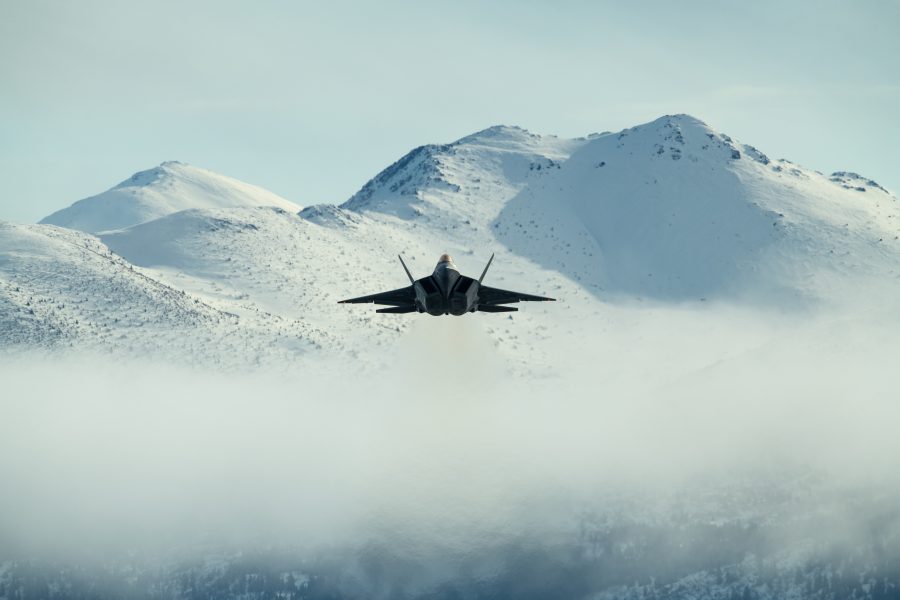
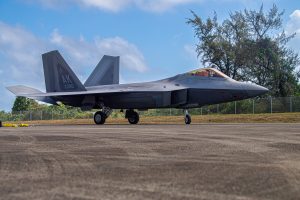
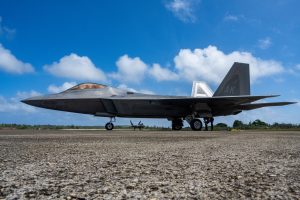
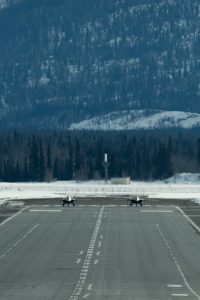
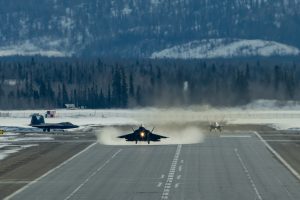
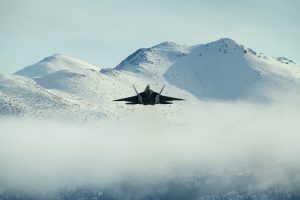
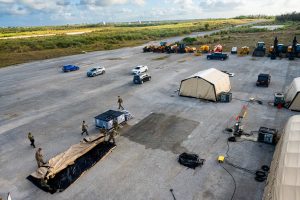
A U.S. Air Force F-22 Raptor assigned to the 90th Fighter Squadron takes off from Joint Base Elmendorf-Richardson, Alaska, April 7, 2024, for Agile Reaper 24-1. AR 24-1 is an effort from JBER’s 3rd Air Expeditionary Wing to exercise Agile Combat Employment. The exercise will use combat-representative roles and processes to deliberately target all participants as a training audience and stress the force’s capability to generate combat air power across the Indo-Pacific region. (U.S. Air Force photo by Senior Airman Patrick Sullivan)
Audio of this article is brought to you by the Air & Space Forces Association, honoring and supporting our Airmen, Guardians, and their families. Find out more at afa.org
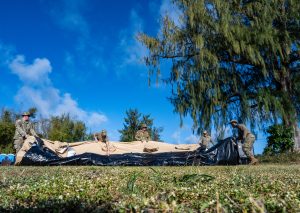
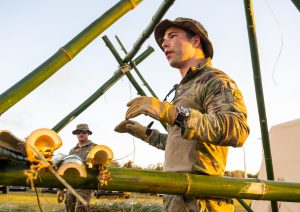
A recent seven-day exercise sent Air Force F-22s—along with other USAF aircraft—to austere, challenging environments across Guam and the Northern Mariana Islands.
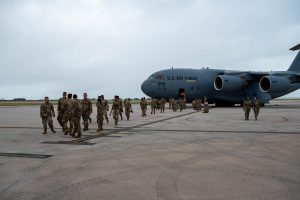
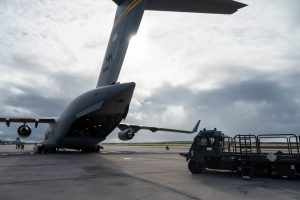
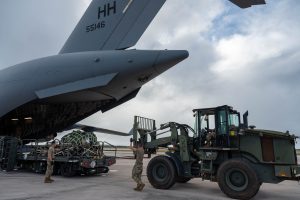
Agile Reaper, taking place for the second time after its inaugural edition last year, featured 800 Airmen and 29 aircraft across five different locations from April 10-16, training on the Agile Combat Employment concept that leaders say will define the service in the years to come.
The 3rd Air Expeditionary Wing from Joint Base Elmendorf-Richardson, Alaska, conducted simulated combat situations and tested agility in deploying combat air power across the expansive Indo-Pacific region.
“The goal is to develop resilient warfighters who are confident in their ability to execute using mission-type orders, generate airlift sorties in a contested environment with limited resources and grow together as a diverse team while gaining familiarity with other career fields,” Lt. Col. Logan Sutton, 535th Airlift Squadron commander, said in a release.
The exercise used a hub-and-spoke model: Andersen Air Force Base, Guam, served as the central hub, while Saipan and Tinian of the Northern Mariana Islands, the Japanese island of Iwo To, and Andersen’s Northwest Field served as the spokes for the exercise.
Many of the spokes have limited resources and bare-bones facilities. While the Northwest Field is on Guam, it is separated from the rest of the base.
F-22s from Elmendorf-Richardson and Joint Base Pearl Harbor-Hickam, Hawaii, flew across the Pacific for the exercise. Elmendorf-Richardson also sent an HC-130 Combat King II for air refueling and a C-12 Huron for transport, a base spokesperson to Air & Space Forces Magazine. KC-46 and KC-135 tankers came from McConnell Air Force Base, Kan., and Eielson Air Force Base, Alaska, respectively.
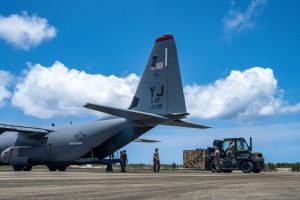
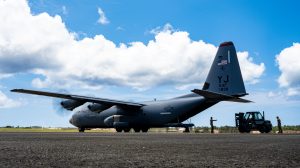
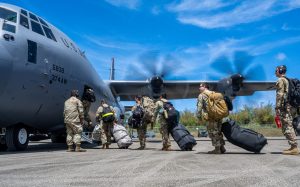
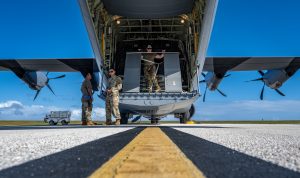
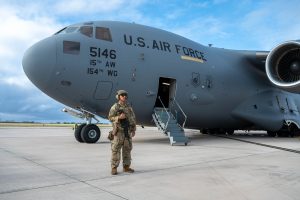
Travis Air Force Base, Calif., dispatched its C-5 Galaxy, and Yokota Air Base, Japan, contributed a C-130 Hercules to transport service members and cargo back and forth between Guam.
“The Airmen landed in Saipan with limited resources and quickly worked to secure food, water, shelter and operational necessities,” Sutton said. “These competencies have been exercised routinely in specialized military units. However, doing so at scale with Mission Ready Airmen increases the flexibility and effectiveness of joint maneuver forces throughout the theater.”
Col. Kevin Jamieson, 3rd Wing and 3rd Air Expeditionary Wing commander of the Elmendorf-Richardson said this year’s training was to test “the limits of what a cohesive 3rd AEW is capable of in a combat-representative environment” based on the experience on Guam and Tinian last year. The training also served as the Air Force Force Generation (AFFORGEN) certification for the wing, a requirement for the service’s deploying forces.
Significant support operations were provided from Pearl Harbor-Hickam and Elmendorf-Richardson. While the main exercise concluded earlier this month, the rest of the forces continued to provide support until April 29, the spokesperson added.
Audio of this article is brought to you by the Air & Space Forces Association, honoring and supporting our Airmen, Guardians, and their families. Find out more at afa.org
A U.S. Air Force F-22 pilot controlled a YFQ-44A Fury Collaborative Combat Aircraft this month while both aircraft were in flight, according to an Oct. 16 release, another milestone in the service’s ambitious CCA efforts.
The Marine Corps recently conducted its first-ever “ripple” release of eight Small Diameter Bomb IIs from an F-35B, a key early step in proving out the capability for all F-35 variants.
The Air Force will field operational prototypes for an autonomous drone to replace its MQ-9 Reaper in 2028, Secretary of the Air Force Troy Meink said Oct. 14.
One of the Air Force’s critical B-2 Spirit stealth bombers has returned to Whiteman Air Force Base, Mo., after an extensive course of maintenance to restore its stealth coating and preserve its structural integrity.
BAE Systems has received a contract from Lockheed Martin to install an upgraded Block 4 electronic warfare system into new F-35 Joint Strike Fighters, as well as to retrofit some older jets.
The Air Force has figured out a way for maintainers to inspect what had been a “blind spot” in F-16 engines, after problems in that area led to the catastrophic crashes of two jets in recent years.
The Air Force has begun evacuating stealth fighters, gunships, and special operations planes ahead of Hurricane Isaias expected landfall over the Gulf Coast this weekend.
The Air Force’s B-52 bomber may soon be able to carry up to 20 stealthy long-range anti-ship missiles to strike moving targets at sea, a key capability in a potential fight with China.
A reported surge of MQ-9 Reaper drones to Latin America could widen the scope of intelligence gathering and free up more strike options against cartels in the region, experts tell Air & Space Forces Magazine.
✓
Thank You!
Check your inbox to verify your email address and finish setting up your AFA account.
★
Welcome Back!
An account with this email already exists. Please log in to continue.
Subscribe to the Air & Space Forces Daily Report
The latest news from Air & Space Forces Magazine, as well as news from other leading publications, delivered right to your inbox every morning!
We’re sorry, there has been an error. Please review your input or try again later.