
The U.S. military conducted strikes on Iranian targets around the Strait of Hormuz on May 7, as the conflict with Iran flared up again—though officials say the ceasefire remains in effect.
U.S. Central Command said in a release that its forces “eliminated inbound threats and targeted Iranian military facilities responsible for attacking U.S. forces, including missile and drone launch sites; command and control locations; and intelligence, surveillance, and reconnaissance nodes.”
Despite the back-and-forth, U.S. officials said they were still hoping to preserve the month-old ceasefire between the U.S. and Iran.
“It’s just a love tap,” President Donald Trump told ABC News. “The ceasefire is going. It’s in effect.”
CENTCOM, which oversees U.S. forces in the Middle East, added in its own statement that it “does not seek escalation but remains positioned and ready to protect American forces.”
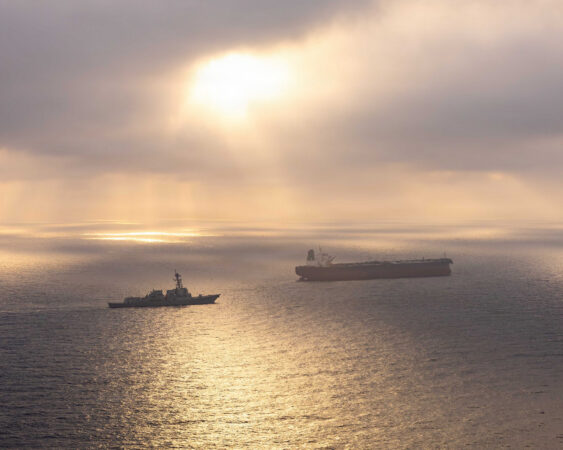
The guided-missile destroyers USS Truxtun, USS Rafael Peralta, and USS Mason were transiting the Strait of Hormuz toward the Gulf of Oman when they were attacked by multiple Iranian missiles, drones, and small boats, which Iran’s Islamic Revolutionary Guard Corps is known to use in the tight waterway, according to CENTCOM. The IRGC Navy claimed credit for the attack. A U.S. official and the IRGC said Iran fired a mix of ballistic missiles, cruise missiles, and drones at the American ships. Trump said in a social media post that the Iranian boats were destroyed and the Iranian projectiles were shot down by U.S. forces.
While Iran claimed to have successfully damaged the U.S. destroyers transiting the strait, CENTCOM said no American assets were harmed.
The command said the attacks were “unprovoked” and that the U.S. responded with “self-defense strikes.”
Iranian officials accused the U.S. of breaking the ceasefire.
Trump said Iran must sign an agreement or risk further hostilities breaking out.
“[J]ust like we knocked them out again today, we’ll knock them out a lot harder, and a lot more violently, in the future, if they don’t get their Deal signed, FAST!” Trump wrote on social media.
It was unclear whether the U.S. forces had been attacked before the strikes on Iran occurred. The Pentagon declined to answer questions about the incident and referred to CENTCOM’s statement when asked about the matter. A spokesperson for CENTCOM did not elaborate on the incident beyond the command’s public message.
Fox News reported that the U.S military carried out strikes on Qeshm Island and Bandar Abbas, and an Iranian naval facility in Minab, in retaliation for an Iranian strike on the United Arab Emirates and its oil hub of Fujairah. Iranian state media reported explosions at Qeshm Island and Bandar Abbas.
U.S. targets included Iranian drone launching sites, coastal radars, and coastal anti-ship cruise missile sites, a senior U.S. official said.
U.S. officials, including Chairman of the Joint Chiefs of Staff Air Force Gen. Dan Caine, played down attacks on the UAE on May 5, as they rolled out “Project Freedom,” an American effort to project shipping in the Strait of Hormuz. The U.S. is continuing its blockade of Iranian ports, including a dramatic May 6 episode in which a U.S. Navy F/A-18 Super Hornet fighter jet from the USS Abraham Lincoln aircraft carrier fired its 20mm cannon at the rudder of an Iranian oil tanker, M/T Hasna, attempting to run the blockade and reach an Iranian port in the Gulf of Oman.
“American destroyers are on station, supported by hundreds of fighter jets, helicopters, drones, and surveillance aircraft, providing 24/7 overwatch for peaceful commercial vessels,” Secretary of Defense Pete Hegseth said May 5 in a press conference at the Pentagon alongside Caine.
But Saudi Arabia and Kuwait suspended the U.S. military’s use of their bases and airspace. American airpower, including P-8 Poseidon maritime patrol aircraft, Air Force tankers, E-3 Sentry AWACS battle management planes, and EA-37 Compass Call electronic warfare planes are among the aircraft that have been operating from Prince Sultan Air Base, Saudi Arabia, during the U.S. conflict with Iran, which also typically hosts U.S. fighter aircraft. Overflight access to the two countries is critical to U.S. operations in the region. The U.S. military is helping enforce the blockade with a vast array of Air Force, Navy, and Marine Corps assets, including over 100 fighters, drones, tankers, and surveillance aircraft. Trump abruptly paused “Project Freedom” on May 5. By May 7, Saudi Arabia and Kuwait lifted their restrictions on U.S. aircraft, the day the U.S. struck Iranian sites.