
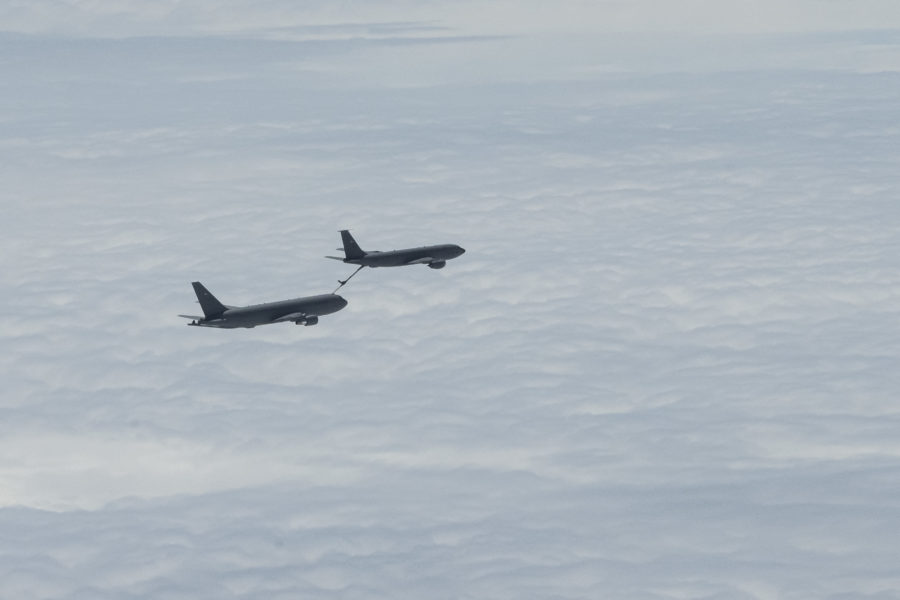
The Air Force has started upgrading some of its KC-46 refuelers with new beyond-line-of-sight connectivity to help them have greater battlefield awareness, the latest step in a multi prong plan to equip tanker and airlift fleets with tools that have long been reserved for fighter and bomber fleets.
Sierra Nevada Corporation announced July 15 it has upgraded four KC-46s with its Mobility Air Forces Connectivity technology as part of a contract to upgrade communications and networking capabilities for 35 Pegasus aircraft.
The deal is just one part of Air Mobility Command’s broad effort to give tankers and airlifters more survivability in modern air warfare operations. Currently, mobility aircraft have limited awareness of where enemy and friendly forces are positioned as they fly into an operational area.
That gap in knowledge is worrisome for Air Force officials as they prepare for more and more operations in contested airspace—particularly for tankers supporting fighter and bomber missions. The issue gained even more attention with the fatal March 12 crash of a KC-135 Stratotanker in western Iraq during Operation Epic Fury. The incident, which resulted in the deaths of all six crew members of Zeus 95, is still under investigation, but the Pentagon has said the crash was not a result of hostile or friendly fire.
Improved, beyond-line-of sight communications equipment has been a focus at AMC for several years now. Former commander Gen. Mike Minihan noted back in 2022 that the mobility fleet had gaps in command and control and launched a “25 by ’25” campaign to to equip a quarter of of the mobility fleet with better connectivity kits by 2025. That campaign fell short of Minihan’s ambitious goal—but the issue has started to pick up steam.
The reconciliation package known as the One Big Beautiful Bill Act passed in July 2025 included “$84 million for KC-135 Mobility Aircraft Connectivity.” And the Air Force’s proposed fiscal 2027 budget would add another $91 million to fund an updated version of Real-Time Information in the Cockpit, or RTIC, program for the KC-135. That’s a significant increase over the $31.7 million the effort received in fiscal 2026, according to budget documents.
Minihan, now retired, sees this as a crucial moment for the future of the mobility fleet. He told Air & Space Forces Magazine he worries that the KC-135 and crew lost in the Iraq crash will soon be forgotten, as will the support for increased battlefield awareness for tanker and airlift crews.
“The farther we get away from Zeus 95, the more pressure there’s going to be to downplay the connectivity needed for the mobility fleet,” said Minihan. “We don’t dilute the connectivity need for any other part of the Air Force,” Minihan said. “We don’t do it for the bomber fleet. We don’t do it for the fighter fleet, but we continually do it for the mobility fleet.”
For now, though, AMC is moving forward and making progress, giving funding priority to the KC-46 and KC-135 fleets, followed by the C-17 Globemaster fleet, said Col. Paul Tucker, director of the Commander’s Initiative Group at AMC overseeing the effort. Connectivity upgrades for the C-5 Galaxy fleet remain unfunded.
“We are getting traction with at least getting the tankers funded, and then we think there’s some initial money for the C-17 that we’re being told should be coming down the pike to be able to begin connecting that aircraft,” Tucker told Air & Space Forces Magazine.
“What we’ve learned over time is that the tools we have available to us—which are mostly either a line-of-sight radio or [satellite communications]—do not have either the range or the data throughput” needed to help aircrews see through the fog of war and make quick, informed decisions, Tucker said.
“We need to be able to have true battlespace awareness to make those decisions,” he added.
In the long term, AMC’s goal is to equip its mobility fleets with a communications system capable of fusing multiple feeds of battlefield data coming in from different sources and then providing crew members with only the updates they need such as enemy position changes.
“I need to be able to get stuff really fast from as many sources as possible, and then I need to have the compute on board that can synthesize that and kind of correlate it,” said Tucker, a C-17 pilot by trade.
The solution could include artificial intelligence or an effective algorithm. “That’s a lot of what we’re experimenting with right now—do I need full-fledged AI, or am I okay with just having a good enough computer program?” Tucker said.
It could also “provide the crews more like an iPhone alert, you get a notification on your tablet that says, ‘here’s a threat,’ and then provides a recommended course of action,” Tucker added. “Then the crew can focus on flying their mission and accomplishing the mission without have without having to do all that synthesis in their heads.”
The team at AMC has tested prototypes on tankers and the C-17 so far, evaluating everything from data storage capacity to ethernet speeds, Tucker said.
“We have tested three or four different moving maps; we have tested a bunch of different types of connections. I have a really big pallet that has a ton of compute, and I have a very small, carry-on size computer—which one gives me enough performance to do the mission knowing there’s tradeoff between size and power and capability,” Tucker added.
Currently, the effort is refining a requirements document which will fuel a future program of record, he said.
“We have gone from zero to ‘I have a fully functional, willing-to-field-it-today prototype’ in three years,” Tucker said. “That’s where we are. That’s the type of speed we could bring. But I still have to get it into the budget and get it into a [five-year spending plan] and that’s where it slows down.”
In the short-term, the Air Force is focusing on different connectivity upgrades for the KC-46 and the KC-135 fleets.
The Sierra Nevada contract for the Pegasus tankers is part of an upgrade effort for the Pegasus Advanced Communications Suite, or PACS, which comes standard on the KC-46. It involves upgrading the Tactical Data Link 16 uplink in PACS with a more modern version of Link 16, a beyond-line-of sight/line-of-sight connectivity capability that’s been used by U.S. and NATO strike aircraft for decades. The Air Force has proposed roughly $83 million for the effort in the 2027 budget, according to fiscal 2027 budget documents. The service is also proposing an additional $504 million for the effort through 2031.
KC-135s are scheduled to receive RTIC 2.0, an upgraded version of the original RTIC which first began receiving funding to equip some Stratotankers in 2019, according to budget documents. RTIC 2.0 will also include an updated version of Link 16, Tucker said.
“The KC-135 is upgrading their RTIC to something called RTIC 2.0 … and that’s very similar to the upgrades to what the KC-46 is trying to do, which is get the new Link 16 radio, get additional radios on the aircraft, get beyond line-of-sight connectivity,” Tucker said.
It’s unclear how many of the roughly 370 KC-135s in the service’s inventory have already been equipped with the original RTIC. The $91 million proposed in the fiscal 2027 budget would fund “up to an additional 103” RTIC 2.0 aircraft kits, budget documents state. The Air Force has also proposed spending an additional $102 million on the effort through 2031.
These upgrades may not be as advanced as the battlespace awareness tools on a fighter jet, but they may be enough, said retired Col. Robert Owen, a former C-130 pilot and professor emeritus at Embry-Riddle Aeronautical University.
“The fighter needs to know where the bad guys are, what kind of bad guys they are, and so forth; the tanker just needs to know basically are bad guys in this quadrant,” said Owen.
Tanker pilots would “need to know if there is an enemy airplane within 100 miles … whereas a fighter needs to know where everything is within 200 miles, so [the fighter] has a higher data flow,” added Owen.
Equipping KC-135s with a connectivity solution that includes Link 16 “may well be adequate” for what the Air Force needs, Owen said.
“Link 16 has been upgraded and upgraded; it has a lot of bandwidth,” he said. “It’s encoded, but like anything encoded, it can be broken, so like all systems, it’s not perfect.”
Minihan said he is supportive of any effort to improve connectivity for the mobility fleet but is conflicted about the short-term path forward.
“The fleet is so behind that it’s hard it’s hard to say no to something that provides better than what you have,” Minihan said, adding that RTIC may be the “minimal capability” available.
“Let’s not hit the easy, comfortable button that undershoots what’s really needed here.”
Before his tenure at AMC ended in 2024, Minihan projected that the entire tanker and airlift fleets could have been equipped with modernized connectivity for roughly $2 billion.
“I don’t think $2 billion is too much to spend on ensuring the mission of the United States Air Force. And I don’t think $2 billion is too much to spend so we don’t run airplanes into each other,” Minihan said.
“The mobility fleet needs to be connected at the same quality that the rest of the fleet is connected, and whatever the cost is, we need to pay it.”
