
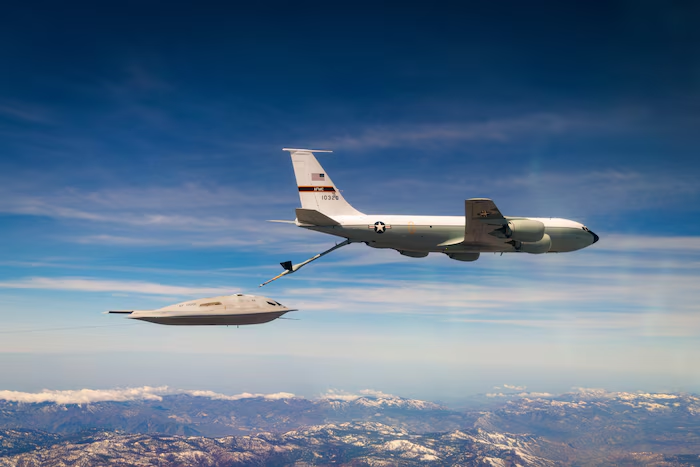
The Air Force is quietly wrapping up a round of market research on arming its tanker fleet with weapons capable of shooting down incoming enemy threats. The service awarded contracts to four firms beginning in February to study options for equipping refuelers such as the KC-135 Stratotanker and KC-46 Pegasus with active self-defense technology.
The results could carry major implications. The Air Force has projected spending more than $500 million through 2031 on an effort called Large Aircraft Survivability Systems, or LASS—a program intended to provide a new level of protection to aerial refuelers as well as cargo aircraft. Aerial refueling aircraft are expected to become “extremely vulnerable” to enemy attack in conflict with a peer adversary, budget documents state. LASS would develop a suite of on-board sensors and defense weapons to defeat drone and missile threats.
The Air Force Life Cycle Management Center’s Future Tankers office awarded more than $6 million in contracts to Anduril Industries, BAE Systems, Lockheed Martin Corporation, and Sierra Nevada Corporation between Feb. 12 and March 17, according to Sam.gov and USASpending.gov.
- Anduril Industries—Feb. 12 award for $664,630
- BAE Systems—Feb. 12 award for $1.3 million
- Lockheed Martin—Feb. 18 award for $1.6 million
- Sierra Nevada Corporation—March 17 award for $2.7 million
Aviation Week first reported the firms were tasked to present options for an “air-launched self-defense weapon” as part of the “Tanker Platform Agnostic Kinetic Self Defense Study.”
Anduril, BAE, and Lockheed were scheduled to complete their studies in June, but Sierra Nevada has until July 8, according to USASpending.gov.
The Air Force Life Cycle Management Center did not immediately respond to a query from Air & Space Forces Magazine.
Under the LASS program, the Air Force is requesting $50 million in 2027 to develop onboard sensors to provide aircrews a “common operating picture.” The service also plans to invest $18 million to design kinetic and nonkinetic weapons “to defeat any long-range threat” without external assistance, according to the budget documents.
The service plans to invest $508 million in the effort over its next five budgets, a plan that includes spending $264 million on the effector system in fiscal 2028 and 2029, as well as $176.2 million for the sensors spread out between fiscal 2028-2031, according to budget documents.
Lawmakers, however, would like to see the Air Force do more to protect its tanker fleet. In its first draft of the fiscal 2027 National Defense Authorization bill, the House Armed Services Committee said it wants the Air Force to submit a report by Dec. 1 explaining the service’s plan for moving the program out of research and development and having it ready for initial fielding by late 2031.
Lawmakers stressed that the Air Force’s ability to carry out successful long-range strategic strike missions such as Operation Midnight Hammer may be challenged in the future if tankers can’t defend themselves against enemy missile and drone attacks.
Meanwhile, Air Mobility Command leaders and U.S. Transportation Command are studying options for its future tanker needs. Options on the table include acquiring more KC-46 Pegasus tankers and fielding systems for protecting the tankers or developing a stealthy refueling platform that is more survivable in contested airspace. A third way would combine both strategies. The Air Force is already planning to procure an additional 75 KC-46s to replace some of the service’s 60-year-old KC-135s.